Connect with us

Headlines

Tony Elumelu: Turning Africa into One Independent Entrepreneurial Village

Published

on

By Eric Elezuo
“Everything I have today is because of Africa, I was born here, went to school here, I work here and I’m achieving some level of financial comfort here.”
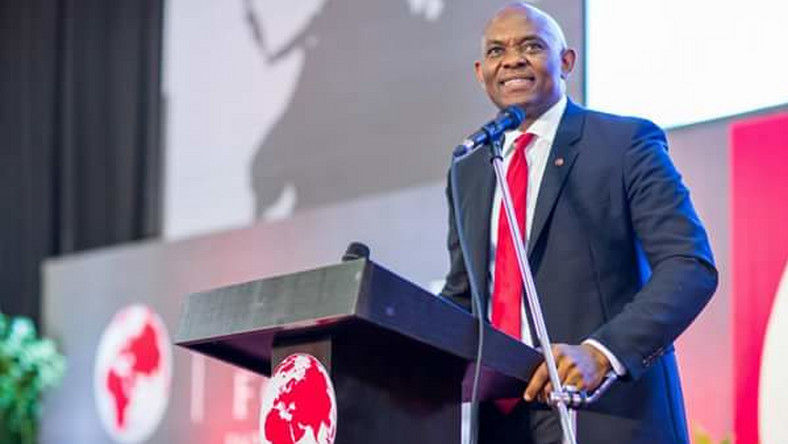
That is vintage Tony Elumelu, the Chairman of Heirs Holdings, the United Bank for Africa, Transcorp and founder of The Tony Elumelu Foundation. A Nigerian national honours holder, the Commander of the Order of Nigeria (CON), and Member of the Order of the Federal Republic (MFR). He has just successfully held the fourth edition of his annual Tony Elumelu Foundation Entrepreneurial Forum with about 54 African countries participating.
Born Tony Onyemaechi Elumelu on March 22, 1963, in Jos, Nigeria, the economist by training, visionary entrepreneur and philanthropist, acquired and turned Standard Trust Bank into a top-five player in Nigeria. In 2005, his corporate reputation as an African business leader was sealed when he led the largest merger in the banking sector in Sub-Saharan Africa to acquire United Bank for Africa (UBA). In five years, he transformed it from a single-country bank to a pan-African institution with over seven million customers in nineteen African countries.
In 2011, New African magazine listed him as one of the 100 most influential people in Africa, and a year later (2012), he was recognised as one of “Africa’s 20 Most Powerful People” by Forbes Magazine.
Following his retirement from UBA in 2010, Elumelu founded Heirs Holdings, which invests in the financial services, energy, real estate and hospitality, agribusiness, and healthcare sectors. In the same year, he established the Tony Elumelu Foundation, an Africa-based and African-funded philanthropic organisation dedicated to the promotion of excellence in business leadership and entrepreneurship, and to enhancing the competitiveness of the private sector across Africa.
His stated objective at the formation of Tony Elumelu Foundation was to “prove that the African private sector can itself be the primary generator of economic development.” The Foundation is charged with the mission of driving Africa’s economic development by enhancing the competitiveness of the African private sector. As a premier pan-African-focused not-for-profit institution, the Tony Elumelu Foundation is dedicated to the promotion and celebration of entrepreneurship and excellence in business leadership across the continent, with initiatives like The Tony Elumelu Entrepreneurship Programme (TEEP).
In a bid to expand his conglomerate as well as his business horizon, in 2011, through Heirs Holdings, he acquired a controlling interest in the Transnational Corporation of Nigeria Plc (Transcorp), a publicly quoted conglomerate that has business interests in the agribusiness, energy, and hospitality sectors. Elumelu was subsequently appointed chairman of the corporation.
His enterprise is not limited to self financed enterprises as he serves as an advisor to the USAID’s Private Capital Group for Africa (PCGA) Partners Forum. He also sits on the Nigerian President’s Agricultural Transformation Implementation Council (ATIC). He is also vice-chairman of the National Competitiveness Council of Nigeria (NCCN) whose formation he was a key driver in, and serves as Co-Chair of the Aspen Institute Dialogue Series on Global Food Security.
Elumelu additionally chairs the Ministerial Committee to establish world-class hospitals and diagnostic centres across Nigeria, at the invitation of the Federal Government and the Presidential Jobs Board, engineered to create 3 million jobs in one year. He also serves as a member of the Global Advisory Board of the United Nations Sustainable Energy for All Initiative (SE4ALL) and USAID’s Private Capital Group for Africa Partners Forum.
One will not be wrong to address him as a philosopher as well as he is the originator of the term Africapitalism. According to him, Africapitalism is an economic philosophy that embodies the private sector’s commitment to the economic transformation of Africa through long-term investments that create both economic prosperity and social wealth. Elumelu sees Africans taking charge of the value-adding sectors and ensuring that those value-added processes happen in Africa, not through nationalisation or government policies, but because there is a generation of private sector entrepreneurs who have the vision, the tools and the opportunity to shape the destiny of the continent. He insists that Africapitalism is not capitalism with an African twist; it is a rallying cry for empowering the private sector to drive Africa’s economic and social growth.
Having studied under Professor Porter at Harvard Business School, Elumelu subscribes to Michael Porter’s concept of Creating Shared Value (CSV). Professor Porter is the Founding Patron of The Tony Elumelu Foundation. In the same vein, CSV refers to the idea that “companies must take the lead in bringing business and society back together.” It asserts that “businesses acting as businesses, not as charitable donors, are the most powerful force for addressing the pressing issues (society) face(s).”
In 2003, the Federal Government of Nigeria granted Tony Elumelu the title of Member of the Order of the Federal Republic (MFR), a national honour, and in 2006, he was voted African Business Leader of The Year by the Africa Investor magazine and was also recognised as  African Banker of the Year in 2008 by the African Banker magazine. In 2009, the Nigerian President Umaru Musa Yar’adua honoured him with a place on the Presidential Committee on the Global Financial Crisis.
In 2012, he was awarded the prestigious National Honour of Commander of the Order of the Niger (CON) for his service in promoting private enterprise. Apart from being recognised as one of “Africa’s 20 Most Powerful People in 2012” by Forbes Magazine as well as being featured in the New African Magazine’s list of the “100 Most Influential Africans in Business”. He was awarded an honorary Doctorate of Science degree from the Benue State University and an honorary Doctorate of Business Administration from the University of Nigeria, Nsukka.
In 2013, Elumelu received the Leadership Award in Business and Philanthropy from the Africa-America Institute (AAI) Awards. He was also named African Business Icon at the 2013 African Business Awards.
In addition, ESI-Africa, frequently described as “Africa’s power journal”, named Elumelu in its 2015 ‘ESI Most Influential Figures in African Power’ list, in January 2015.
Elumelu is not just a financial wizard; he also writes as well as provides incredible inspiration to writers. Some works that involves him include:
How to Excel at Work – Proven strategies for achieving superior work performance by Bili A. Odum -a book inspired by Elumelu’s work ethics.
Elumelu has contributed to the Nigeria Leadership Initiative White Papers, writing on Leveraging private sector approaches in transforming government delivery.
The Power of Vision: Insights on Tony Elumelu is a testimonial compiled on the occasion of his retirement as Group Managing Director/Chief Executive Officer at the United Bank for Africa. It contains messages from Aliko Dangote, former Nigerian President Olusegun Obasanjo, Professor Michael Porter, former World Bank managing director and Nigeria’s Minister of Finance, Ngozi Okonjo-Iweala, President of Sierra Leone; Ernest Bai Koroma, former United States Comptroller of the Currency, Eugene Ludwig and Sanusi Lamido Sanusi, former Governor of the Central Bank of Nigeria.
He has written about his philosophy and the economic development of Africa for several publications around the world including The Economist, the Wall Street Journal and Financial Times.
The TOE Way: A handbook that offers insights into Elumelu’s philosophies, business practices, values and secrets of success, written by the man himself.
Tony Elumelu is happily married to Awele Vivian Elumelu, who he married in 1993, and they are blessed with five wonderful girls; Nneka, Ugo, Ogor, Oge and Onyinye.
Sir, for your steadfastness in business and transformation of lives as well as unleashing the Midas magic to anything you are involved in or touched, you deserve to be our Personality in Focus. Congratulations sir!
Continue Reading
Advertisement


Click to comment

Leave a Reply

Your email address will not be published. Required fields are marked *

Headlines

Nigeria Needs More Taxpayers, Not Higher Taxes, Says Finance Minister Taiwo Oyedele

Published

on

The Minister of Finance and Coordinating Minister of the Economy, Taiwo Oyedele, on Thursday said Nigeria’s revenue challenge lies in expanding the tax net rather than increasing tax rates, stressing that the country needs more taxpayers, not higher taxes.

Oyedele spoke in Abuja while receiving the leadership of the Chartered Institute of Taxation of Nigeria during a courtesy visit to the Federal Ministry of Finance at the end of the Institute’s maiden National Tax Awareness Day, which featured a road walk and taxpayer sensitisation at Wuse Market as well as a visit to the headquarters of the Nigerian Revenue Service.

The awareness campaign coincided with one year since President Bola Tinubu signed Nigeria’s landmark Tax Reform Acts into law on June 26, 2025.

Commending the Institute for supporting the Federal Government’s tax reform agenda, Oyedele said public misunderstanding of taxation remained one of the biggest obstacles to improving compliance. According to him, many Nigerians still believe that whenever the government talks about taxation, it is simply seeking to collect more money from citizens.

“We are still not getting enough revenue from taxes; it is not about increasing taxes, but making sure that those who are supposed to pay taxes pay.

We want to promote fairness in tax administration,” he said.

The minister added that getting Nigeria’s tax system right would have a transformative impact on national development. He also urged the Institute to establish annual awards to recognise the country’s most compliant taxpayers as a way of encouraging voluntary tax compliance.

Earlier, the tax awareness campaign commenced at Wuse Market, where the 17th President of the Chartered Institute of Taxation of Nigeria, Innocent Ohagwa, said the initiative was introduced to bridge the information gap surrounding the country’s tax reforms and improve voluntary compliance.

He explained that although the reforms had been in force for one year, many Nigerians were still uncertain about the changes and how they would affect businesses and individuals.

“The laws have been signed, implementation has begun, yet many taxpayers and stakeholders are still grappling with what has changed, what remains the same, and how these provisions affect their businesses and personal affairs,” he said.

According to Ohagwa, widespread misconceptions have continued to fuel anxiety, with some people believing the reforms introduced new taxes across all aspects of economic activity, while others assume they were designed solely to raise government revenue.

He, however, said the reforms contain significant reliefs and incentives for both individuals and businesses. Among the benefits, he said, individuals can now claim rent relief of up to 20 per cent of annual rent paid, subject to a maximum of N500,000, while essential goods and services, including food, education, healthcare, electricity transmission, and non-oil exports, now enjoy zero-rated Value Added Tax treatment.

He added that compensation for loss of employment or personal injury now attracts higher tax exemption thresholds. For businesses, Ohagwa said companies with annual turnover not exceeding N100m and fixed assets of not more than N250m are exempt from Companies Income Tax, Capital Gains Tax, and the Development Levy.

“This means thousands of small businesses can now reinvest in growth, job creation, and innovation,” he said.

He added that targeted tax incentives had also been introduced for agriculture, aquaculture, dairy production, cocoa processing, and animal feed manufacturing, while eligible investors could benefit from tax credits under the Economic Development Incentive.

Despite the incentives, the CITN president reminded taxpayers that compliance remained a legal obligation.

“Compliance is not a burden; it is a civic duty. It is our collective contribution to nation-building. And taxation works best when there is trust — taxpayers must fulfil their obligations, while the government must uphold accountability, transparency and the effective use of public resources,” he said.

He urged traders, entrepreneurs, and business owners to obtain Tax Identification Numbers, keep proper records, file accurate returns on time, and seek professional guidance from the Nigerian Revenue Service, the FCT Internal Revenue Service, or members of the Institute whenever necessary.

Explaining the rationale for the awareness campaign, Ohagwa said the Institute approved an annual National Tax Awareness Day after observing that many Nigerians remained uninformed about the reforms despite ongoing sensitisation.

He said Wuse Market was deliberately chosen because it represented one of the country’s key grassroots commercial hubs where taxpayer education was most needed, adding that the campaign was held in June because it coincides with the peak filing period for many corporate taxpayers.

After the market sensitisation, the CITN delegation proceeded to the headquarters of the Nigerian Revenue Service, where both organisations reaffirmed their commitment to strengthening tax awareness, voluntary compliance, and the implementation of Nigeria’s tax reforms.

Receiving the delegation on behalf of the Executive Chairman of the NRS, Dr Zacch Adedeji, the Executive Director, Finance and Corporate Services, Mohammed Abubakar, described the occasion as significant because it marked one year since the signing of the country’s landmark tax reform legislation.

“That historic milestone signalled the beginning of a new era in Nigeria’s tax administration, one anchored on simplicity, fairness, transparency, efficiency, and service delivery,” he said.

According to Abubakar, the reforms are intended to build a tax administration system that is trusted, technology-driven, and responsive to the needs of taxpayers and businesses.

He added that sustainable revenue mobilisation depends not only on enforcement but also on public awareness and confidence in tax institutions. “Taxpayers are more likely to comply when they understand their obligations, appreciate the value of taxation and have confidence in the institutions administering our tax laws,” he said.

The visit also highlighted the Service’s digital transformation agenda, with officials pointing to initiatives such as Rev360 and other technology-driven platforms aimed at delivering more efficient tax administration.

Also speaking, the Group Director, Medium Tax Group, Dr Gbenga Daniel, said the NRS would continue collaborating with professional bodies to deepen taxpayer education and improve service delivery.

“The Nigerian Revenue Service values its longstanding partnership with CITN. Together, our institutions share a common vision of improving tax administration and fostering voluntary compliance for national development,” he said.

The reception brought together Executive Directors of the NRS, members of the CITN Governing Council, senior management staff, tax professionals, and industry stakeholders before the delegation proceeded to the Federal Ministry of Finance for the courtesy visit, where Oyedele urged Nigerians to embrace the country’s evolving tax system through greater compliance rather than misconceptions about higher taxation.

In June 2025, President Bola Tinubu signed four sweeping tax reform bills into law, including the Nigeria Tax Act and related statutes that together overhaul decades-old tax statutes and modernise the country’s tax system.

The Punch

Continue Reading

Headlines

Trump Declares Trade War on Nations Imposing Digital Tax on US Tech Firms

Published

on

U.S. President, Donald Trump, has threatened to impose a 100 per cent tariff on imports from any country that introduces a digital services tax (DST) targeting American technology companies.

In a statement posted on his Truth Social platform on Friday, Trump warned that countries introducing or maintaining digital services taxes on U.S. tech firms would face immediate retaliatory tariffs on all goods exported to the United States.

“Any country that imposes such a Tax will immediately be met with a 100% TARIFF on any Goods sent to the United States of America,” Trump declared, insisting that digital services taxes unfairly single out American businesses and undermine U.S. economic interests.

The latest warning is aimed primarily at several European countries that have adopted or are considering digital services taxes on multinational technology companies such as Apple, Google, Meta, Amazon, and Microsoft.

Washington has long argued that such taxes disproportionately target U.S.-based firms while discriminating against American innovation.

Trump also asserted that the proposed 100 per cent tariff would supersede existing and future trade agreements, signalling a more confrontational trade policy if countries proceed with taxing revenues generated by U.S. technology giants within their borders.

France became the first major economy to introduce a digital services tax in 2019, prompting repeated threats of retaliatory tariffs from Washington.

Other countries, including the United Kingdom, Italy, Spain, Austria, and Canada, have either implemented or proposed similar measures while negotiations continue under the Organisation for Economic Co-operation and Development (OECD) to establish a global framework for taxing multinational corporations.

The OECD’s two-pillar international tax agreement was designed to reduce unilateral digital taxes by allocating a greater share of multinational profits to countries where earnings are earned while establishing a global minimum corporate tax

Continue Reading

Headlines

South Africa Nothing Without Africa – MTN Boss, Mcebisi Jonas

Published

on

The MTN Group Chairman, Mcebisi Jonas, has condemned the ongoing anti-foreigner sentiment in South Africa, describing it as a symptom of State failure being cynically exploited by politicians with no interest in genuine solutions.

The speech is seen as one of the most substantive interventions by a senior business figure into xenophobic crisis currently plaguing South Africa.

Delivered during the funeral service of Zimbabwean-born activist and public servant, Thokozani Damasane, Jonas’ words have sparked a wave of discussion across South African civil society.

“I was thinking, what is home to Damasane?” he said. “Because I understand, and I understood very early in life, that home is where humanity is. Home is about humanness. It is about the good of humanity and striving for the good of humanity.”

Thokozani Damasane was born and educated in Zimbabwe before relocating to South Africa during the post-apartheid transition period. Jonas described him as arriving “as an outcast” into a country still finding its post-liberation footing – and choosing, nonetheless, to commit himself entirely to its struggles and its people.

“He immersed himself deeply into the struggles, into the pains of South Africans, and he became one of us,” Jonas said.

“In Damasane’s strength, our strength as South Africa and South Africans is reflected. And in his weaknesses, our own weaknesses are reflected.”

Speaking further, Jonas blamed the state for the failure being witnessed, emphasising that if foreigners leave South Africa today, the country’s problems will still persist.

“Foreigners can leave tomorrow – inequality will be with us,” he told the congregation.

“Foreigners will leave tomorrow – unemployment will be with us. Foreigners will leave tomorrow – our police will remain corrupt. Foreigners will leave tomorrow – our politicians will still be concerned with one thing: being elected and re-elected.

“The problem is the failure of the state. The State doesn’t manage immigration. It doesn’t manage its borders. It doesn’t enforce
law enforcement. It doesn’t manage education. What are you expecting?”

Jonas argued that this failure created fertile ground for political manipulation. “When people feel the burn, they become vulnerable to politicians whose sole purpose is to be elected and re-elected. Some of them have no credibility whatsoever. But they lead marches and tell our people that the problem is not us – it is foreigners.”

Jonas recounted a conversation he had witnessed between Damasane and a young man who had challenged the right of foreigners to be in South Africa. Damasane’s response, Jonas said, had stayed with him ever since.

“Damasane said to this guy: Just wait fifteen or twenty years. You will also want to leave your country.”

Jonas told mourners those words now carry a weight Damasane may not have anticipated. “As I stand up today, I look at South Africa. The level of oppression and inequality, the level of exclusion of our people, the level of corruption, the betrayal of the dream of liberation – those words of Damasane ring very loud in my ears.”

South Africa is nothing without Africa

Jonas closed with a call for what he described as a return to “national consciousness” – one rooted in continental solidarity and economic interdependence rather than ethnic exclusion.

“We are a nation embedded in Africa,” he said. “And without Africa, our growth as a country – economically – our fortune is intertwined with the growth of Africa. South Africa is nothing without Africa. And Africa is nothing without South Africa.”

He also reframed the question of legacy and identity for Damasane’s children, who were present. “Sometimes this thing called meritocracy is measured in wealth. No. It is values, it is principles, it is integrity. And your father had all of that.”

“We cannot judge people by their origin,” he told mourners. “We cannot determine the legal status of people by their origin.”

Continue Reading