
Metro
‘Tribal Bigot’, Catholic Priest Lashes Out at Primate Ayodele over Derogatory Comment Against Igbo


- /home/rhoncare/pointblank.ng/wp-content/plugins/mvp-social-buttons/mvp-social-buttons.php on line 27
https://pointblank.ng/wp-content/uploads/2025/11/Ayodele-Primate.jpg&description=‘Tribal Bigot’, Catholic Priest Lashes Out at Primate Ayodele over Derogatory Comment Against Igbo', 'pinterestShare', 'width=750,height=350'); return false;" title="Pin This Post">
- Share
- Tweet /home/rhoncare/pointblank.ng/wp-content/plugins/mvp-social-buttons/mvp-social-buttons.php on line 69
https://pointblank.ng/wp-content/uploads/2025/11/Ayodele-Primate.jpg&description=‘Tribal Bigot’, Catholic Priest Lashes Out at Primate Ayodele over Derogatory Comment Against Igbo', 'pinterestShare', 'width=750,height=350'); return false;" title="Pin This Post">
Brazil-based Catholic Missionary Priest, Rev. Fr. Chinaka Justin Mbaeri, has criticised the leader of INRI Evangelical Spiritual Church, Primate Elijah Ayodele, over comments he made about the Igbo.
In a post on Facebook on Tuesday, Mbaeri described Ayodele as a “tribal bigot” and urged the Federal Government to hold him accountable for statements he said were capable of inciting ethnic tension.
The priest faulted Ayodele’s alleged claim that Igbo people were under a “curse” and needed to “cleanse” themselves before they could attain the presidency, saying such remarks were reckless and amounted to hate-leaning speech against an ethnic group.
According to Mbaeri, the comments promote negative stereotypes and undermine national unity at a time when religious leaders should be advocating peace and cohesion.
The cleric also questioned Ayodele’s credibility, alleging that the cleric was resorting to inflammatory remarks in search of relevance following “many failed prophecies.”
Mbaeri expressed concern for Ayodele’s congregation, insisting that a leader who makes such ethnic statements from the pulpit requires “correction and accountability.”
He wrote: “Another tribal bigot that the Federal Government ought to arrest is this so-called Primate Ayodele!
“At a time like this when religious leaders should be working for national healing, calming ethnic tensions, and teaching unity, this one is busy throwing petrol into the fire and spreading ethnic hostility under the cover of “prophecy.”
“This same man publicly declared that the Igbo people are under a “curse” and that until they “cleanse” themselves, the presidency will always elude them. Imagine that level of recklessness. Instead of addressing real issues like capacity, competence, electoral systems, or national policies, he reduces an entire ethnic group to some imaginary spiritual defect. This tribal profiling derives itself from religion and prophecy.
“Who even gave him the authority to tag over 40 million Nigerians as “cursed”? What he did fits the exact definition of hate-leaning speech aimed at an ethnic group. After many failed prophecies of his and with the thoughts of not gaining relevance, he believes that spewing hate speeches would give him clout?
“The implication of such a statement is dangerous because it feeds division, poisons minds and makes one tribe look inferior or disqualified from national leadership, thus, promoting negative stereotypes. And because it comes from someone calling himself a “spiritual leader,” people who don’t know better may take it seriously.
“Honestly, I pity his congregation. How can people listen to this kind of talk every week and still think they’re receiving direction? A leader who stands on a pulpit to insult an entire ethnic group needs correction, accountability, not microphone privileges.
“Nigeria is already struggling with enough tension. The last thing we need is another man in a religious attire dragging hatred into public discourse. If he wants to do politics, let him join a party. If he wants to talk spirituality and act like a seer, let him leave ethnicity out of it. But to stand on a platform and say the Igbo people are blocked from leadership because of “a curse” is sheer irresponsibility.
“He should face the consequences of his words, because sentiments like this have torn nations apart. Enough is enough!”



The Edo State Special Criminal Court has sentenced four men to death for their involvement in the kidnapping of a woman at the Vegetable Market along Airport Road in Benin City.
Justice Aigbona Momodu handed down the sentences after finding the defendants guilty on multiple counts connected to the kidnapping case.
The convicts are Marvellous Isaac, Wisdom Michael, Rufus Emete Michael and Gift Raphael.
Isaac and Michael were sentenced to death on counts two through nine. They also received separate prison terms on other counts, including seven years on count one, while Isaac was sentenced to 10 years on count 10 and life imprisonment on count 11.
Rufus Emete Michael was sentenced to death on counts two, three, four, six and seven, in addition to a seven-year prison term on count one.
The fourth defendant, Gift Raphael, was sentenced to death on counts two, four, six and eight and received seven years imprisonment on count one.
Delivering the sentences, Justice Momodu ordered that the death sentences be carried out by hanging or lethal injection, in accordance with the court’s judgment.
The court also ordered the forfeiture of a JoJef pump-action firearm and ammunition tendered as exhibits during the trial.
The firearm, identified as Exhibit M, along with two unused cartridges and two spent cartridges listed as Exhibits E and E1, was ordered to be handed over to the Edo State Police Armourer at the State Criminal Investigation Department for destruction.
Justice Momodu directed that the exhibits be transferred to the police through the Deputy Director of the Criminal Division and destroyed within 30 days.
The convictions bring to an end the trial arising from the abduction of the woman at the Vegetable Market along Airport Road, an incident that added to concerns over kidnapping and armed crime in Benin City.
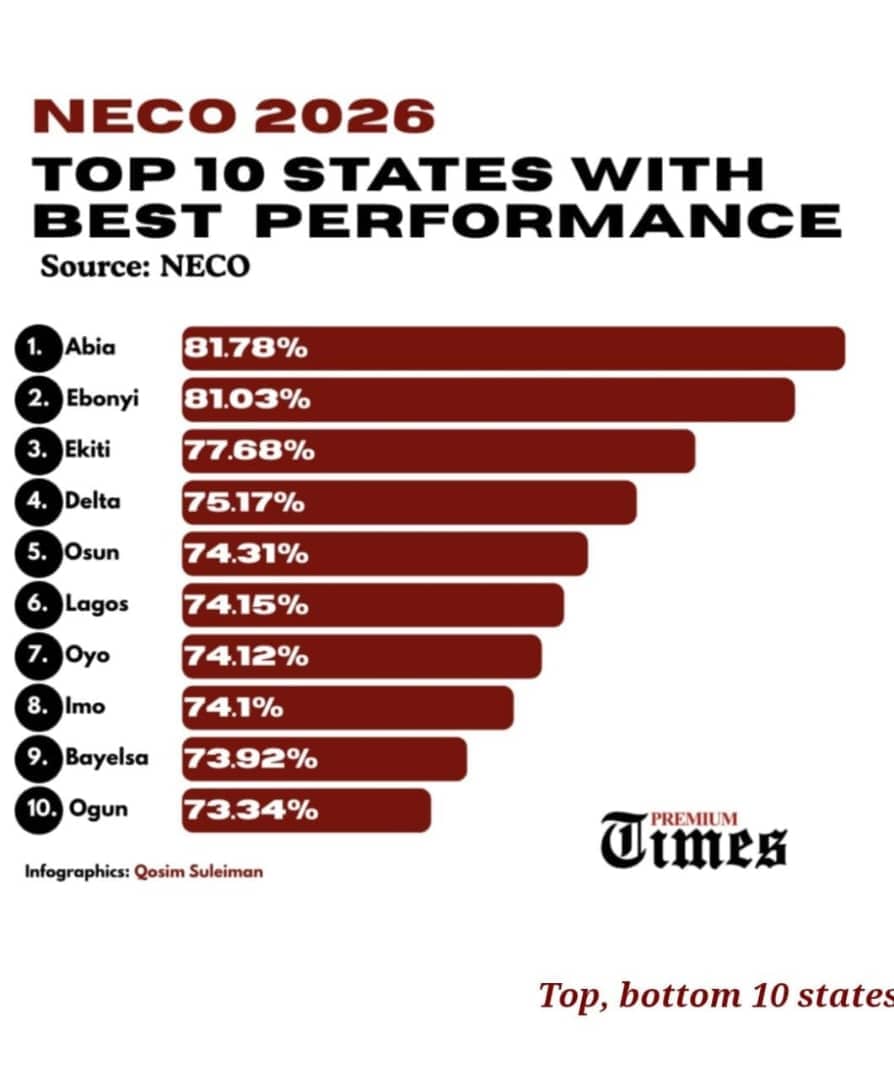
Osun State Governor, Senator Ademola Adeleke, has hailed the state’s strong performance in the 2026 National Examinations Council (NECO) Senior School Certificate Examination, describing the result as a positive reflection of ongoing efforts to reposition education in the state.
Osun placed fifth nationally in the 2026 NECO ranking, with 74.31 per cent of candidates recording at least five credits, including English Language and Mathematics.
While congratulating the students, teachers, parents, school administrators and other stakeholders, the governor noted that the state performance has been improving within a single digit rating for three consecutive years namely 2024, 2025 and 2026.
“Osun has moved from 33rd position in the 2022 NECO ranking to 5th in 2026, while improving its pass rate to 74.31 per cent. This is encouraging, and it shows that our sustained interventions in the education sector are yielding positive results,” the Governor said.
Governor Adeleke said the improved performance reflects his administration’s deliberate investment in the education sector, including the recruitment of additional teachers to strengthen the teaching workforce, while prioritising workers’ welfare and creating a more conducive environment for effective teaching and learning across public schools.
The Governor said the performance reinforces his administration’s determination to continue investing in education, noting that the objective is to build a system that gives every Osun child the knowledge, skills and opportunities needed to succeed.
“This result is encouraging, but we see it as a reason to do more. We will continue to invest in our schools, improve the learning environment, support our teachers and provide our students with the necessary tools to excel.
“We are building an education system that prepares our young people not only for examinations but for life,” the Governor said.
He assured that ongoing interventions in the education sector would be sustained and expanded, while urging students to remain committed to their studies.
His Excellency also commended teachers across the state for their dedication and sacrifices, assuring them that the administration would continue to prioritise measures that strengthen the education system and improve workers’ welfare.
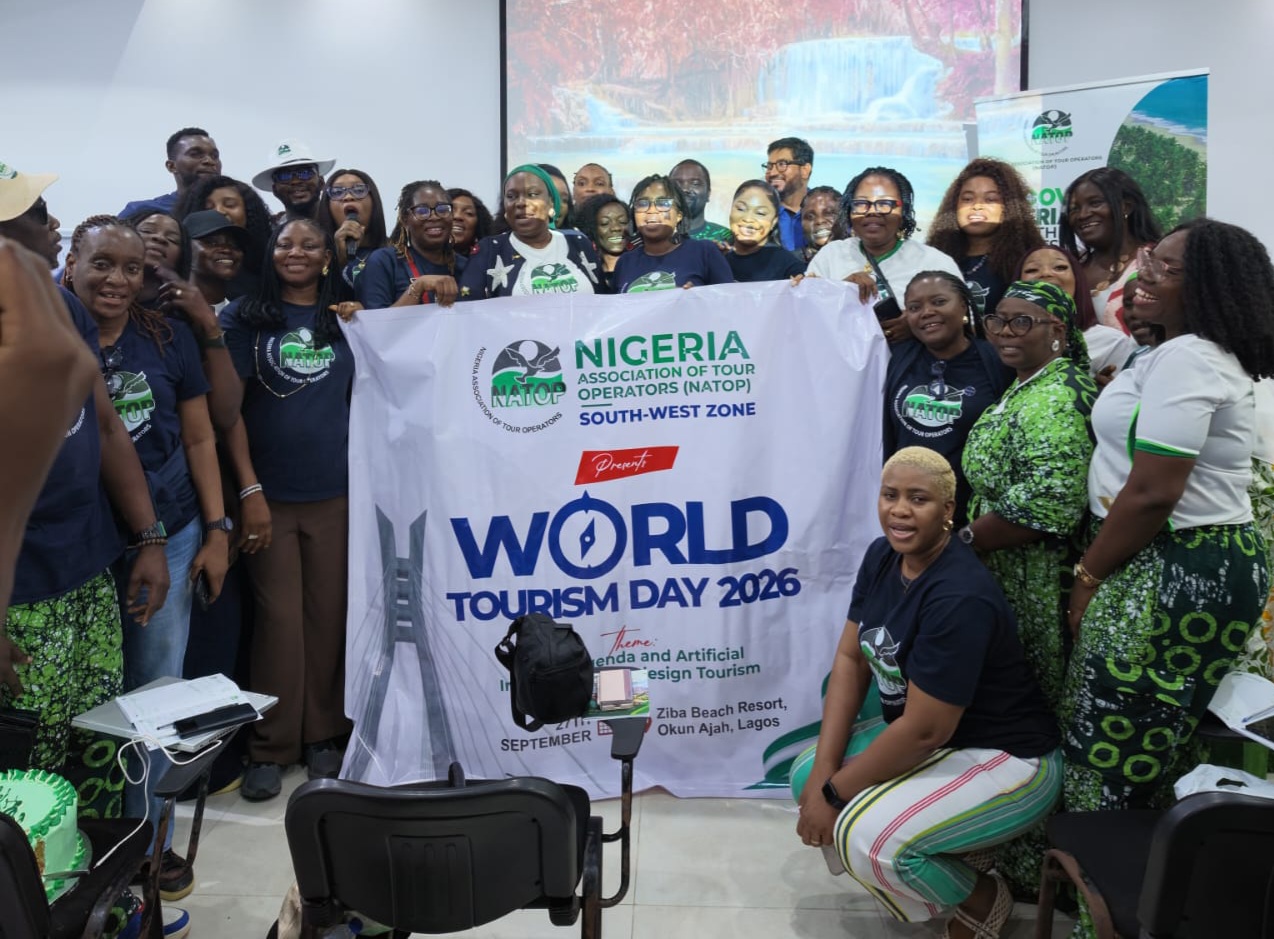
The Nigeria Association of Tour Operators (NATOP) marked the 2026 World Tourism Day with activities which capture capacity building, technology, destination promotion and domestic tourism, and celebration.
In the South West Zone, close to 200 tour operators gathered at Ziba Beach Resort, Lagos, for a special training focused on Artificial Intelligence and its application in tourism, equipping operators with digital tools to improve their businesses and destination marketing.
In Abuja, the FCT and Northern Zone, in collaboration with Naija Adventurers, staged a colourful Tourism Awareness Walk and Hike to the Centre of Nigeria.
The celebration also spread to the South-South Zone, where members marked the day with a destination tour, alongside activities to commemorate with the world tourism day celebrations.
In line with the theme for this year’s WTD celebration: ‘Digital agenda and artificial intelligence to redesign tourism’ the NATOP training on AI and application in tour operation at Ziba Beach Resort Lagos saw a large turnout of the members of the association.
The President of the association, Hajia Bolaji Mustapha explained that the idea for the location and training was to train members on how to do tour business, to know how to promote tourism digitally, using different AI tool and everything so that they will grow their businesses.
She said: “we follow the theme and, you know, blend with the old situation. Let’s do the training so that we attach it to the World Tourism Day with the theme that we have achieved something and also celebrate.”
She said the training will go a long way in helping the tour operators do greater content to digitally tell destination stories using AI, and also using the tool for expression.
Mustapha also explained why the association chose Ziba Beach Resort: “We always attach World Tourism Day to a tourism site. And definitely, if you look at this whole area and this community, that’s why we see that Ziba is a tourism site. We want to explore and of course. The resort newly launched its third phase. So, we will use this opportunity to look at their rooms, look at how we can sell this destination, to showcase it that the resort is actually in Nigeria, not Zanzibar. By using the place, we would kill two birds with one stones.
Facility tour of Ziba Beach Resort
“As tour operators who are willing to tell the good story of our Nigeria, we need to bring ourselves up to the speed, align with the digital revolution. Let everybody go digital. Because we also see the content creators are taking our business, we want to align it with what they do. We are the ones that understand the business and we’ll be able to tell the story better, so that anybody coming to Nigeria will be able to discover Nigeria with the experts.”
Also commenting on the celebration, the NATOP Vice President South West and chairman of the WTD Organizing Committee for the zone, Mrs. Wonuola Olatunde-Lamidi explained why NATOP South West’s usage of the 2026 WTD for training. She said many of the members still have a lot to learn about the tour business, and that some do not understand the foundation of the business, including how to create packages hence the need for the training.
Mrs. Olatunde-Lamidi spoke further: “Many don’t understand the foundation of what it is to create a tour package. And when you have people that are not well-trained in an industry, the industry will not grow. The kind of people that you also have will not have enough earning power to do many things. And because this is an industry that I have been in for 16 years, I run Diamonds and Pearls Travels with my husband. And I’ve seen Diamonds and Pearls Travels metamorphose into a company where people don’t just look at us as travel agents. We have become a Destination Management Company (DMC). We have become a trusted brand. We have become a company that when we talk about a destination, people want to go to that destination because of how we have portrayed the destination. And you may not realize that, as tour operators, you can actually decide where people go. You can make people go to a particular destination by marketing it, by letting them know the benefits of that destination.”
The tour operators had opportunity to tour the resort and unwind during the programme.


