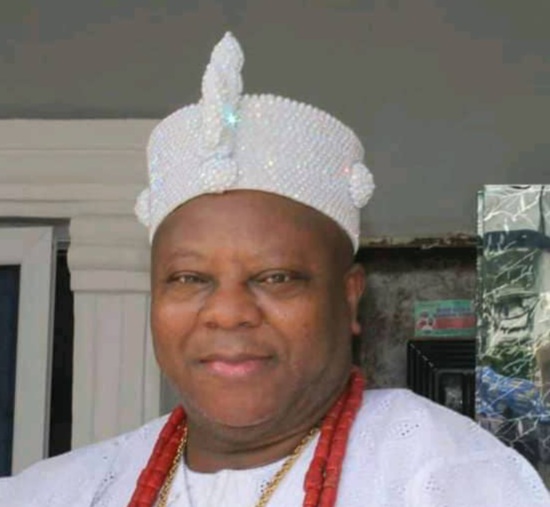
A United States District Judge, Christopher Boyko, on Tuesday, sentenced the Apetu of Ipetumodu in Osun State, Oba Joseph Oloyede, to 56 months in prison over a $4.2m COVID-19 relief fund fraud.
A statement of the United States Attorney’s Office, Northern District of Ohio, indicated that Oloyede was convicted of creating and leading a scheme that defrauded more than $4.2m from federal loan and grant programmes designed to support small businesses that suffered economic hardship during the COVID-19 pandemic.
The monarch pleaded guilty to a six-count charge bordering on conspiracy to commit wire fraud, engaging in monetary transactions with criminally derived property, and making and subscribing a false tax return.
Oloyede is a dual Nigerian and American citizen residing in Medina, Ohio.
As part of his sentence, Oloyede was also ordered to serve three years of supervised release and pay $4,408,543.38 in restitution.
He forfeited his Medina home on Foote Road, acquired with proceeds of the scheme, as well as $96,006.89 in fraud proceeds seized by investigators.
Court documents showed that between April 2020 and February 2022, Oloyede conspired with 62-year-old Edward Oluwasanmi of Willoughby to submit fraudulent applications for loans made available through the U.S. Small Business Administration under the Coronavirus Aid, Relief, and Economic Security Act.
The loans, including the Paycheck Protection Programme and the Economic Injury Disaster Loan scheme, were intended to help small businesses survive financial shocks caused by the pandemic.
Investigations revealed that Oloyede, who operated as a tax preparer and owned five businesses and one nonprofit, worked with Oluwasanmi, his tax client, who also owned three businesses in Ohio.
Using these entities, both men submitted multiple fraudulent loan applications with falsified information.
Their scheme secured about $1.2m for Oluwasanmi’s businesses and $1.7m for Oloyede’s entities.
In addition, Oloyede filed fraudulent PPP and EIDL applications in the names of some of his tax clients, collecting kickbacks of between 15 and 20 per cent of the loans obtained. These payments were never declared to the Internal Revenue Service.
Prosecutors told the court that Oloyede used proceeds from the scheme to acquire land, build a home, and purchase a luxury vehicle.
In total, he was linked to 38 fraudulent loan applications, amounting to $4,213,378 disbursed by the SBA.
Oluwasanmi, his co-conspirator, was sentenced in July 2024 to 27 months in prison for his role in the fraud.
He was also ordered to serve three years of supervised release, pay a $15,000 fine, and return more than $1.2m in restitution.
He forfeited most of the proceeds he received, including a commercial property in South Euclid and over $600,000 traced to his financial accounts.
The case was investigated by the U.S. Department of Transportation–Office of the Inspector General, the FBI, Cleveland Division, and IRS–Criminal Investigations, under the Pandemic Response Accountability Committee Fraud Task Force.
It was prosecuted by Assistant United States Attorneys Edward D. Brydle and James L. Morford for the Northern District of Ohio.
The Nigeria Democratic Congress (NDC) presidential candidate, Peter Obi, has clarified that he did not owe salaries, pensions, gratuities or any money during the period he was Governor of Anambra State.
Obi stated this in response to recent claims by the current government of Anambra State.
The Anambra State Government recently claimed that it is till repaying loans obtained by previous administrations, including those of former governors Obi and Willie Obiano.
According to the government, it has focused largely on paying existing obligations rather than accumulating new debts.
Obi served as the Governor of Anambra State from March 2006 to March 2014.
Reacting to the claim, Obi said: “I left office as Governor nearly 13 years ago. On the day I left office, I was not owing any salaries, pensions, gratuities or any money that the Anambra State Government was supposed to pay.
“I did not owe a single supplier or contractor. If you find even one person I owed, I will end my 2027 campaign today.”
Former Vice President Atiku Abubakar has unveiled a 12-point policy agenda he says will guide his administration if he wins the 2027 presidential election on the platform of the African Democratic Congress (ADC).
The policy commitments were published by AbdulRasheed Shehu, Special Assistant on Broadcast Media to Atiku, as part of the former vice-president’s campaign message ahead of the election.
The agenda focuses on the economy, education, local government autonomy, transportation, electricity, job creation, security, agriculture, healthcare and the restructuring of the federal system.
Atiku proposed the restoration of a targeted petroleum subsidy as part of measures to reduce transportation costs and ease the pressure of rising living expenses on Nigerians.
He also promised to review the operations of the Nigerian Education Loan Fund (NELFUND), including consideration of debt forgiveness for beneficiaries. The proposal is based on the position that Nigerian students should have access to affordable education and scholarships rather than being burdened with debts.
On local government administration, the former vice-president pledged to implement the Supreme Court judgment on local government autonomy. Under his proposal, funds meant for local councils would be paid directly to them and deployed for development at the grassroots.
Atiku also identified the development of Nigeria’s maritime infrastructure as a major part of his economic agenda. He proposed reviving the Eastern maritime port corridor by restoring the operational capacity and competitiveness of ports in Port Harcourt, Calabar and Warri, while supporting the development of the Uyo Deep Sea Port.
According to the policy document, strengthening the eastern and southern ports would reduce pressure on the Lagos port corridor, lower logistics costs, create employment and improve trade between the South-East, South-South and northern markets.
The former vice-president further promised to reopen Nigeria’s land borders to legitimate commercial activities. He said the move would help revive legal cross-border businesses, support traders and strengthen regional commerce.
Atiku also proposed changes to the electricity sector, including a review of the existing tariff classification system. His campaign said the reform would address what it described as discriminatory billing and make electricity more affordable to consumers.
Politics
Young Nigerians and women also feature prominently in the proposed agenda. Atiku plans to establish a $10 billion startup and entrepreneurship financing programme aimed at providing greater access to capital, while also increasing the participation of youths and women in government appointments and economic opportunities.
The security sector is another major focus of the policy commitments. Atiku proposed recruiting more security personnel, improving their welfare and strengthening the use of modern intelligence and field technology.
His plan also includes tackling corruption within the security system, confronting insurgency, banditry and other serious crimes with greater political will, and strengthening security cooperation with neighbouring countries.
In agriculture, Atiku said his administration would seek to encourage Nigerians to return to farming by improving security in farming communities and lowering production costs. The plan also includes greater access to financing and other forms of support for farmers and agricultural entrepreneurs.
The former vice-president equally proposed a major overhaul of the healthcare sector through institutional reforms and increased access to quality and affordable basic healthcare. The agenda also promises to address shortages of medical personnel, as well as their remuneration and welfare.
On governance, Atiku proposed devolving more powers to states and local governments by restructuring the Exclusive and Concurrent Legislative Lists. He said the federal government should become smaller and more efficient, concentrating on responsibilities that require national coordination while giving subnational governments greater capacity to manage local affairs.
He also pledged to implement the Oronsaye Report as part of efforts to reduce government waste and eliminate duplication among federal institutions. The proposal is intended to rationalise government agencies, reduce institutional overlap and corruption opportunities, and improve efficiency and service delivery across the public service.
Atiku Unveils 12-Point Plan to Rescue NigeriaAtiku Unveils 12-Point Plan to Rescue Nigeria
The release of the 12-point agenda comes days after Atiku’s wife, Titi Abubakar, urged Nigerian youths to support her husband in the 2027 presidential election.
Speaking at the ADC All Support Groups Town Hall Meeting in Abuja, Titi said Atiku’s experience would enable him to begin governing without having to learn the responsibilities of the presidency on the job.
“Atiku is a sellable material. That is why I am so proud of my husband. Atiku is a philanthropist. Atiku has done it before. Atiku is not going to learn on the job. And Atiku is not a novice,” she said.
She also said Atiku was seeking the presidency to improve the lives of Nigerians rather than to enrich himself.
“Atiku is a man of honour, a man of his word. Atiku is not coming to chop government money. Atiku wants to give back to you people. Atiku wants you people to know what it is all about government,” Titi said.
She further highlighted Atiku’s proposed inclusion of young people and women in government, recalling his pledge to reserve 40 per cent of appointments for the two groups.
Titi also urged young voters to protect their votes and reject attempts to buy their support ahead of the election.
“Don’t allow them to come and give you money and you sell your conscience. If you sell your vote, you are selling the vote of your generation yet unborn,” she said.
She acknowledged that the ADC might not have the financial resources of some political opponents but urged youths not to exchange their votes for temporary financial benefits.
“ADC don’t have that money to give you. Don’t be a sellout. Because these people, they have all our money in their kitties,” she said.
Titi had also criticised the state of governance and the economy, saying, “Nothing is working. Our economy is in shambles.”
Former Vice President Atiku Abubakar has called on the Tinubu administration to provide clarity on how savings from the removal of fuel subsidy have been applied, following renewed concerns raised by the Academic Staff Union of Universities (ASUU) over unpaid entitlements and unresolved agreements.
Speaking on Sunday through his Senior Special Assistant on Public Communication, Phrank Shaibu, Atiku said the subsidy removal imposed significant costs on households through higher fuel prices, transport fares, food prices and school fees.
The presidential candidate of the African Democratic Congress (ADC) noted that the policy was also presented to Nigerians as a step that would release resources for education, healthcare, infrastructure and other essential services.
“If the subsidy has been removed and Nigerians have borne the attendant costs, then Nigerians deserve a clear explanation of how the savings are being applied,” Atiku said.
He said public universities continue to face funding challenges, with lecturers raising concerns about unpaid entitlements and outstanding agreements, while students face the risk of disruptions to the academic calendar.
Atiku added that the administration has cited increased allocations to State governments as part of the benefits of subsidy removal.
He, however, asked why public education across the federation still faces severe pressure, with both Federal and State-owned universities experiencing industrial disputes and infrastructure gaps.
“If more resources are reaching the federal government and states, citizens are entitled to ask how those resources are translating into improved classrooms, laboratories, hostels and teaching facilities,” he said.
The former vice president also raised questions about the government’s student loan scheme, NELFund.
He said the rising cost of education has put additional strain on families and that the loan programme should be matched with measures to expand access and reduce the cost burden.
“Every year, more young Nigerians seek university education. The physical capacity of the system needs to expand to meet that demand. We need to see more classrooms, laboratories, hostels and expanded admission spaces,” he said.
Atiku further said that while government has asked citizens to make sacrifices, it must also ensure transparency and equity in the application of public resources, including the use of waivers and concessions.
He called for accountability in the management of proceeds from subsidy removal, and urged the government to prioritise investment in education, healthcare and infrastructure.
“ASUU is again raising concerns over unpaid entitlements and outstanding agreements. State universities have also experienced disruptions. Students are taking loans to fund education, while infrastructure in many universities remains inadequate.
“The sacrifice has been made by Nigerians. The expected improvements in public services must now be seen and felt,” he said.
Atiku urged President Bola Tinubu to address the concerns raised by ASUU and other stakeholders, and to ensure that commitments made at the time of subsidy removal are fulfilled.