
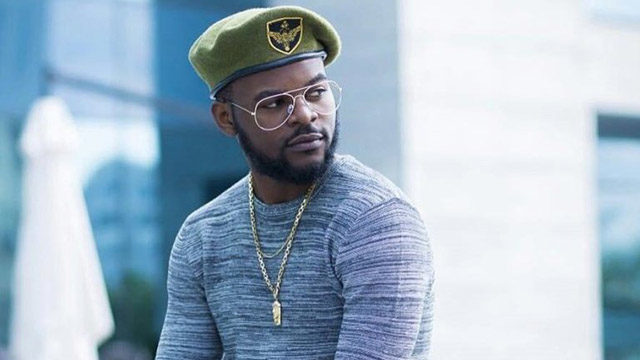
Nigerian artist Folarin Falana, popularly known as Falz, has shared the reason why he puts out songs that spark controversy.
Entertainment
Why I Sing Controversial Songs – Falz

- Share
- Tweet /home/rhoncare/pointblank.ng/wp-content/plugins/mvp-social-buttons/mvp-social-buttons.php on line 69
https://pointblank.ng/wp-content/uploads/2020/10/Falz.jpg&description=Why I Sing Controversial Songs – Falz', 'pinterestShare', 'width=750,height=350'); return false;" title="Pin This Post">
The rapper explained his reasoning in a recent interview with Arise TV, emphasising that life in Nigeria is meaningless. He stated that he was not afraid of death.
With the release of his most recent song with Vector, ‘Yakubu,’ named after the chairman of the Independent National Election Commission, INEC, Prof. Mahmood Yakubu, the actor was featured on Arise TV to speak on “Music as a Socio-political Tool.”
In the song, Vector and Falz criticised INEC, its chairman, and other political parties for allegedly engaging in electoral fraud during the just-ended general elections. Falz asserts that he would rather die fighting for justice than keep silent and perish as a result of the nation’s broken system.
He joined the programme from the United Kingdom through Skype, but the rapper claimed that he was not overseas because he was terrified of conflict with state actors over the contentious song.
He said, “I knew that was going to come up when you announced that I was doing this from London. Like I said earlier on, this is not the first time, this is not the second time, this is not the third time.
“I have released tons of records that are very confrontational. And I was on ground. I’m always on ground when I released these records.It is not to say that I’m running anywhere. Absolutely not. Everyone know where to find me. If anyone wants to find me. But I have no reason to fear anything. And I always say this when people ask me ‘how do you do these things without any fear of consequences?
“And this is the same answer that I always give: the kind of life we are living already is one which we are more or less fading away already. It’s not a meaningful life what we have in Nigeria as a country.
What’s the worst that could happen? It’s death. I don’t fear death. I would rather go down fighting for a just cause. I would rather be remembered as someone that lived a life that was meaningful rather than someone that for example was walking down the road and got run over by a danfo [bus] because he was driving recklessly. Or, someone that got a heart disease and could not save himself because there are no hospitals capable of saving him in Nigeria.”
In the aftermath of the 2023 Nigerian general elections, which were, according to many, marred by gross irregularities, rappers Falz and Vector released ‘Yakubu,’ a rap song that captured the event and highlighted the irregularities.
Pulse.ng
Continue Reading


During a Twitch livestream on September 20, 2026, Nigerian Afrobeats star Davido revealed that his highest single purchase cost him an astounding $11 million. This surprising admission took place while he engaged with fans alongside streamer Enzo.
Short clips of the livestream quickly gained traction on social media as viewers reacted to the news, especially since Davido did not divulge specifics about the purchase.
While making the comment, Davido remained casual and did not provide any details about what the purchase was, which led to immediate speculation among fans. Some suggested that it could be a luxury property, perhaps a condo in Atlanta, considering the amount.
Others dismissed the idea since none of Davido’s known vehicles come close to that valuation. Fans noted his penchant for luxury cars, but the figures just didn’t add up for a purchase that high.
Throughout the livestream, Davido also showcased music from his recent projects and engaged casually with those watching. Nevertheless, the discussion about his significant purchase became the highlight post-broadcast.
Davido, known for his luxurious lifestyle, currently owns eight luxury vehicles, including three Rolls-Royces, two Lamborghinis, and three Mercedes-Maybachs. He shared that he is now focusing on his $70 million house in Eko Atlantic and is done buying cars for the year.
The exact nature of Davido’s $11 million purchase remains a mystery, keeping fans intrigued.
Read some comments below as compiled by gistlover:
@Quincy1122 Arthur:”How much u tak buy ur jet? Abi na family jet”
@Delcan:”Davido be capping sometimes and he doesn’t do anything extraordinary apart from showing off he gat money talking about money and crying because of a woman just to stay relevant”
@Dehkardo:”I think say this guy guide before”
@Promise Chinemerem Edwin:”You people should build industries and factory, give back to the society who made you. Create Job opportunities and stop blabbing.”
@Comrade Ayumzi:”Eleven million dollars may sound too huge to be real, but then, it’s Davido. He even beckoned on one of his retinues, should in case. The dude is surrounded with access to liquid, and he himself has huge liquid assets too. A lot of artistes would say this, and I will not believe it for example, your merch is 1.5 million per shirt and other piece, over a hundred k naira for only a cap, and you come online to boast of having a liquid balance of five hundred million naira at the bank? How much is an original Gucci or Versace? But here is someone from an oligarchy family speaking: two uncles a governor, dad owns a power grid, grandpa was a senator, himself a top-rated Apple Music, Spotify, YouTube, and more revenue earner. Even though he is braggadocious and didn’t mention what he bought, I believe him maybe it’s a condo in Atlanta. But for a fact, he doesn’t own a Bugatti, and none of his vehicles are worth that much it sounds suspicious.”
@ASSURANCE🪶:”Na lie wetting he do way make them pay him such amount”
@Naija2capeblog:”The way he said $11 million with zero hesitation is the real flex. Not even a smile. Just “this is what I did.” December cannot come fast enough.”

The Big Brother Naija Season 11 competition has lost three more housemates, with Yusuf, Bells and Chimsom Chuka exiting the show during Sunday’s live eviction programme.
Their eviction brings the number of contestants remaining in the ‘Show Ya Sef’ house down to 10, with the competition gradually approaching its final stage.
The trio joined Araga and Abi, who were evicted during the previous round, on the list of housemates who have left the season through eviction.
Other contestants who had earlier departed the show include Martins, Mercedes, Kamsy, Cassi, Sultex, Goddessa and Gerard. Neche, however, left the house voluntarily.
The season also recorded the disqualification of Nomy during the week, further reducing the number of contestants in the competition.
The ‘Show Ya Sef’ edition began on July 26, 2026, with 24 housemates entering the house to compete for the ₦160m grand prize.

Reality TV star Josephina Otabor, popularly known as Phyna, and actress Nkechi Blessing are billed to face each other in a celebrity boxing bout on October 1, 2026.
The fight, tagged “Phyna vs Nkechi,” is scheduled to hold at the Federal Palace Hotel in Lagos as part of the “Chaos in the Ring” series organised by Balmoral Group Promotions.
The event, announced by Balmoral Group Promotions and DAZN Boxing on Friday, will be broadcast live on DAZN and SuperSport.
The bout is powered by Bet9ja and is the latest celebrity boxing contest in the series, which has previously featured entertainers including Portable, Charles Okocha, Speed Darlington and Carter Efe.
Promotional materials released by the organisers featured Phyna and Nkechi in boxing attire ahead of the October 1 contest.
Details of the undercard and ticketing arrangements have yet to be announced by the organisers.


