
Metro
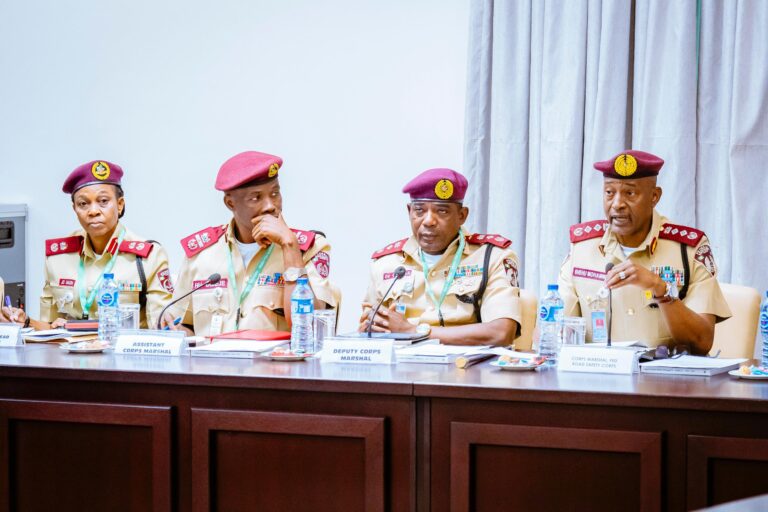
X-raying the Impact of NaRSAC on Seamless Implementation of Nigeria Road Safety Strategy Document II: FRSC Shehu Mohammed Perspective

- /home/rhoncare/pointblank.ng/wp-content/plugins/mvp-social-buttons/mvp-social-buttons.php on line 27
https://pointblank.ng/wp-content/uploads/2024/10/IMG-20241013-WA0084.jpg&description=X-raying the Impact of NaRSAC on Seamless Implementation of Nigeria Road Safety Strategy Document II: FRSC Shehu Mohammed Perspective', 'pinterestShare', 'width=750,height=350'); return false;" title="Pin This Post">
- Share
- Tweet /home/rhoncare/pointblank.ng/wp-content/plugins/mvp-social-buttons/mvp-social-buttons.php on line 69
https://pointblank.ng/wp-content/uploads/2024/10/IMG-20241013-WA0084.jpg&description=X-raying the Impact of NaRSAC on Seamless Implementation of Nigeria Road Safety Strategy Document II: FRSC Shehu Mohammed Perspective', 'pinterestShare', 'width=750,height=350'); return false;" title="Pin This Post">
By Olusegun Ogungbemide
The inauguration of the National Road Safety Advisory Council (NaRSAC) Committee by the Vice President, Federal Republic of Nigeria, Kashim Shettima, marks a significant milestone in Nigeria’s quest for road safety.
The Federal Republic of Nigeria is a federal constitutional republic comprising 36 states, a Federal Capital Territory Abuja and 774 Local Government Areas. With a total of 923,768 square kilometres and human population of well over 170 million, Nigeria is the most populous country in Africa, the most populous black nation and currently the 7th most populous nation in the world.
The total road network which is estimated at 200,183km (comprising 36,183km federal, 32,000km State and 132,000km of Local roads) has earned Nigeria her rank as the country with the second largest road network in Africa as at 2019. Currently, more than 95% of urban transportation in Nigeria is done by road, and about 70% of these trips are by public transport.
This huge burden placed on road transportation sector makes it extremely herculean a task to handle the administration of safety, as well as management of traffic on Nigerian roads.
The fact remains that no single government, or agency of government left alone, can boast of having the sole capacity to combat the menace of road traffic crashes and entrench safety on the roads. That is why the task of road safety is basically a collective effort. It requires the combined efforts of both the public and private sector, civil society organisations, non-governmental organisations, religious bodies as well as traditional institutions amongst others.
This analysis brings to the fore, the potential impact of the NaRSAC Committee on the implementation of Nigeria Road Safety Strategy Document II as well as provides a comprehensive overview of the NaRSAC committee’s potential impact on Nigeria’s road transportation sector.
Recall that the United Nations embarked on Decade of Action against road crashes, injuries and fatalities in the break of the new millennium. This decade of action is anchored on safe system approach, leveraging on the 5 pillars namely; safer roads, safer road users, safer vehicles, road safety administration and post crash care. Apart from emphasizing on achieving reduction in road crashes by 50%, it also targets to achieve a universe where crashes result in zero death.
To achieve this feat, member countries were mandated to develop a strategy document spanning through a decade that would identify critical stakeholders, including all the tiers and arms of government and apportion responsibilities and roles to every key player. This led to the development of NRSS document. The idea behind it is to have an all inclusive approach to road safety in Nigeria, where everyone has a role to play.
The Nigeria Road Safety Strategy (NRSS) document II is the second edition of an action plan to improve road safety in Nigeria and align with safety management approach with global best practices. With the maiden edition (NRSS 2014-2018) reaching its terminal phase in 2018, a comprehensive review of the strategy was necessary, not just to pursue the adopted policy path, but also to enrich core contents, improve on implementation methodology, and generally consolidate the tremendous gains of the first edition.
Thus the NRSS II (2021-2030) advances the progress already made and charts a way forward. NRSS II, therefore, articulates the multi-sectoral activities that are necessary for the achievement of Nigeria’s much desired road safety and outlines the country’s roadmap for reducing road crashes and fatalities. The document identifies key strategies, including: Improving road infrastructure, Enhancing vehicle safety standards, Strengthening enforcement and regulation, as well as, Promoting public awareness and education.
The NaRSAC committee’s primary responsibility is to implement all strategic initiatives provided in the document as a guide on road safety implementation in Nigeria. They will also coordinate stakeholder engagement, monitor implementation progress and advise on resource allocation.
The committee’s inauguration will definitely usher in a new dawn for road safety in Nigeria. It is expected amongst others to enhance policy coordination and streamline road safety efforts across federal, state, and local governments; Improve stakeholder engagement by fostering collaboration among government agencies, private sector, and civil society organizations; boost implementation, as well as accelerate progress toward achieving the Strategy Document’s goals, and also Increase resource allocation by attracting funding and resources from government, private sector, and international partners.
As the lead agency that superintends over the administration of safety in the country, the Federal Road Safety Corps has already commenced putting all necessary measures in place to ensure a seamless implementation of the strategies in the document. Under the leadership of the present Corps Marshal, Shehu Mohammed deployment of technology as well as staff capacity development programmes have been introduced. This is to ensure that the staff are well prepared to handle the technological aspect of the combat mission against crashes on our roads.
With the inauguration of this committee, the Corps, as well as the country is set for better days and it is hoped that the members will wake up to the task ahead and commit their time to the realisation of the mandate of the Committee.
In addition to the aforementioned impacts of this inauguration, the corporate strategic goal of the Corps projected to reduce road crashes in Nigeria by 5% at the end of 2024 has actually gotten a credible boost and the Corps will sure take absolute advantage of this development to make Nigerian roads safer than they already are.
Obviously, the Corps now has a greater commitment of requesting from all stakeholders to share in the vision that Road Safety as an agenda needs more attention, more care, and more funding.
We are absolutely committed to improving our visibility, performance, rescue response time, technology driven operations, and respect for law-abiding road users. So that together as we enjoy shared responsibilities as stakeholders we can do more, we can do better and we can save more lives and properties of Nigerian citizens for the ultimate economic growth and development of our Nation.
Let me congratulate the motoring public, the Federal Republic of Nigeria, and of course, the Federal Road Safety Corps for this great achievement.



The management of the Nnamdi Azikiwe University (UniZik), Awka, Anambra State, has ordered an immediate, comprehensive and impartial investigation after a viral video showing students assaulting a lecturer over an alleged sexual misconduct sparked outrage online.
The incident that occurred on Saturday on the Awka campus.
Footage that circulated widely on social media on Saturday captured some UniZik students physically assaulting and rough-handling a lecturer from the Department of Chinese Studies, Faculty of Arts.
According to witnesses and the circulating videos, the lecturer was allegedly caught attempting to molest a female student within the university premises before students intervened.
The clips have drawn widespread condemnation and calls for a thorough probe, with many Nigerians debating both the allegation and the students’ resort to violence.
The lecturer’s identity has not yet been officially released by the university.
In a statement issued at the weekend, the Director of Information and Public Relations, Aloysius Attah, said the institution is “deeply saddened” by the development.
The management strongly condemned jungle justice and self-help while also taking the sexual misconduct allegation seriously.
“The Management of Nnamdi Azikiwe University, Awka, has received reports of the alleged physical assault and attack on a lecturer in the Department of Chinese Studies, Faculty of Arts, following an allegation of attempted sexual misconduct involving a female student of the University,” the statement read.
Attah confirmed that authorities have directed an immediate investigation to “establish the facts and circumstances surrounding the incident.”
UniZik says the investigation will cover two tracks:
1. The sexual misconduct allegation — to determine if the lecturer attempted to molest the female student.
2. The assault on the lecturer — to identify students involved in the physical attack and address breaches of campus discipline.
“The university remains committed to upholding the highest standards of discipline, academic integrity and the safety and dignity of all members of the university community,” Attah added.
Sexual harassment allegations in Nigerian universities have repeatedly sparked protests and policy reviews. UniZik itself has faced pressure in recent years to strengthen its anti-sexual harassment framework.
At the same time, university authorities are under pressure to curb vigilante actions on campus, warning that mob justice undermines due process and endangers lives.
For now, the lecturer has been taken off active duty pending the outcome of the probe, according to campus sources.
UniZik said further updates will be provided as the investigation progresses and urged students and staff to remain calm and allow due process.

The 2026 World Conference of Zion Prayer Movement Outreach will be held next week at Zion City, the permanent site of the ministry at Mgbichi, Ngor Okpala, Imo State.
A press statement released by Zion Ministry in Lagos on Friday disclosed that the three-day crusade will begin on Friday, August 21, and end on Sunday, August 23, 2026.
The World Conference is the largest annual gathering organized by Zion Prayer Movement Outreach and attracts participants from across Nigeria, Africa, Europe, North America, Asia, the Middle East and others parts of the world.
It is the Third time the annual conference will be held outside Lagos, and the crusade will mark the end of the 100 Days Fasting and Prayer started in May by the ministry. Like in previous editions, hundreds of thousands of Zionites from across the world are expected to attend this year’ conference.
The Annual 100 Days Fasting and Prayers is one of the ministry’s most significant spiritual programmes during which members engage in a season of prayers, fasting, worship, Biblical reflection, thanksgiving and fellowship. The programme culminates in the closing World Conference drawing worshippers, pilgrims, clergy, volunteers and media representatives.
The Spiritual Director of Zion, Evangelist Chukwuebuka Anozie Obi, said that the crusade is expected to record thousands of people giving up their lives to Christ, awesome miracles, instant healings, deliverance from bondage, salvation of souls and verifiable testimonies.

By Tolulope A. Adegoke PhD
“We are not the final word, nor the first; we are the crucial comma between what was endured and what is yet to be authored. To walk in victorious posterity is to accept that the soil beneath our feet is borrowed, the air in our lungs is loaned, and the systems we build are merely scaffolding for a cathedral we will never see completed. True victory, then, is not found in the monuments we leave behind, but in the capacity we cultivate in those who will inherit the work. For the future does not begin when we are gone—it begins the moment we decide to act as if we are already guests in it.”
Introduction: The Shift from Legacy to Posterity
In the lexicon of leadership and development, the term “legacy” has long been the gold standard. It implies what one leaves behind. However, to speak of “Positive Victorious Posterity” is to engage in a far more active, dynamic, and demanding discipline. Posterity is not a passive inheritance; it is a living entity that we are actively shaping with every decision made in the boardroom, every policy enacted in the legislature, and every culture cultivated within a community.
To walk in Victorious Posterity is to move with the deliberate intention of ensuring that future generations are not merely surviving the consequences of our actions but are thriving because of the systems we install today. To work in this realm is to engineer solutions that are anti-fragile—gaining strength from the volatility of the future rather than crumbling under it.
This write-up explores the mechanics of this philosophy, dissecting how it functions at the individual, corporate, and national levels to solve the pressing challenges of inequality, environmental degradation, economic instability, and social fragmentation.
Part I: The Foundational Pillars of Victorious Posterity
Before we can apply this concept, we must understand its structural integrity. Victorious Posterity rests on three interdependent pillars:
1. Intergenerational Equity: The recognition that the rights of future generations carry equal weight to the rights of the present. This is not a moral nicety; it is a fiduciary duty. When we drain natural resources or accumulate national debt, we are borrowing from the future’s pocketbook without their consent.
2. Adaptive Resilience: Victory is not the absence of crisis, but the ability to emerge from crisis stronger. Posterity-focused systems are built with “slack”—redundancies and buffers that allow for shock absorption, whether that be economic downturns, climate events, or supply chain disruptions.
3. Semantic Integrity: The narratives we build today become the operating systems of tomorrow. A culture that celebrates short-term greed will produce a generation of transactional leaders. A culture that celebrates problem-solving and empathy will produce innovators and healers.
Part II: Impacting Peoples (The Micro Level)
At the individual and community level, the walk of Victorious Posterity is primarily concerned with Human Capital Development. The pressing challenge here is the “Skills Mismatch”—the growing chasm between what educational institutions produce and what the future economy demands.
The Solution: Victorious Posterity works by shifting educational paradigms from “knowledge retention” to “cognitive adaptability.” It is about teaching people how to think, not what to think.
· Example (Finland’s Education Reform): Finland has moved away from “subject-based” teaching to “phenomenon-based” learning. Students don’t just study history; they study the historical, geographical, and economic impacts of climate change on their specific locality. This walk toward posterity ensures that children graduating today are not memorizing facts that will be obsolete in a decade but are instead solving real-world problems. The result is a populace that is inherently ready to pivot, upskill, and contribute meaningfully to a volatile job market.
· Example (Community Banking in Bangladesh): The Grameen Bank model didn’t just lend money; it walked with communities to build credit history and entrepreneurial skills. By focusing on women and rural populations, it ensured that the posterity of those villages would not be defined by generational poverty but by generational commerce. The victory is visible in the literacy and health outcomes of the next generation, who now have mothers that are business owners.
Part III: Impacting Corporates (The Meso Level)
For corporations, the greatest pressing challenge is the tension between Quarterly Returns and Long-Term Sustainability. The modern capital market often penalizes long-term R&D in favor of immediate stock buybacks. Victorious Posterity demands a redefinition of the “Fiduciary Duty” to include stakeholders beyond the shareholder—employees, environment, and society.
The Solution: The walk of victory for a corporation involves embedding ESG (Environmental, Social, and Governance) metrics not as a PR exercise, but as core operational KPIs that dictate supply chain decisions, hiring practices, and innovation pipelines.
· Example (Patagonia’s “Earth is Now Our Only Shareholder”): Patagonia’s radical restructuring is a masterclass in Victorious Posterity. By transferring ownership to a trust dedicated to climate action, they effectively built a corporate structure that cannot be forced to prioritize profit over the planet. Their work involves using regenerative organic agriculture in their supply chain, which regenerates soil health. This is a direct intervention to solve the agricultural crisis. They are working now to ensure that cotton farmers fifty years from now have arable land, rather than desert.
· Example (Microsoft’s Carbon Negative Pledge): Unlike “Carbon Neutrality” (which allows for offsets), Microsoft’s pledge to be Carbon Negative by 2030 requires them to remove more carbon than they emit. This pushes the corporation to invest heavily in direct air capture technology and biochar. By walking this path, they are solving the challenge of “climate techno-pessimism,” proving that heavy industry can be a solution to environmental damage rather than the cause.
· The “Reverse Mentorship” Model: Corporates that work for posterity invert the traditional mentorship dynamic. They pair senior leadership with junior Gen-Z employees to understand emerging technological trends and social ethics. This ensures the corporate strategy remains relevant to the future demographic it aims to serve.
Part IV: Impacting Nations (The Macro Level)
At the national level, the challenges are systemic: Resource Scarcity, Geopolitical Fragmentation, and Aging Infrastructure. Nations often operate on a 4-year election cycle, which is antithetical to the 30-year horizon required for infrastructure and education. Victorious Posterity requires the establishment of “Future Generations Ombudsmen” or similar legislative checks that protect long-term interests from short-term political expediency.
The Solution: National policies must pivot toward “National Resilience” and “Circular Economies.”
· Example (The Netherlands’ “Deltaworks” and Room for the River): The Dutch are historically known for fighting the sea. However, in their walk toward posterity, they recognized that building ever-higher dikes was a losing battle against rising sea levels. The “Room for the River” program strategically relocated dikes inland, lowered groynes, and created water buffers to allow controlled flooding in designated areas. This is the victory of coexistence over conquest. It solved the challenge of catastrophic climate flooding by designing a landscape that accepts water rather than merely resists it, ensuring the nation’s survival for centuries.
· Example (Estonia’s Digital Governance): Estonia built its digital infrastructure on the premise that government services should be accessible to citizens regardless of geography or time. By creating a secure, blockchain-backed digital ID system, they have solved the challenge of bureaucratic corruption and inefficiency. Their posterity is “digitally native”—meaning future generations will inherit a government that is transparent, efficient, and low-cost, rather than a burdensome bureaucracy.
Part V: The Psychological Framework—The “Walk”
To “walk” in this manner requires a psychological shift from a “Survival Mindset” to a “Stewardship Mindset.”
· The Challenge: The modern world is riddled with “Doom-scrolling” and “Climate Anxiety.” This often paralyzes action. People feel that the future is bleak, so they consume more now.
· The Victorious Walk: This philosophy reframes the future as a garden to be tended, not a battlefield to be survived. It requires leaders to exercise “Radical Optimism”—the belief that human ingenuity, combined with ethical constraint, can solve technical problems.
· Practice: Leaders must engage in “Reverse Thinking”—imagining the year 2075 and looking back to 2026. From that future perspective, what decision would they wish they had made? This mental exercise forces leaders to abandon sunk costs and embrace daunting transitions (e.g., moving from fossil fuels to green hydrogen).
Part VI: The Strategic Framework—The “Work”
To “work” in Victorious Posterity involves a practical, step-by-step strategic model that I term the “Posterity Matrix.”
1. Impact Auditing: We cannot manage what we do not measure. Corporates and nations must develop “Lifecycle Assessment” tools that measure the total cost of a product or policy over a 50-year horizon, not just a 5-year horizon. This includes social cost of carbon, social disruption of automation, and biodiversity loss.
2. Generational Councils: Establish advisory boards comprised of individuals aged 15-25 to review major policy proposals. Their lack of experience is actually their asset; they are the voice of the future’s user experience.
3. Diversified Sovereignty: At the national level, this means investing in domestic food and energy production to insulate the nation from global shocks (e.g., Israel’s desalination and drip-irrigation technologies that made a desert nation into an agricultural powerhouse).
4. Ethical AI Deployment: Posterity works when AI is used to augment human potential, not just replace it. Nations must invest in AI that predicts infrastructure decay (bridges, roads) to fix them before they collapse, solving the crisis of aging public assets.
Conclusion: The Intergenerational Contract
Positive Victorious Posterity is not a destination; it is a continuous, iterative process of negotiation between the living, the unborn, and the planet. It demands that we view time not as a linear arrow, but as a cycle of renewal.
For the Individual, it means becoming a lifelong learner who contributes more knowledge than they consume. For the Corporate, it means becoming a regenerative entity that creates more value (environmental and social) than it extracts. For the Nation, it means becoming a guardian of resources, a cultivator of peace, and an enabler of human dignity.
The pressing challenges of our time—political polarization, ecological collapse, and economic inequality—are not insurmountable. They are merely the friction that forces us to innovate. Victorious Posterity walks with the humility of knowing we are not the final chapter and works with the audacity of knowing we are the most important chapter so far. It is in this tension between humility and audacity that victory is forged.
Let us stop asking, “What will we leave behind?” and start asking, “What are we building alongside?” Because ultimately, posterity is not waiting in the future; it is being assembled in the present, piece by piece, by those who dare to walk forward with their eyes fixed on the horizon, and their feet firmly rooted in the soil of today.
Dr. Tolulope A. Adegoke, AMBP-UN is a globally recognized scholar-practitioner and thought leader at the nexus of security, governance, and strategic leadership. His mission is dedicated to advancing ethical governance, strategic human capital development, resilient nation building, and global peace. He can be reached via: tolulopeadegoke01@gmail.com, globalstageimpacts@gmail.com


