Metro
Zero to Global Impact: The Mike Adenuga Blueprint for Unstoppable Legacy!


- /home/rhoncare/pointblank.ng/wp-content/plugins/mvp-social-buttons/mvp-social-buttons.php on line 27
https://pointblank.ng/wp-content/uploads/2025/08/DR.TOLULOPE-A.-ADEGOKE-AMBP-UN__-1-744x600.jpg&description=Zero to Global Impact: The Mike Adenuga Blueprint for Unstoppable Legacy!', 'pinterestShare', 'width=750,height=350'); return false;" title="Pin This Post">
- Share
- Tweet /home/rhoncare/pointblank.ng/wp-content/plugins/mvp-social-buttons/mvp-social-buttons.php on line 69
https://pointblank.ng/wp-content/uploads/2025/08/DR.TOLULOPE-A.-ADEGOKE-AMBP-UN__-1-744x600.jpg&description=Zero to Global Impact: The Mike Adenuga Blueprint for Unstoppable Legacy!', 'pinterestShare', 'width=750,height=350'); return false;" title="Pin This Post">
By Tolulope A. Adegoke, PhD
“The most enduring legacy is built not on capital alone, but on the tangible empowerment of millions and the unshakable conviction that a local dream can achieve irreversible global impact” – Tolulope A. Adegoke, PhD
The Forging of a Pan-African Empire That Redefined an Entire Economy
In the exclusive pantheon of global business titans, where stories often blur into familiar tales of privilege and pedigree, the narrative of Dr. Mike Adenuga stands apart. It is not merely a story of wealth accumulation. It is a master-class in audacious vision, a case study in resilient leadership, and a powerful testament to the transformative power of an indigenous dream that refused to be contained by borders.
This is the anatomy of an impact that reshaped a continent. This is the journey from zero to global impact.
The Foundry: Where Hustle Met Strategy
Every empire has an origin story, and Adenuga’s was forged not in ivory towers, but on the gritty streets of New York City. While pursuing his MBA at Pace University, the young scholar from Ijebu-Igbo, Nigeria, traded the theoretical models of the classroom for the visceral economics of a taxi cab. Each fare was a lesson in micro-entrepreneurship, each passenger a case study in human need.
Global Insight: The Unconventional MBA.
This period was Adenuga’s true strategic incubation. It instilled a granular financial discipline and, more importantly, a profound, grassroots empathy. He learned to understand what people truly value—a lesson no textbook could teach. This foundational empathy became the non-negotiable core of every venture he would later build, proving that the most potent competitive advantage often comes from the ground up.
The First Conquest: Shattering the Oil Ceiling
Returning to Nigeria, Adenuga built a formidable foundation in trading and banking. But his ambition was trained on a sector considered the exclusive domain of Western behemoths: oil and gas. Where others saw an impenetrable fortress, Adenuga saw a national imperative.
In 1991, his company, Consolidated Oil, achieved the unprecedented: becoming the first indigenous Nigerian company to strike oil in commercial quantity. This was far more than a lucky break; it was a meticulously executed strategic coup that sent a seismic message across the global energy industry: local expertise could not only compete but could pioneer.
Global Insight: Redefining the Possible.
Adenuga’s oil triumph demonstrates that the most formidable barriers to entry are often psychological, not logistical. With deep local knowledge, unwavering conviction, and strategic alliances, even the most capital-intensive industries can be unlocked. He didn’t just find oil; he found a blueprint for national industrial self-belief.
The Masterstroke: The Empathetic Disruptor
If oil established Adenuga as a national force, telecommunications would make him a continental icon. When Nigeria’s GSM sector launched, it was dominated by foreign giants. Adenuga’s Globacom (Glo) entered not as a mere competitor, but as a revolutionary insurgent focused on a radical idea: market creation.
While incumbents focused on extracting value from an elite minority, Glo’s strategy was to empower the excluded majority.
Per-Second Billing: This wasn’t a pricing tactic; it was a philosophical manifesto. It democratized connectivity, telling a nation, “Your time has value.” It was a disruptive act that forced the entire market to evolve for the benefit of the consumer.
Infrastructure as a National Project: Glo’s massive investment in a fibre-optic backbone was a bet on Nigeria’s digital future. It wasn’t just building a network; it was laying the foundational plumbing for the nation’s future fintech and digital economy.
Global Insight: Innovation is About Inclusion.
True, world-class disruption doesn’t come from serving existing customers better, but from empowering entirely new ones. Glo’s genius was in seeing the vast, untapped potential of the underserved—a lesson in scale that resonates from Silicon Valley to emerging markets everywhere.
The Phoenix Principle: The Unbreakable Comeback
The path to legacy is never linear. Adenuga’s journey was punctuated by profound challenges: the controversial revocation of his first GSM license and a significant legal confrontation in 2009. These were moments that could have defined and ended lesser careers.
Yet, his response defines the essence of resilient leadership. He demonstrated strategic patience, recalibrated, and returned with greater force—securing a new license in 2003 to launch Glo and navigating his legal challenges with fortitude to emerge with his empire not diminished, but strengthened.
Global Insight: Legacy is Forged in the Fire
Global audiences admire success but are inspired by resilience. Adenuga’s story teaches that a leader’s mettle is measured not by the avoidance of failure, but by the grace and power of their comeback. It is a lesson in strategic endurance and an unshakeable belief in one’s mission.
The Blueprint: A Legacy of Tangible Empowerment
Today, the “Adenuga Doctrine” is evident across Africa and beyond:
Pan-African Ambition: Glo’s expansion into multiple West African nations models how a homegrown vision can scale to become a powerful multinational force.
The Synergistic Conglomerate: His investments—from oil (Conoil) to real estate and aviation—demonstrate a sophisticated understanding of how diversified assets can create a resilient and mutually reinforcing ecosystem of value.
Quiet Impact: His philanthropy, though discreet, is significant, focusing on education and community development, ensuring his legacy is measured not just in wealth, but in upliftment. Dr. Mike Adenuga Jr. is more than a billionaire; he is an architect of modern African enterprise. His story imparts a final, crucial lesson: The most enduring legacy is built not on capital alone, but on the tangible empowerment of millions and the unshakable conviction that a local dream can achieve irreversible global impact.
For the visionary in Lagos, the innovator in London, or the entrepreneur in Los Angeles, the Adenuga Blueprint offers a timeless guide: start with empathy, innovate for the many, challenge the status quo, embrace resilience as your core strategy, and build a legacy that truly rules its world.
Congratulations to GLOBACOM (Glo) on 22 years of phenomenal growth and unbreakable loyalty. I join The Sage, Dr. Mike Adenuga, and leaders worldwide in celebrating a brand built on a profound cultural foundation, yet destined for limitless global impact. Here’s to beyond borders!
Dr. Tolulope A. Adegoke, AMBP-UN is a Recipient of the Nigerian Role Models Award (2024), and a Distinguished Ambassador For World Peace (AMBP-UN)


By Tolulope A. Adegoke
“Poverty becomes a weapon the moment a government discovers that hunger is more obedient than argument, and that a people preoccupied with survival have neither the time to question nor the strength to resist. The antidote is not charity but citizenship—the deliberate construction of institutions that make deprivation a failure of policy rather than a technique of power.” – Tolulope A. Adegoke, PhD
Abstract
Poverty in many third world countries is not merely a consequence of resource scarcity or economic mismanagement; it is, in a growing number of cases, a deliberate instrument of political control. This write-up examines the phenomenon of weaponized poverty—the strategic deprivation of populations to secure compliance, suppress dissent, and perpetuate elite dominance. Drawing on documented cases and institutional evidence, it analyzes the mechanisms through which poverty is weaponized, the consequences for governance and human development, and the comprehensive solutions available to dismantle this cycle. The argument advanced here is solution-oriented: weaponized poverty is a policy choice, and like all policy choices, it can be reversed through deliberate institutional reform, inclusive social protection, and accountable leadership.
Defining Weaponized Poverty
Weaponized poverty refers to the calculated use of economic deprivation—restricted access to food, employment, healthcare, education, and other socioeconomic rights—as a means of subjugating a population or a targeted segment of it. Unlike incidental poverty arising from structural constraints or natural misfortune, weaponized poverty is defined by its instrumentality: deprivation is imposed, sustained, or selectively alleviated to produce political outcomes.
The distinction matters. When poverty is weaponized, the objective is not the elimination of hardship but its calibration. The population must be kept sufficiently destitute to depend on the ruling authority, yet not so desperate as to revolt. This calibration is visible in the cyclical distribution of palliatives—temporary relief measures that pacify immediate discontent without addressing underlying structures of deprivation.
Scholarship on forced migration has illuminated this dynamic with particular clarity. Research demonstrates that states can and do engage in economic persecution to subdue political opponents, limiting access to food, employment, healthcare, education, and other socioeconomic rights in order to impose a state of destitution on targeted populations . In such contexts, poverty becomes an element of persecution rather than an incidental hardship—a distinction with profound implications for how the international community understands both displacement and governance failure.
Mechanisms of Weaponization
Weaponized poverty operates through several identifiable mechanisms, each of which degrades the social contract while consolidating power.
Selective deprivation and patronage. In this model, access to basic necessities is contingent on political loyalty or acquiescence. A state may withhold services from regions or communities perceived as oppositional while directing resources to loyal constituencies. The result is not uniform poverty but a stratified deprivation that rewards compliance and punishes dissent. Research on North Korea demonstrates how socioeconomic wellbeing and mobility can become functions of perceived loyalty to the state, with the result that poverty serves as an instrument of political discipline.
Palliative dependency. Where outright repression is costly or visible, governments may substitute systematic deprivation with periodic handouts. Palliatives—food distributions, small cash transfers, or subsidized essentials—are deployed not as rights but as favors, cultivating a psychology of dependency. Analysis of the Nigerian palliative system reveals how such measures, ostensibly designed as temporary relief, have evolved into instruments of governance: the population is kept in a state of manageable precarity, grateful for relief that never addresses the structures producing their poverty. The term “palliative” has acquired a cynical resonance, becoming emblematic of a carrot-and-stick approach to managing the masses.
Exclusion from productive participation. Weaponized poverty frequently involves the systematic exclusion of populations from economic opportunity—through discriminatory land policies, restricted access to credit, or the destruction of local livelihoods. When communities cannot participate in the formal economy, they become dependent on state or elite-controlled channels of survival. The World Bank has documented how networks, neighborhoods, and norms can function as “forces of preservation” that maintain existing power structures and limit social mobility, trapping generations in poverty regardless of individual effort.
Institutional capture. The weaponization of poverty is enabled by the capture of institutions—judicial, legislative, and administrative—that might otherwise provide recourse. When the legal system offers no protection against arbitrary deprivation, and when electoral processes are managed to produce predetermined outcomes, the poor have no institutional channel through which to contest their condition. The result is a closed system in which poverty is both the product and the perpetuator of powerlessness.
Consequences for Third World Development
The consequences of weaponized poverty extend far beyond the immediate suffering of affected populations. They undermine the foundations of sustainable development in ways that compound over generations.
Human capital erosion. When populations are denied adequate nutrition, healthcare, and education, the resulting deficits in human capital persist across generations. A child raised in conditions of weaponized poverty—where schools are inaccessible and health services unavailable—enters adulthood with diminished capacities that no subsequent policy can fully remedy. The World Bank’s 2024 report on poverty and prosperity notes that in the poorest economies, the focus must be on economic growth and investing in human, financial, and physical capital. When these investments are deliberately withheld, the damage is cumulative and often irreversible.
Political instability and displacement. Populations subjected to economic persecution eventually move—internally or across borders. Research demonstrates that people flee not merely poverty but poverty as a result of economic coercion. This creates cascading consequences: strain on receiving regions, vulnerability to exploitation during transit, and the permanent loss of productive citizens from countries that can least afford their departure.
Erosion of state legitimacy. When the state is experienced primarily as an instrument of deprivation rather than protection, citizens withdraw trust and participation. The social contract—the implicit agreement by which citizens accept governance in exchange for security and opportunity—dissolves. What remains is a hollowed-out state that maintains order through coercion and patronage rather than consent, vulnerable to sudden collapse when economic shocks or political crises disrupt its mechanisms of control.
Obstruction of economic growth. Weaponized poverty is, in narrowly economic terms, self-defeating. Economies cannot grow sustainably when large segments of the population are excluded from productive participation. The World Bank has emphasized that for lower-middle-income countries, the focus should shift to growth and shared prosperity—measures that increase incomes, improve resilience to shocks, and lower emissions. Countries that have achieved rapid poverty reduction have done so through inclusive growth strategies that recognized the poor as economic actors rather than objects of control.
Pathways to Solutions
The solution to weaponized poverty is not technical but political. It requires the construction of institutions, policies, and incentives that make weaponization costly and inclusion beneficial. The following pathways, drawn from documented successes across diverse contexts, offer a comprehensive framework for action.
1. Institutionalize universal social protection as a right, not a favor.
Social protection systems that provide universal or near-universal coverage—rather than targeted, discretionary benefits—remove the discretionary power that enables weaponization. When citizens are entitled to support by law rather than dependent on the goodwill of officials, the capacity to withhold support as punishment is eliminated.
The scale of the challenge is substantial. According to the International Labour Organization’s World Social Protection Report 2024–26, only 52.4 percent of the world’s population is covered by at least one social protection benefit, leaving 3.8 billion people unprotected. The design principle is critical: benefits must be adequate, predictable, and legally guaranteed. Benefits that are too low to meaningfully affect poverty leave recipients focused on survival with no capacity to plan or invest, perpetuating the very dependency that weaponization exploits. Adequacy, combined with legal entitlement, transforms social protection from a tool of pacification into an instrument of empowerment.
2. Build shock-responsive delivery systems.
Poverty weaponization thrives on crisis. When droughts, floods, or economic downturns strike, populations without reliable support become desperate and dependent. Shock-responsive social protection systems—those that can rapidly expand during crises—prevent this dynamic by ensuring that emergencies do not become opportunities for exploitation. The infrastructure required includes dynamic registries, digital payment systems, and case management capacities that can scale quickly. The World Bank has documented how countries that invested in such systems before the COVID-19 pandemic responded more effectively during it, demonstrating that proactive investment pays dividends.
3. Link social protection to economic inclusion.
Handouts alone, no matter how well designed, are insufficient. The goal must be graduation from poverty, not permanent maintenance at a subsistence level. Economic inclusion programs—which combine cash or asset transfers with training, market access, and mentorship—have demonstrated the capacity to increase household incomes and business revenues substantially. The World Bank’s State of Economic Inclusion Report 2024 found that in Zambia, an economic inclusion program for women led to a 19 percent increase in consumption and a 45 percent rise in business profits, with cost recovery within twelve months. Such programs transform the poor from objects of policy into agents of their own development, a shift with profound implications for both economic growth and political dignity.
4. Reform fiscal policy and combat corruption.
Weaponized poverty is sustained by fiscal systems that extract from the many to benefit the few. Regressive taxation, inefficient subsidies that disproportionately benefit the non-poor, and unchecked corruption all divert resources that could fund inclusive social protection. Redirecting resources toward the poorest segments of the population is not a radical measure but a common-sense reallocation that prioritizes human development over politically convenient but economically regressive expenditures.
Anti-corruption measures are equally essential. When public resources are siphoned into private accounts, the programs designed to protect the poor are hollowed out. Independent oversight, transparent procurement, and accountability mechanisms that impose real consequences for diversion of funds are not optional complements to social protection; they are preconditions for its effectiveness. The World Bank’s research on social mobility emphasizes that disciplining elites—through progressive tax policies and accountability—is essential for breaking cycles of inequality.
5. Strengthen legal empowerment and civic space.
The weaponization of poverty depends on the absence of recourse. When the poor cannot sue for denied services, cannot organize to demand accountability, and cannot vote out officials who preside over their deprivation, they have no mechanism to alter their condition. Legal empowerment—access to courts, legal aid, and enforceable rights to basic services—provides the poor with tools to contest weaponization.
Civic space is equally critical. A free press, independent civil society organizations, and protected rights of assembly and expression create the conditions under which weaponization becomes visible and contestable. The Kenyan experience is instructive: when citizens protested against regressive taxation and rising inequality, the government responded with arbitrary arrests, abductions, and restrictions on civic space rather than addressing the root causes of discontent. Amnesty International’s research documents how authorities used unlawful surveillance, restriction of civic space, and repression of media to suppress dissent rather than address the economic grievances that sparked protests. This pattern—repression in place of remedy—illustrates why civic space must be protected as a development priority, not merely a political preference.
6. Pursue equitable growth through diversified economic structures.
The structural conditions that enable weaponization include economies that offer narrow opportunities for productive participation. When a nation’s economy is concentrated in a few sectors controlled by elites, most citizens have limited avenues for economic advancement independent of elite patronage. Diversification—particularly into manufacturing and knowledge-intensive services—creates broader opportunities and reduces the leverage of those who control access to livelihoods. No country has achieved sustained poverty reduction without structural transformation that creates productive employment for large segments of the population.
The Leadership Imperative
Institutions and policies do not create themselves. They are the products of leadership—of choices made by those with authority to allocate resources, design programs, and enforce rules. The persistence of weaponized poverty is therefore, at its root, a leadership failure: a failure to recognize that the security and prosperity of the few cannot be sustained indefinitely on the deprivation of the many.
The choice is not between idealism and realism. It is between two forms of realism: the short-term realism of those who believe they can maintain power through deprivation, and the long-term realism of those who understand that durable prosperity requires broadening the base of economic participation. The first approach produces fragility, instability, and eventual collapse. The second produces resilience, growth, and legitimacy.
The World Bank’s 2024 analysis of social mobility offers a pertinent observation: when systems are perceived as rigged, people disengage from productive effort. Why invest in education or strive for success if advancement depends on connections rather than merit? The answer, for leaders who understand long-term national interest, is to reform the system so that effort is rewarded and talent is utilized regardless of origin. This is not merely a moral imperative but an economic one.
Conclusion
Weaponized poverty is not an immutable feature of third world existence. It is a choice—a series of choices—made by those who hold power and sustained by institutional arrangements that can be reformed. The solutions are known: universal social protection, economic inclusion, fiscal justice, legal empowerment, civic space, and equitable growth. What is required is the leadership to implement them and the civic pressure to hold leaders accountable.
The international community has a role to play—through development assistance that prioritizes institution-building over short-term relief, through trade and investment policies that support rather than undermine inclusive growth, and through diplomatic engagement that consistently elevates human dignity over geopolitical convenience. But ultimately, the decisive action must come from within the countries affected—from leaders who choose to govern for all rather than for themselves, and from citizens who demand nothing less.
Poverty can be a weapon. But weapons can be laid down. The question is whether the will exists to do so.
Dr. Tolulope A. Adegoke, AMBP-UN, is a globally recognized scholar-practitioner and thought leader at the nexus of security, governance, and strategic leadership. His mission is dedicated to advancing ethical governance, strategic human capital development, resilient nation-building, and global peace. He bridges the worlds of academic rigor and practical application, contributing to leadership discourse at the highest levels of policy and practice. He can be reached via: tolulopeadegoke01@gmail.com, globalstageimpacts@gmail.com
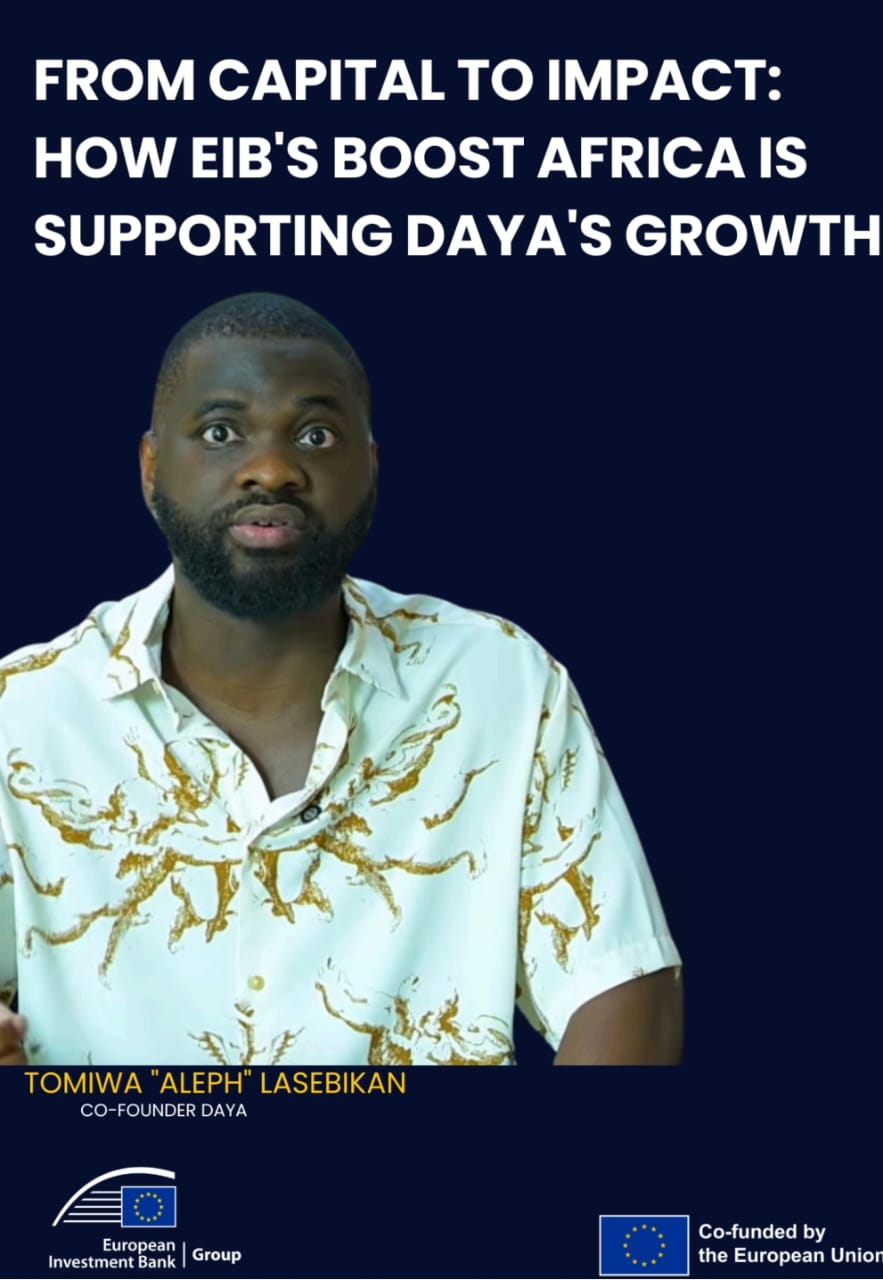
Nigeria’s entrepreneurial potential
deserves investment—and the support to turn ideas into growing businesses.
Through Boost Africa, the European
Investment Bank (EIB), together with the African Development Bank (AfDB) and with EU support, is strengthening entrepreneurship and innovation.
By supporting venture capital investment and providing technical assistance, Boost Africa helps African businesses, including those in Nigeria, access capital, expertise
and networks to grow and reach new
markets.
Meet one of the businesses behind the Boost Africa story. Hear Daya’s
co-founders, Tomiwa “Aleph” Lasebikan, and Paul Joe share the company’s journey and ambition to connect African businesses to global markets.
▶ Watch Daya’s Boost Africa story:
#BoostAfrica #EIB #Entrepreneurship #Nigeria

The African Democratic Congress Presidential Campaign Council (ADC PCC) has dismissed the judgment delivered today by Justice Peter Lifu of the Federal High Court, Abuja, purporting to nullify the leadership of Senator David Mark and Ogbeni Rauf Aregbesola and voiding the nomination of our presidential candidate, Alhaji Atiku Abubakar.
Describing the ruling as an academic exercise that has been overtaken by events, the ADCPCC said its legal team are prepared to appeal the verdict.
The Council maintains that the judgment is of no practical effect and cannot override or displace an existing judgment of a court of coordinate jurisdiction on the same subject matter.
It is important to recall that the same Federal High Court, Abuja, in a judgment delivered by Justice Musa Liman, had already examined the circumstances surrounding the emergence of Senator Mark and Ogbeni Aregbesola and held that the transfer of leadership from Chief Ralph Nwosu to Senator Mark did not violate the provisions of the party’s constitution.
Justice Liman acknowledged that the disputed July 2, 2025 meeting was a stakeholders’ meeting which preceded the National Executive Council (NEC) meeting of July 29, 2025, at which Senator Mark and Ogbeni Aregbesola emerged as National Chairman and National Secretary respectively. The NEC meeting was also monitored by the Independent National Electoral Commission (INEC).
The legal implications of that judgment cannot be wished away. The leadership question has already been subjected to judicial scrutiny by a court of coordinate jurisdiction. It is therefore untenable to suggest that a subsequent pronouncement can simply erase or displace an existing judicial decision without due regard to the principles governing judicial authority and the administration of justice.
The ADC PCC consequently regards today’s ruling as an exercise in futility, particularly as the party’s legal team is taking immediate steps to challenge the decision through the appropriate judicial channels.
Beyond its legal implications, however, the timing of this judgment raises serious concerns. It comes against the backdrop of the failed APC presidential campaign flag-off in Kaduna and the hugely successful and unprecedented ADC presidential campaign flag-off in Sokoto. The contrast is unmistakable: while the ADC is gaining momentum and attracting growing national acceptance, the ruling party appears increasingly unsettled by the prospect of a formidable opposition.
Rather than confront the ADC politically and through the ballot box, the APC appears increasingly desperate to deploy every available instrument to frustrate the opposition and undermine its growing electoral momentum.
It is particularly unfortunate that Justice Lifu has once again become associated with a controversial judicial pronouncement involving the ADC. He is the same judge whose earlier judgment declaring the party deregistered was subsequently set aside by the Court of Appeal.
The Council is also aware of developments surrounding the proceedings, including allegations of pressure and political interference. We consider it imperative that the independence, impartiality and integrity of the judiciary must never be compromised or sacrificed on the altar of partisan political interests.
Let it, however, be clearly understood that no amount of pressure, intimidation or judicial manoeuvring can extinguish the democratic aspirations of millions of Nigerians who have found renewed hope in the ADC.
For the avoidance of doubt, Senator David Mark remains the National Chairman recognised by the party, while Ogbeni Rauf Aregbesola remains its National Secretary. The ADC remains focused, united and resolute in its determination to provide Nigerians with a credible political alternative.
We urge our candidates, members and supporters across the country to remain calm, vigilant and committed to their campaigns. There is absolutely no cause for panic. The party’s leadership remains firmly engaged in addressing the legal and political issues arising from this development.
We call on Nigerians not to be distracted by this judgment but, rather, to draw greater inspiration from the collective struggle to defend multiparty democracy, political pluralism and the constitutional right of citizens to freely choose their leaders.
The ADC legal team is already taking steps to seek appropriate interim relief, including a stay of execution where legally applicable, and will subsequently pursue an appeal against the judgment.
The ADC is not distracted. The campaign continues. The struggle for a better Nigeria remains unstoppable.