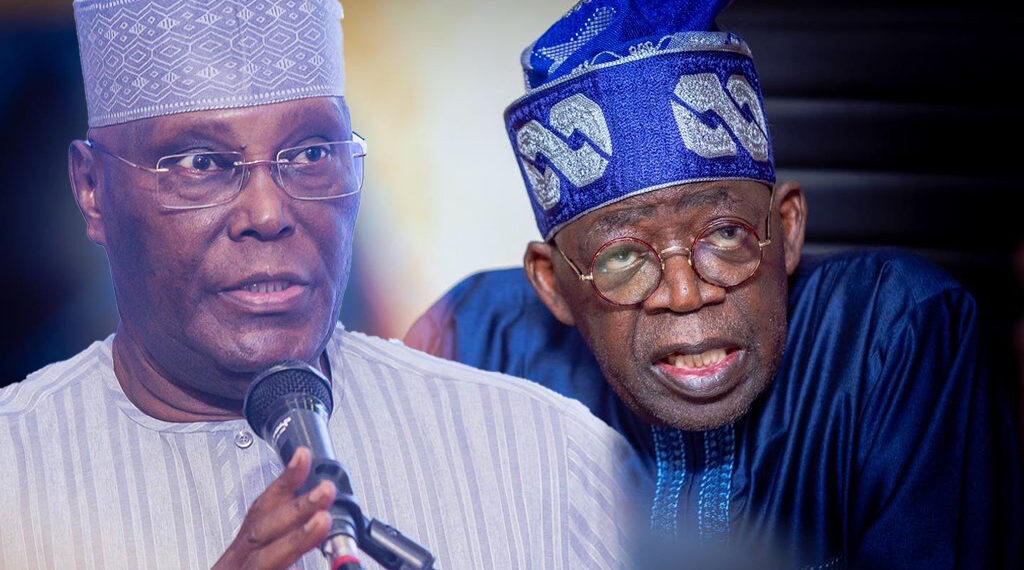
In a bid to establish allegations of forgery and lying on oath against President Bola Tinubu, the Peoples Democratic Party (PDP) presidential candidate in the February 25 poll, Alhaji Abubakar Atiku, has sought the leave of the Supreme Court to bring introduce fresh evidence to prove that Asiwaju Bola Tinubu submitted a forged certificate to the Independent National Electoral Commission (INEC) as requirement to contest the election.
The documents, which Atiku sought on Friday evening to tender are Tinubu’s academic records, which were handed over to him by Chicago State University (CSU) on Monday, October 2, 2023.
The 32-page documents were released to the former Vice President on the orders of Judge Nancy Maldonado of the District Court of Illinois, Eastern Division, Illinois, United States of America (USA).
The US court had ordered the CSU to release the said documents to Atiku despite Tinubu’s objection because the court was convinced that it would help Atiku establish his allegations of forgery and lying on oath against Tinubu, who won the February 25 presidential election.
Atiku had consistently maintained that the issue of forgery and perjury is a serious constitutional matter; hence, the court should order the removal of Tinubu as president.
The PDP presidential candidate predicated his prayers for leave to file fresh evidence on Order 2, Rule 12(1) of the Supreme Court Rules 1985, Section 137(1)O of the Constitution of the Federal Republic of Nigeria, 1999 (as amended), and under the inherent jurisdiction of the Court as granted by Section 6(6)(a) of the Constitution of the Federal Republic of Nigeria, 1999 (as amended).
The application dated October 5 but filed on October 6 specifically prayed the apex court for an order granting him leave “to produce and for the court to receive fresh and additional evidence by way of deposition on oath from Chicago State University for use in this appeal, to wit: the certified discovery deposition made by Caleb Westberg on behalf of Chicago State University on October 3, 2023, disclaiming the certificate presented by the 2nd respondent, Bola Ahmed Tinubu, to the Independent National Electoral Commission”.
Atiku further prayed the Apex Court to “receive the said deposition in evidence as an exhibit in the resolution of this appeal”, as well as any such order or orders the Apex Court may deem fit to make in the circumstances.
The application was predicated on 20 grounds, which, amongst others, claimed that the “deposition sought to be adduced is, along with its accompanying documents, such as would have an important effect on the resolution of this appeal”.
According to the appellant, “the deposition is relevant to this matter, having confirmed that the certificate presented by the 2nd Respondent to the Independent National Electoral Commission (INEC) did not emanate from Chicago State University, that whoever issued the certificate presented by the 2nd Respondent did not have the authority of the Chicago State University, and that the 2nd Respondent never applied for any replacement certificate nor was he issued any replacement certificate by the Chicago State University.
“The deposition, which is on oath and deposed to in the presence of the 2nd Respondent’s Attorney, is credible and believable and ought to be believed. The deposition is clear and unambiguous, and no further evidence is needed to be adduced on it.
“The evidence is such that it could not have been obtained with reasonable diligence for use at the trial, as the deposition required the commencement of the suit in the United States of America before receiving it. It was not possible to obtain the said evidence before the trial at the court below.
“The deposition was made on October 3, 2023, after the conclusion of the trial at the Court below and was not available to be tendered at the trial”.
Atiku, through his lead counsel, Chief Chris Uche (SAN), reminded the Apex Court that “the presentation of a forged certificate to INEC by a candidate for election to the office of President of the Federal Republic of Nigeria is a weighty constitutional matter, requiring consideration by the Courts as custodians of the Constitution”.
Uche stated that the original certified deposition has been forwarded to the Supreme Court in a letter addressed to the Chief Registrar of the Supreme Court.
In a 20-paragraph affidavit deposed in support of the appeal numbered SC/CV/935/2023 with petition number CA/PEPC/05/2023, the deponent, one Uyi Giwa-Osagie, a legal practitioner, stated that the certificate Tinubu presented to INEC in support of his qualification to contest the presidential election was tendered in evidence at the trial and marked as Exhibit PBD1B, and a copy of the same is annexed herein as Exhibit “E”.
Giwa-Osagie added that the same document was tendered at the aforesaid deposition in the United States of America, and at the trial, a certificate obtained from Chicago State University was also tendered in evidence as exhibit PBE4, and a copy thereof is annexed herewith as exhibit “G.”.
“That the deposition is a relevant piece of fresh evidence explaining the status of the certificate the 2nd Respondent presented to INEC in support of his qualification to contest the election.”
Meanwhile, Uche informed the Apex Court that they would be relying on the Record of Appeal already transmitted and “in the well of this Honourable Court, which the Honourable Court is entitled to look at”.
While citing a plethora of cases, the senior lawyer said, “My Lords, we most humbly adopt the facts as presented in the supporting affidavit, and the same will be referred to in the course of the argument”.
Besides, Uche submitted that the Supreme Court has the power, jurisdiction, and discretion to grant an application for adducing fresh or additional evidence on appeal.
Order 2 Rule 12(7), (2), and (3) of the Supreme Court Rules provide as follows: “A party who wishes the Court to receive the evidence of witnesses (whether they were or were not called at the trial) or to order the production of any document, exhibit, or other thing connected with the proceedings in accordance with the provisions of Section 33 of the Act shall apply for leave on notice of motion prior to the date set down for the hearing of the appeal.
“The application shall be supported by an affidavit of the facts on which the party relies for making it and of the nature of the evidence or the document concerned.
“It shall not be necessary for the other party to question the additional evidence intended to be called, but if leave is granted, the other party shall be entitled to a reasonable opportunity to give his own evidence in reply if he so wishes.
“My Lords, we submit that the requirements for the grant of applications to adduce fresh or additional evidence on appeal have been established by this Honourable Court in a plethora of cases, and they are as follows:
“It must be shown that the evidence sought to be adduced in evidence could not have been obtained with reasonable diligence for use at the trial.
“The fresh evidence must be such that if given, it would probably have an important effect on the result of the case, although it need not be decisive, and the evidence must be such as is presumably to be believed; in other words, it must be apparently credible”.
According to Uche, from cases already decided by the apex court, it could be seen that there is only one single requirement, which is the need to do justice fairly, equitably, and justly.
“We humbly submit that the grant of the present application will certainly be in furtherance of the course of justice in this matter. This is a case in which the 2nd Respondent was purportedly returned as the winner of the said election to the office of the President of the Federal Republic of Nigeria, and the Appellants/Applicants have, amongst other grounds, challenged the election of the 2nd Respondent on the ground of his qualification to contest the said election and more especially on the basis that the 2nd Respondent presented a forged document to INEC.
“The appellants and applicants have also, in their appeal, challenged the striking out of their pleadings, raising the issue of the qualification of the second respondent to contest the said election.
“The evidence required to establish that the certificate presented by the 2nd Respondent to the 1st Respondent in support of his qualification to contest the said election is the deposition from Chicago State University, which deposition did not become available until after the determination of the case by the lower Court.
“The said evidence is now available and forwarded to this Honourable Court. We submit that the appellants and applicants have successfully explained the delay and difficulties in obtaining the said evidence earlier than now and all the necessary steps taken to obtain the evidence and to present the same to this Honourable Court.
“We submit that a successful proof of the said allegation will render the 2nd Respondent unqualified to have contested the said election ab initio for presentation of a forged certificate to the Independent National Electoral Commission (INEC) pursuant to the provisions of Section 137(1)(j) of the Constitution, being a weighty matter of constitutional importance,” he said.
He added that the Supreme Court had, in the case of Saleh vs. Abah (2017), held that “the intention of the Constitution is that anyone who has presented a forged certificate to INEC should stand automatically disqualified for all future elections if, as in this case, a court or tribunal finds the certificate to have been forged, and it matters not whether or not such fact is further fraudulently or desperately concealed in subsequent elections or declaration forms.
“No decent system or polity should condone or, through judicial policy and decisions, encourage the dangerous culture of forging certificates with impunity to seek electoral contests.”.
While submitting that “a weighty constitutional issue as the one raised in this matter is akin to a jurisdictional issue which is so fundamental and important that it can be raised at any time and in any manner in the course of the proceedings or on appeal,” Uche said and urged the apex court to “resolve this issue in favour of the appellants or applicants and grant this application,”.
Meanwhile, no date has been fixed for the hearing of the motion by the Supreme Court.