
Personality in Focus
Dangote Increases in Wealth, Ranks World’s 86th Wealthiest Person

- /home/rhoncare/pointblank.ng/wp-content/plugins/mvp-social-buttons/mvp-social-buttons.php on line 27
https://pointblank.ng/wp-content/uploads/2019/05/Dangote.jpeg&description=Dangote Increases in Wealth, Ranks World’s 86th Wealthiest Person', 'pinterestShare', 'width=750,height=350'); return false;" title="Pin This Post">
- Share
- Tweet /home/rhoncare/pointblank.ng/wp-content/plugins/mvp-social-buttons/mvp-social-buttons.php on line 69
https://pointblank.ng/wp-content/uploads/2019/05/Dangote.jpeg&description=Dangote Increases in Wealth, Ranks World’s 86th Wealthiest Person', 'pinterestShare', 'width=750,height=350'); return false;" title="Pin This Post">
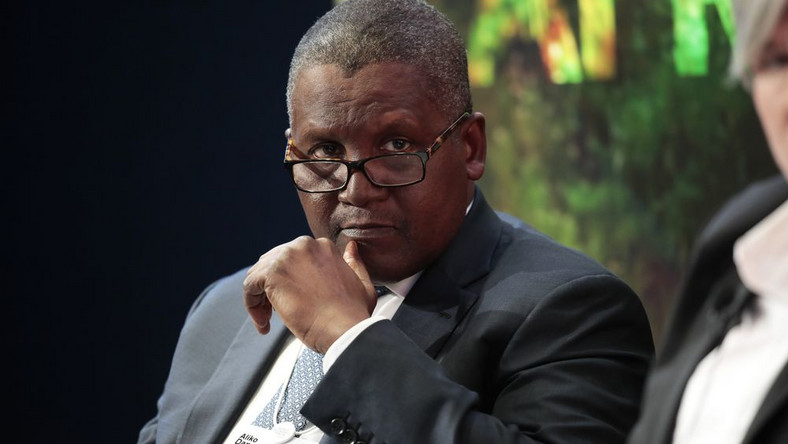
Billionaire Aliko Dangote has seen his wealth nearly doubled to $23.9 billion, according to Forbes, which ranks the Nigerian entrepreneur as the wealthiest person in Africa and 86th in the world. Forbes had ranked Aliko Dangote as the 144th richest person in the world in 2024 with $13.4 billion. Forbes estimates Dangote’s net worth at $23.9 billion, primarily due to his 92.3 percent stake in Dangote Petroleum Refinery & Petrochemicals.
At 67 years old, Dangote is once again one of the top 100 richest individuals worldwide, a position he has not held since 2018, according to the Forbes Real-Time Billionaires List.
This places him significantly ahead of South African Johann Rupert, who is ranked 161st in the world with an estimated wealth of $14.4 billion and far above Mike Adenuga, who is the second richest in Nigeria and 481st in the world, with a net worth of $6.8 billion.
Dangote disupted the government’s oil monopoly by building the largest Petroleum Refinery in Africa.
After 11 years, a $23 billion investment, and numerous challenges, the Dangote Refinery began operations last year.
Located on a vast 6,200-acre site in the Lekki Free Zone, the refinery, at full capacity, will process a remarkable 650,000 barrels per day (b/d), making it the seventh-largest refinery in the world and the largest in Africa.
Additionally, the refinery’s adjacent petrochemical complex has an annual production capacity of 3 million metric tons of urea, making it Africa’s largest fertiliser producer.
The Dangote Refinery is already having a significant impact on global energy markets. Imports of petroleum into Nigeria are on track to reach an eight-year low, affecting European refiners that have traditionally sold to Nigeria, according to energy intelligence firm Vortexa.
Furthermore, Nigeria has become a net exporter of jet fuel, naphtha (a solvent used in varnishes, laundry soaps, and cleaning fluids), and fuel oil, according to S&P Global.Dangote sees the refinery as part of a larger vision to transform Nigeria, one of the world’s largest crude oil producers, into a major producer of refined petroleum products.
This would enable Nigeria to compete with European refineries and supply gasoline to Nigerian consumers“I want to provide a blueprint for industrialisation across Africa,” Dangote says in an interview with Forbes.
“We have to build our nation by ourselves. We have to build our continent by ourselves, not [rely on] foreign investment.”
He believes Africa has long been “a mere dumping ground for finished products,” and his refinery represents “a pivotal step in ensuring that Africa can refine its own crude oil, thereby creating wealth and prosperity for its vast population.
”Dangote said the refinery is the biggest risk of his life and without success, it would have affected him greatly.
“It was the biggest risk of my life,” says Dangote about his decision to embark on the project. “If this didn’t work, I was dead.
Zainab Usman, director of the Africa Programme at the Carnegie Endowment for International Peace, according to Forbes, said Nigerians see Dangote as a hero and a real industrialist transforming the country.
He is seen in most parts of Nigeria as a hero. He is seen as a real industrialist who builds things,” she said.
A professor of African studies at the Soka University of America, Chika Ezeanya, also corroborated this view, noting that Dangote is meeting the needs of consumers on the continent.
“I think he’s believed staunchly in the fact that Nigerians need products that he has to offer,” he said while adding: “Governments can come and go, policies can be changed, but the needs of the Nigerian consumer will only grow and expand.”


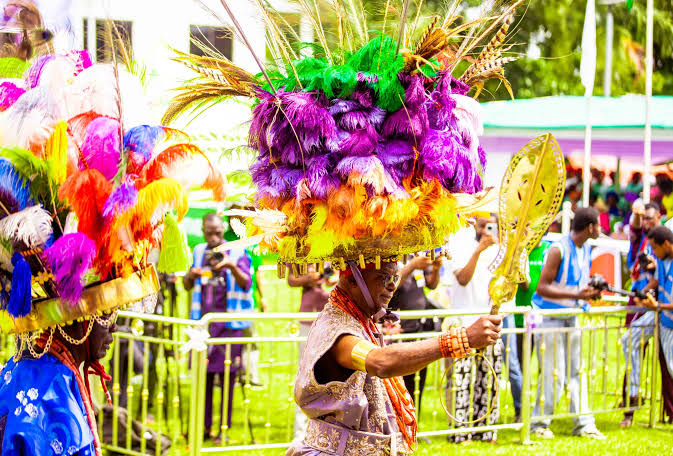
The Obi of Onitsha, His Majesty Igwe Alfred Nnaemeka Achebe, has commended Globacom for its unwavering commitment to the preservation and promotion of Nigeria’s cultural heritage, noting that the telecommunications company’s sustained support has helped transform the Ofala Festival into a world-renowned cultural celebration.
Speaking on the 2026 edition of the festival, held at Ime Obi, Onitsha, Anambra State, on Friday, the monarch paid a glowing tribute to Globacom for its longstanding role as the principal sponsor of the festival, a partnership that has spanned fifteen consecutive years since 2011.
According to the monarch, “Their partnership has transformed the festival from a palace ritual to a world-renowned cultural festival owes a great deal to purposeful partnership. Since 2011, Globacom has stood with us as our principal partner – now fifteen consecutive years of unwavering commitment.” He added that “In good times and challenging times, Globacom has helped us preserve the authenticity of Ofala while enhancing its presentation, documentation, broadcast and global reach. They have helped take a living heritage to the global stage”.
Igwe Achebe also applauded the vision of Globacom’s Chairman, Dr Mike Adenuga Jr., whose commitment to cultural preservation, he noted, reflects a profound appreciation of the role of indigenous traditions in strengthening national identity and social cohesion.
“I thank Globacom and its Chairman, Otunba (Dr) Mike Adenuga Jr., GCON, a true man of culture, for his vision and belief that culture is not a luxury but a foundation for unity,” the monarch said.
Commenting on the theme of this year’s festival, “Igba Mbo, Iga N’Iru” — Strive and Advance — Igwe Achebe described it as a compelling call to diligence, excellence, self-improvement and collective progress. He explained that the theme embodied the enduring spirit of the forebears who built the Onitsha kingdom on the banks of the Niger, while challenging younger generations to preserve that legacy through enterprise, purposeful endeavour and a commitment to progress.
In his goodwill message to the monarch and the people of Onitsha, Dr Adenuga described Globacom’s association with the Ofala Festival “since 2011 has been much more than a corporate partnership. It has been a relationship which we cherish deeply and regard as a privilege”. He expressed profound appreciation to Igwe Achebe for the opportunity afforded Globacom to contribute to the preservation, celebration and wider projection of the community’s priceless cultural heritage.
He noted that the annual festival provides a valuable platform for showcasing the rich cultural traditions, dignity and enduring values of the Onitsha people to audiences across Nigeria, Africa and the wider world.
Through its longstanding partnership with Ofala, Globacom continues to demonstrate that corporate citizenship extends beyond commercial enterprise to the preservation of the cultural foundations that give communities their identity, strengthen their unity and connect generations.
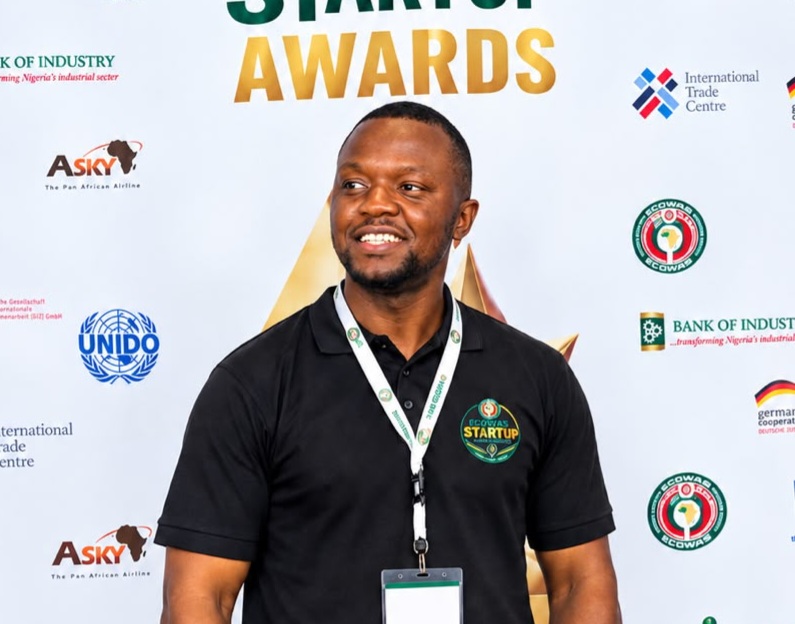
Kardinal Business Travel, a travel technology company with African and global focus, was among 60 startups that pitched at the 2nd edition of the Economic Community of West African States (ECOWAS) Startup Awards, held at the ECOWAS Commission headquarters in Abuja recently.
The company’s Chief Executive Officer and Founder, Cornelius Ugwunwa, presented the company’s case at the three-day event. The awards was part of an ECOWAS initiative to help West African businesses and startups scale through digital transformation, regional integration and sustainable value chains, with the aim of widening access to global markets.
Temitope Kareem, founder of Nigerian healthtech firm HubPharm Africa, won the top prize of $30,000. Senegal’s Gaynako took home $20,000 as first runner-up, while Steve Bah Blesson’s MyOpinion from Côte d’Ivoire won $15,000 as second runner-up.
Speaking during his pitch, Ugwunwa said Africa needs a new system for business travel. He cited a market with $75 billion in inbound travel spending and a strong business travel component in 2025, while travel and tourism as a whole contributed $228 billion to the regional economy.
“When a company sends its employees across Africa for a business engagement, we at Kardinal noticed the challenges of countless inboxes, spreadsheets and emails, mostly after the trip.
Businesses keep asking: How much did we spend? Who did we spend it on? Was it above or below budget? Can we reconcile everything on one platform?” he said.
He described African business travel as a $30 billion market that is largely fragmented and overly dependent on manual processes.
According to him, many businesses lose over $1 billion to manual travel processing and cannot track spending in real time. “That is why Kardinal exists: to solve this entrenched problem,” he said.
Ugwunwa said GoKardinal is an artificial intelligence-driven platform built to track expenses for African businesses. It brings the entire business travel lifecycle (planning, budgeting, booking, financing and expense tracking) onto one platform, in real time.
“GoKardinal is not another travel platform. It is an infrastructure for business travel, powered by AI for expense management,” he said, adding that the idea is to help businesses move without delay from one location to another to do their best work, expand and make profit.
On the company’s performance, he said the platform serves over 51 businesses in Nigeria and across Africa, with estimated weekly profit of $10,000 and gross merchandise value of over $1 million, growing at 65 per cent annually. he added.
He noted that about 80 per cent of African businesses still run their business travel manually, without any form of expense tracking, in a market worth over $30 billion annually. “African business travel is not just travelling for the fun of it.
It is an ecosystem with the potential to generate over $70 billion when digitalised,” Ugwunwa said.
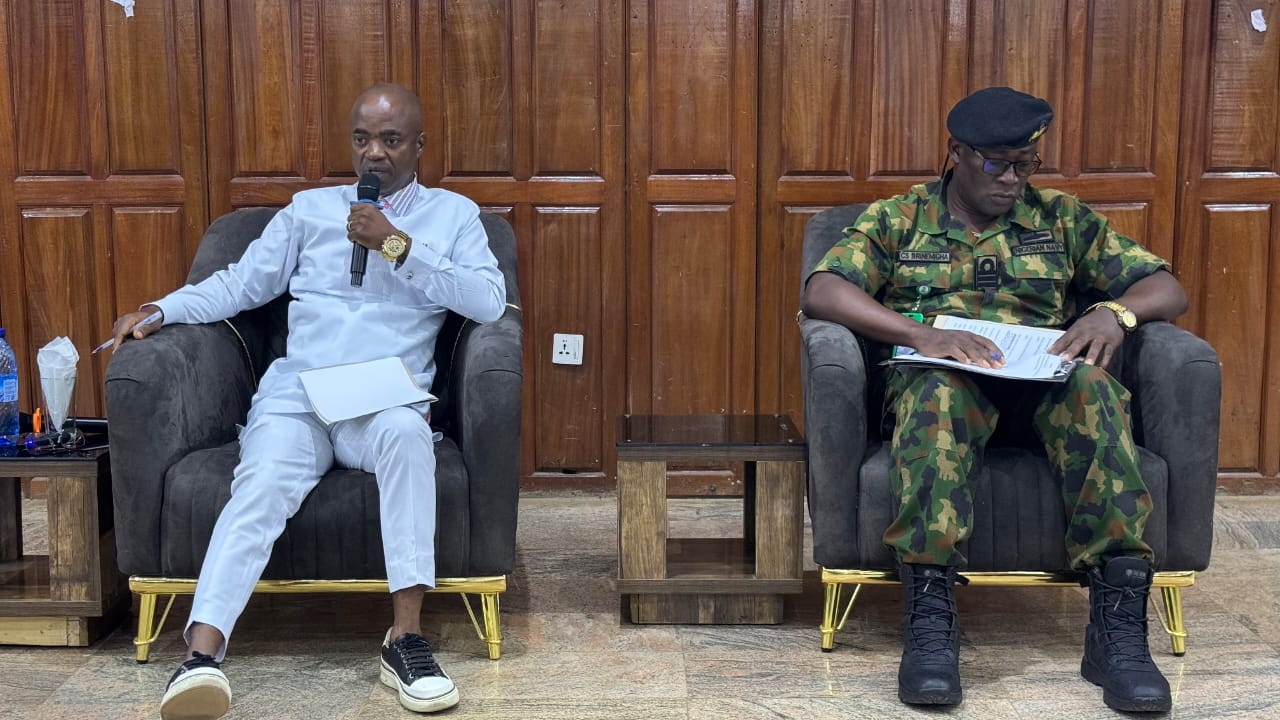
The President of Security Resources & Risk Management Academy, Lagos, Mr. Matthew Ibadin, has charged officers of the Nigerian Armed Forces and allied nations to practice emotional discipline, warning that unmanaged anger remains a greater threat to a Staff Officer than the enemy.
Ibadin, who is also a doctoral researcher at the Nigerian Defence Academy (NDA) and University of Abuja, stated this on Monday while delivering a lecture on “Emotional Discipline Under Pressure and Anger Management for Staff Officers” to participants of Senior Course 48 at the Armed Forces Command and Staff College (AFCSC), Jaji, Kaduna.
The lecture was attended by 436 officers comprising the Nigerian Army, Nigerian Navy, Nigerian Air Force and officers from eight friendly nations.
Describing anger as “a temporary madness that leaves a permanent record,” Ibadin warned officers that “the line between a respected officer and an inmate is thinner than you can imagine.”
“Anger may enter the room, but must never take command,” he said.
The Lion Principle
Illustrating his point with the parable of the lions, Ibadin noted that while both male and female lions roar, the female roars only when necessary and lives 15-18 years compared to 10-12 years for the male.
“She lives longer not because she is weaker, but because she is more disciplined. Many of us have become male lions in uniform – fighting juniors, spouses, traffic, minor disagreements even when no real threat exists. That constant agitation slowly destroys what you have built,” he said.
He therefore charged officers to “be a female lion in strategy and a male lion only when tactically necessary.”
Five Battlefields Where Anger Destroys
Ibadin identified five battlefields where undisciplined anger destroys officers: Health, Home Front, Office and Command, Career and Prison, and Relationships.
On health, he described anger as a silent killer that triggers hypertension, stroke and cardiac arrest, noting that many officers survive the war front but do not survive peacetime.
“At Jaji, your rank commands respect, but at home your rank is irrelevant. If you win at the office and lose at home, you have lost. An officer whose home is under emotional fire cannot think clearly at the command post,” he cautioned.
He warned that signatures appended in anger to operational orders, procurement papers and personnel assessments could lead to Boards of Inquiry, career ruin and mission failure.
He added that 70 percent of inmates in correctional centres for murder never planned to kill, but acted in a moment of unmanaged anger.
Practical Tools
Ibadin introduced practical tools including the 90-Second Rule and the S.T.O.P Protocol – Stop, Take a Breath (4-4-4), Observe, and Proceed with Discipline – for decisions under pressure.
He adopted Aristotle’s five tests for disciplining anger: Right Person, Right Reason, Right Time, Right Degree, and Right Manner.


