
Metro
Guber, Assembly Polls: We’ve Put in Place Robust Security Arrangements – NSCDC


Ahead of the March 18, 2023 gubernatorial and House of Assembly elections, the Nigeria Security and Civil Defence Corps (NSCDC) has assured Nigerians of a strengthened security network to ensure that the Independent National Electoral Commission (INEC) conduct a free and fair election.
The Corps gave this assurance in a statement signed by the Director of Public Relations, CC Olusola Odumosu, and made available to the National Association of Online Security News Publishers (NAOSNP).
The statement noted that following the review, analysis, and processing of reports and observations from the field on the Presidential and National Assembly elections held on the 25th of February, 2023, the management of the Nigeria Security and Civil Defence Corps (NSCDC), has put in place a robust security arrangement geared towards the success of the forthcoming governorship election.
The tightened security approach, according to the statement, is to ensure that the Independent National Electoral Commission (INEC) staff, election materials and citizens are secured during the elections.
In his remarks, the NSCDC Commandant General, Dr Ahmed Abubakar Audi, mni, OFR, while addressing some personnel ready for deployment to states for the elections, said that efforts to curb disruption of the voting process necessitated the deployment of personnel to old and newly discovered flashpoints.
“Ensure the protection of critical national assets and infrastructural domains where vandalism of public utilities frequently occurred,” he ordered.
He affirmed that the already deployed 102,000 officers and men who had been properly trained in regimentation, crowd control, arms bearing and election management techniques are to ensure full security coverage of the election.
He further assured that the Corps will continue to work with members of the public to obtain credible information to nip criminal activities in the bud before, during and after the election.
Audi charged all personnel on election duty to observe the rules of engagement and get themselves acquainted with the Standard Operating Procedure (SOP), code of ethics, and the electoral law as amended.
He warned against any form of misconduct, compromise, or accidental discharge as such acts are unpardonable under his administration.
“You must be professional, apolitical, and non-partisan, respect the fundamental human rights of the citizens, and avoid Intimidation and harassment of voters.
“Personnel must respect fundamental human rights of citizens, protect voters against political thugs, arrest vote buyers, election fraudsters.
“You are to ensure the obedience of law and order, be good ambassadors and maintain the integrity of the system,” CG said.
The Corps helmsman reiterated the need for continuous partnership with the police and other security agencies involved in election security duties, advising them to avoid unnecessary confrontation but to handle misunderstandings (in case of any) with maturity.
Audi warned mischief makers who may intend to perpetrate violence to take lessons from the last Presidential and National Assembly election where many political thugs lost their lives while snatching ballot boxes amongst other electoral crimes
He urged personnel to attract only good comments to the service with their conducts and performances during the polls as anyone found wanting will not be spared and assured those yet to receive the second tranch of the election allowance to exercise patience as glitches in the network is seriously affecting most financial transactions.
“Except for those who supplied wrong account details, and some network glitches, many personnel had received the second credit alerts,” CG informed.


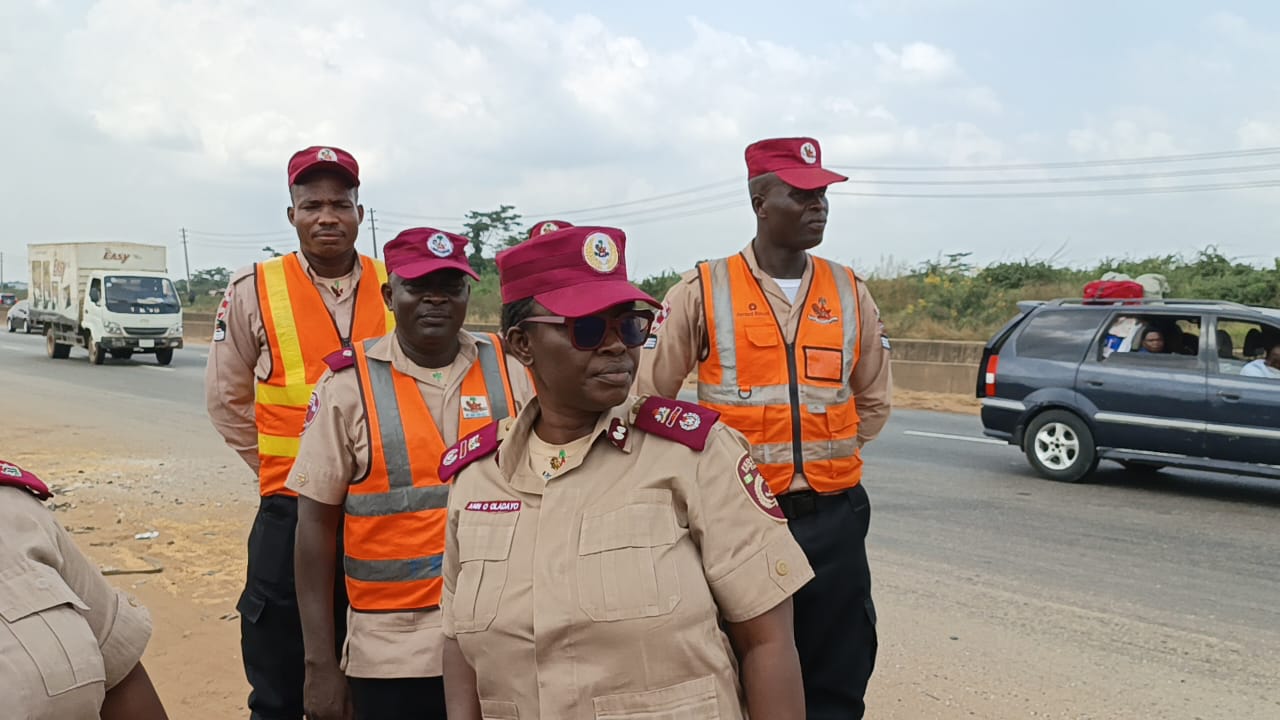
Following the fatal crash on the Lagos–Ibadan Expressway in Ogun State involving world-renowned boxer, Anthony Joshua and his team, the Zonal Commanding Officer (ZCO) of the FRSC RS2 Lagos Zone, Assistant Corps Marshal, ACM Ann O. Oladayo, on Tuesday conducted an on-the-spot assessment of the accident scene, even as the incident has generated widespread public interest and conflicting reports, the National Association of Online Security News Publishers (NAOSNP), can report
Speaking with pressmen during the assessment visit, ACM Oladayo said the inspection was necessary to establish the true facts, noting that some FRSC operatives were already present at the corridor when the crash occurred yesterday. “A lot of reports are out there, but we decided to come for an eyewitness account because some of our operatives were here when it happened. We needed to ascertain what actually occurred,” she said.
According to the FRSC, preliminary findings from eyewitnesses revealed that a trailer conveying soya beans was properly parked off the road, waiting to be offloaded, when a speeding vehicle conveying popular international boxing champion, Anthony Joshua and his friends ran into it. “From what we gathered, the truck was not on the road. It was waiting to be offloaded and was well off the carriageway when the vehicle ran into it,” Oladayo explained.
She dismissed claims that the FRSC failed to respond promptly, stressing that the Corps arrived at the scene within minutes. “Immediately we heard of the incident, we were here in under three minutes. Our priority was rescue. Unfortunately, we lost two lives, but the injured were rescued and taken for medical attention,” she said.
The Zonal Commander added that suspected over-speeding and possible wrongful overtaking were being investigated as likely causes of the crash, noting that the impact force which pulled out the trailer’s tyres suggested excessive speed. “On this highway, the speed limit is 100km/h. From the impact, it is likely that the vehicle exceeded that limit. Investigation is still ongoing,” she stated.
An eyewitness, Yusuf Ajala Oluwaseun, who was at the scene when the crash occurred, blamed persistent speeding along the highway. “We just heard a loud boom. At first, we thought it was a tyre burst. People overspeed a lot on this road. Just last week, an 18-seater bus speeding here hit a man and overturned. FRSC came and rescued the victims,” he said.
Another eyewitness, Sodiq Ayo, confirmed the swift arrival of emergency responders of FRSC and described the moments after the crash. “I heard a sound and came out. People were shouting that someone was still inside the Jeep. When we realised it was Anthony Joshua, everyone gathered, a lot of people were doing video of Anthony Joshua. But before people arrived fully, FRSC came and rescued them,” he recounted.
The FRSC Zonal Commander, Oladayo noted that the damaged trailer has been moved to its facility using a heavy-duty tow truck, while the SUV involved in the crash is currently in the custody of the Ogun State Police Command, as investigations continue. She used the opportunity to caution motorists to plan their journeys properly, avoid over-speeding and reckless overtaking, and ensure their vehicles are roadworthy before travelling.
The Corps reaffirmed its commitment to rapid emergency response and road safety enforcement.

The operatives of Ondo State Security Network Agency aka Amotekun Corps, have arrested 39 suspected terrorists who allegedly fled Sokoto State following the “powerful and deadly” United States airstrikes targeting militants linked to the Islamic State (IS) group in North-western Nigeria.
The Commander of Amotekun Corps in Ondo State, Adetunji Adeleye, disclosed this on Tuesday in Akure while parading a total of 61 suspects apprehended across various parts of the State during the Yuletide period.
According to Adeleye, the 39 suspects claimed during interrogation that they escaped from Sokoto State and moved towards the South-West in the aftermath of the airstrikes.
“These 39 suspects themselves claimed they fled from the Sokoto area,” he told journalists.
He said the suspects, aged between 18 and 45 years, are currently undergoing profiling, adding that those found in possession of incriminating materials would be prosecuted according to the law.
Mr Adeleye further revealed that the Amotekun corps has intensified patrols and strengthened collaboration with sister security agencies, particularly along border communities linking Ondo State with Ekiti, Osun, Ogun, Edo, and Kwara states.
Giving a breakdown of the arrests, the Amotekun commander said that out of the 61 suspects paraded, 50 were arrested for various breaches of law and order, two for offences related to anti-open grazing laws, six for kidnapping-related crimes, while three were arrested for gender-based violence and rape.
He explained that the ember months patrol would officially end on Tuesday, but assured residents that security operations would not be relaxed, as Operation Le Jade Phase Two is scheduled to commence on January 1.
Adeleye added that the Amotekun Corps has also increased its 24-hour surveillance across the state, with the deployment of Amotekun Rangers to forest reserves.
He attributed the numerous arrests to sustained and coordinated efforts by officers and men of the Amotekun Corps to rid the state of criminal elements.
While commending Governor Lucky Aiyedatiwa for providing an enabling environment for effective security operations, Adeleye said the state government has continued to support security agencies without hesitation.
He also lauded the Nigeria Police, the Nigeria Security and Civil Defence Corps, the Nigerian Army, the Department of State Services (DSS), vigilante groups, and members of the public for their cooperation.
Providing details of some arrests, Adeleye said two suspects – Mustafa (34) and Philip (45) – were apprehended for kidnapping around the Ofosio area of Odigbo Local Government Area.
“In the Isua-Akoko axis, three suspects identified as Idris (18), Ibrahim Abdullahi (20), and Lawal Idris (23) were also arrested for alleged criminal activities.
On rape and assault cases, he disclosed that Daniel Ojo (19), Usman (33), and Bejide (41) were arrested in Isinkan for rape and for assaulting Amotekun officers.
“The corps also arrested suspected armed robbers identified as Ola Tunbosun (30), Ibrahim, and Shahidu in Akure North, Oba-Akoko, and Oba-Ile.
“The suspects were allegedly part of a robbery gang that recently stole a vehicle in Akure, with plans to transport it to Abuja for sale. The stolen vehicle, as well as a taxi reportedly used to rob unsuspecting passengers, were recovered and displayed during the parade,” he said.
Adeleye explained that the gang’s modus operandi involved operating in densely populated areas, picking up passengers, introducing another gang member as an extra passenger, and then using a firearm to dispossess victims of their belongings before pushing them out of the vehicle.
He advised members of the public to remain vigilant, particularly when boarding taxis without proper markings or readable registration numbers.
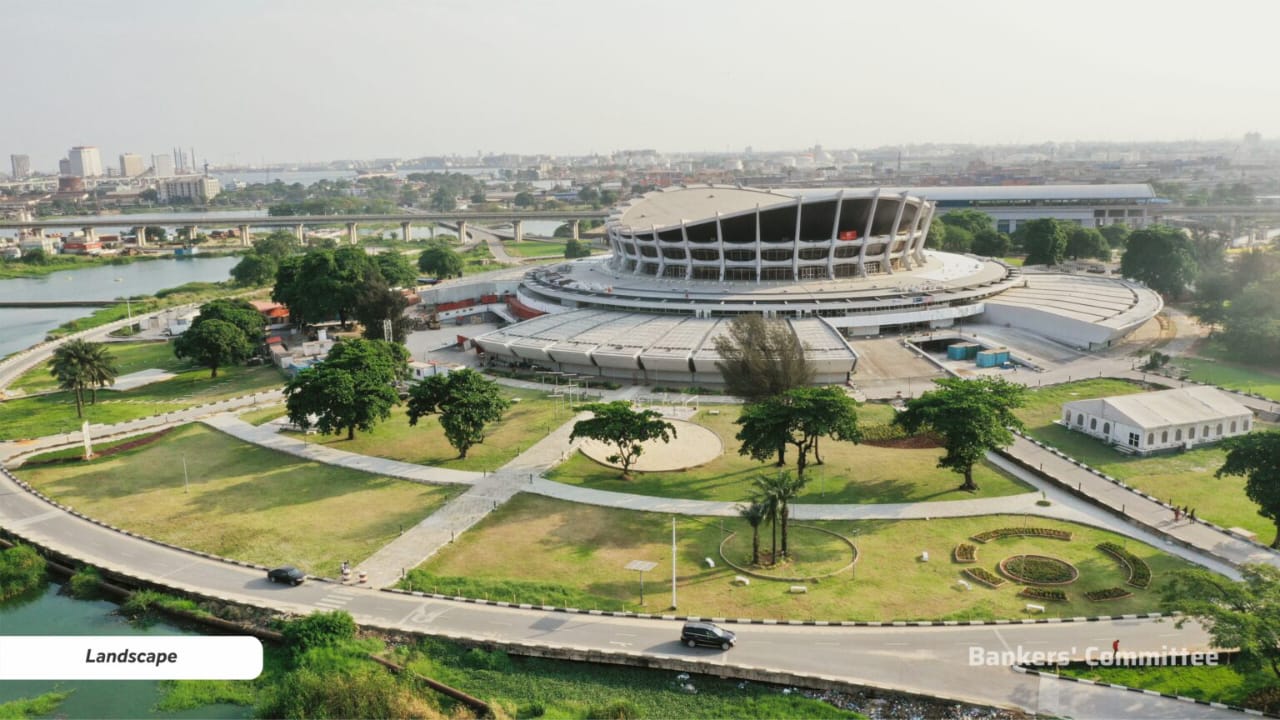
When the National Theatre Lagos first opened ahead of FESTAC ’77, an architectural marvel, a symbol of the cultural soul of a nation ready to introduce its artistic brilliance to the world. Modelled after the Varna Palace of Culture and Sports in Bulgaria and constructed between 1973 and 1976, the National Theatre was designed as an emblem of Nigeria’s ambition to be Africa’s cultural capital. Its 5,000-seat main hall, festival arena, exhibition spaces, and state-of-the-art acoustics made it one of the most sophisticated performance complexes on the continent.
Throughout the 1970s and 1980s, the Theatre became home to Nigeria’s most iconic productions, from Hubert Ogunde’s epic plays to international dance festivals, orchestral performances, film premieres, and global conferences. It was a beacon for African creativity, a place where culture, identity, music, and storytelling came alive. But by the early 2000s, the Theatre, though heavy with cultural memory, had fallen into disrepair. Years of inadequate maintenance, stalled concession agreements, and structural depreciation left the building struggling to meet modern technical and creative demands. The symbol of national pride had become a shadow of its past promise.
Recognising the scale of cultural loss and the opportunity embedded within it, the Bankers’ Committee, with Access Bank playing a pivotal role, initiated the largest cultural infrastructure revitalisation project in contemporary Nigeria. The decision was both strategic and patriotic: Nigeria’s creative industry, now contributing significantly to GDP through film, fashion, music, design, cultural tourism, and digital content, urgently needed a modern, centralised hub that could support global-standard production and creative entrepreneurship. Reviving the National Theatre would not only restore a national icon but also stimulate job creation, attract international collaborations, and reposition Lagos as a premier African creative economy hub.
The renewal of the National Theatre is therefore more than a restoration project; it is a necessary economic intervention, a cultural renaissance, and a visionary step toward building a more inclusive and future-ready Nigeria. And for Access Bank, supporting this transformation is a natural continuation of a long, deliberate commitment to art, culture, and creative empowerment.
Access Bank’s Legacy of Championing the Creative Economy
Well before Nigeria’s creative industry gained global recognition, Access Bank had positioned itself as a cultural investor and ecosystem builder. For over a decade, the Bank has supported transformational initiatives across music, visual arts, fashion, film, sustainability, and youth development.
Access Bank has helped spotlight emerging and established African artists on a global stage through partnerships and collaborations with platforms like ART X. The annual fair, now one of Africa’s most influential contemporary art events, has benefitted immensely from the Bank’s commitment to nurturing young talent, commissioning bold projects, and providing a meeting point for creators, collectors, and global art enthusiasts.
In film and entertainment, Access Bank has backed festivals, documentaries, youth-focused storytelling, and creative incubators, recognising that Nigeria’s cultural exports are among its most powerful global assets. Across literature, community theatre, design, and public art, the Access brand remains synonymous with innovation, creativity, and cultural elevation. The revival of the National Theatre is thus an extension of this commitment.
A Cultural Renaissance Rooted in National Development
The National Theatre project is designed as a two-phase undertaking. Phase One, already significantly advanced, focuses on restoring the original theatre structure. This includes upgrading the main stage, cinema halls, exhibition spaces, lighting systems, acoustics, seating, ventilation, and accessibility infrastructure. The goal is to return the iconic building to world-class functionality while preserving its historic architecture.
Phase Two introduces a modern Creative Industries Park, a multi-purpose development designed to house film production studios, music recording labs, fashion houses, IT and gaming centers, photography studios, coworking spaces, and training academies. This innovation hub is expected to host thousands of young creators annually, enabling them to produce, learn, collaborate, and scale ideas into globally competitive businesses.
With Access Bank’s involvement through the Bankers’ Committee, the project has attracted international partnerships, institutional investors, technical specialists, and creative collaborators. It is poised to become one of the most significant cultural and economic catalysts in West Africa.
In a world where creative exports have become a major source of national influence, from Nollywood films to Afrobeats, digital arts to global fashion, infrastructure is destiny. Nigeria’s young creators generate some of the world’s most consumed cultural content, yet the ecosystem has lacked the physical and institutional support systems needed to harness that potential fully.
The revitalised National Theatre is therefore a launchpad for Nigeria’s next creative era.
With Access Bank’s long-standing commitment to empowering Africa’s creative industries, the revival blends heritage with innovation, history with ambition, and art with economic development.
From art fairs to creative hubs, sustainability initiatives to youth empowerment, Access Bank continues to champion platforms that inspire, educate, and elevate communities across the country.
By supporting the transformation of the National Theatre, the Bank has once again placed itself at the heart of Nigeria’s cultural renewal, bridging past and future, preserving heritage, and building an ecosystem where creativity can thrive without limits.


