
Opinion
IGP Abubakar Adamu: Two Years of a Visionary Cop Redefining Policing

- /home/rhoncare/pointblank.ng/wp-content/plugins/mvp-social-buttons/mvp-social-buttons.php on line 27
https://pointblank.ng/wp-content/uploads/2019/04/IGP-Adamu-1000x600.png&description=IGP Abubakar Adamu: Two Years of a Visionary Cop Redefining Policing', 'pinterestShare', 'width=750,height=350'); return false;" title="Pin This Post">
- Share
- Tweet /home/rhoncare/pointblank.ng/wp-content/plugins/mvp-social-buttons/mvp-social-buttons.php on line 69
https://pointblank.ng/wp-content/uploads/2019/04/IGP-Adamu-1000x600.png&description=IGP Abubakar Adamu: Two Years of a Visionary Cop Redefining Policing', 'pinterestShare', 'width=750,height=350'); return false;" title="Pin This Post">
By Ayo Ogunsan
“Nothing in the world is worth having or worth doing unless it means effort, pain, difficulty… I have never in my life envied a human being who led an easy life. I have envied a great many people who led difficult lives and led them well.” — Theodore Roosevelt
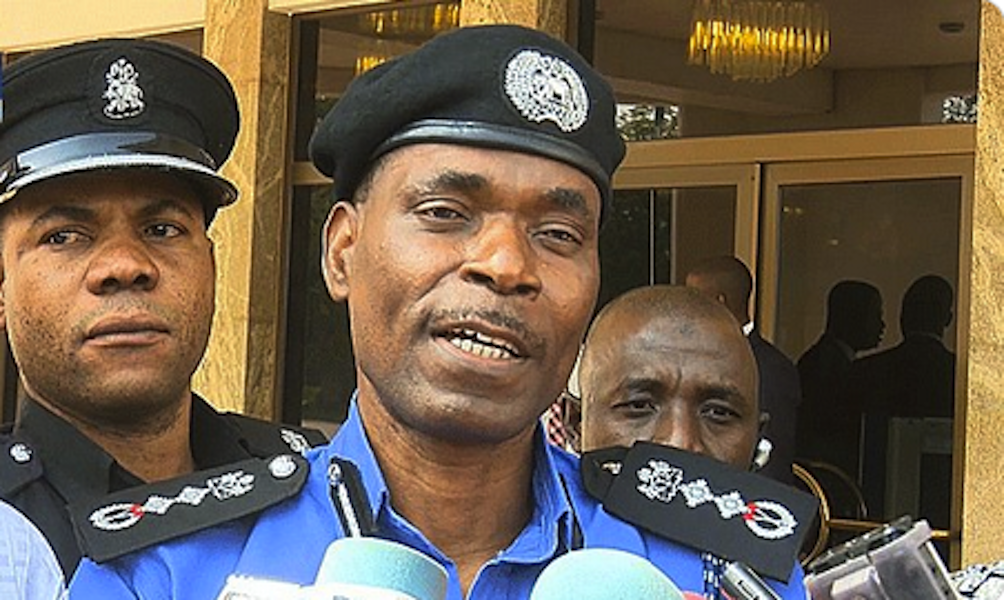
When you think of a selfless police cop with a touch of finesse and pulchritude, you probably have the current IGP in mind. Alas! That is IGP Mohammed Abubakar Adamu, the perfect gentleman of a police officer who hails from Lafia, in Nasarawa State.
Necessitating his appointment is the fact that Adamu Mohammed had risen through the ranks of international policing in Lyon, France, where he became the Vice President of the International Criminal Police (Interpol) – a position he assumed for years, with sterling performance.
The 59-year old Adamu resumed office on January 15, 2019, having been appointed by President Muhammadu Buhari as a replacement for Ibrahim Kpotun Idris (rtd).
Born on September 17, 1961 and enlisted into the Nigerian Police Force in 1986, after graduating from the Ahmadu Bello University, Zaria with a Bachelor’s Degree (Hons) in Geography, he displayed more love for erudition and pedagogy when he went ahead to bag a Master’s Degree in International Criminal Justice System from the University of Portsmouth, England.
Perhaps it seems plausible to say that the effective management of the security resources of the country is another feather to the cap of the 59-year old officer who continues to do his best in the area of fighting banditry and kidnapping, thereby safeguarding our democracy. This act, to a large extent, pays a tribute to resilience and determination in public service.
Of all men there are, Adamu has redefined 21st century policing through institutionalising the ideals and tenets of democratic police networks. Such a fine character must be allowed to continue, even if it means to be begged to continue.
Under his watch, in a space of six months, the Nigerian Police Force, reportedly, recovered 1,181 firearms including Improvised Explosive Devices (IEDs), and rocket launchers, from criminal elements across the country.
A total of 4,187 high profile suspects had been arrested, including 1,629 armed robbery suspects, 1,053 suspected kidnappers, 1,023 over cultism and 482 over murder cases within the period.
The gallant police officer had announced that 389 stolen vehicles were also recovered from criminal elements, with 506 kidnapped victims rescued in the period under review.
Under Adamu, special operations squads against crime, including Puff Adder, have been sufficiently mobilised, leading to the rounding up of high-profile criminals that were hitherto a harbinger.
In the area of technology deployment in crime fighting, staff welfare, surveillance, arms and ammunition, his achievements remain unparalleled —a feat he couldn’t have achieved except through hard work, resilience and diligence.
Standing tall on his scorecard is his disposition and eventual support for community policing. The Adamu-led NPF commenced the process of implementing the community policing agenda, engineered from the provisions of the Police Act, which involves the engagement of citizens in identifying and prioritising prevalent communal security threats. The programme seeks to enhance communal togetherness in security matters through developing and implementing solutions to the identified security threats.
The aftermath of the #EndSARS protest left a devastating blow on the Nigerian Police Force but in his wit and wisdom, Adamu courageously moved to reboost the morale of officers and men, while taking measures aimed at mending walls.
Borne out of courage, he had, in a press briefing, announced that a total of 22 policemen were killed; 71 warehouses and 243 private stores looted across the country.
Many a police boss elsewhere would have got pusillanimous, succumbing to the conflagration of war and ravages of the assailants who appeared as desperados against the policing network. Adamu’s leadership style is, however, a testament to the fact that “courage is grace under pressure”, quoting the exact words of Ernest Hemingway.
Adamu’s legacies will sure endure on the lanes of history, being a spectacle worthy of an applause. Truth is that IGP Adamu, in the last two years, has greatly excelled in policing affairs, in divers ways too numerous to reel out.
Without mincing words, he is a highly cerebral police cop, a perfect gentleman and a man of character, charisma and candour.
Since assuming office as the 20th indigenous Inspector-General of Police, his wealth of experience, nationally and internationally, has largely rubbed off on policing. Having toured the world in the quest to acquire adequate education on police administration, Adamu brought back the requisite know-how needed for modern day policing. By and large, this has positioned him as that erudite cop of uncommon distinction.
Perhaps one enviable trait about the man from Nasarawa is that, despite his gargantuan strides, he has remained humble and simple, almost to a fault.
In the pure words of Benjamin Franklin, “Without continual growth and progress, such words as improvement, achievement, and success have no meaning.”
Sighting it through the eyes of an eagle, it is pertinent to suggest that President Muhammadu Buhari, GCFR, should make no hesitation in instructing IGP Adamu to continue in office; after all, one good turn deserves another.
Suffice to say that Adamu is a round peg in a round hole. A man of such calibre, pedigree and resume should be allowed to continue his good works.
Michael Porter says, “Finally, strategy must have continuity. It can’t be constantly reinvented.”
Dr Ayo Ogunsan, who is the Chairman of Executive Group and Board Member, Lagos State Security Trust Fund (LSSTF), wrote this piece from Lagos.


By Henry Ukazu
Dear Destiny Friends,
One of life’s most misunderstood concepts is the relationship between process and failure. When some people fail, they think they have done something wrong, but it could be that the person is experiencing the process, or their season has not yet come.
To understand this concept, let’s explain the two terms. A process is a series of structured actions, steps, or decisions taken in a specific order to transform input into a desired output or goal. Here are the key elements of a process
- Inputs: The raw materials, data, or starting requirements (such as ingredients, customer requests, or raw code).
- Activities/Steps: The specific tasks or decisions performed by people, tools, or machines.
- Trigger: An event or demand that kicks off the process (like submitting an order or launching an app).
- Output: The result, product, or delivered service.
- Owner: The person or role accountable for the outcome.
Failure, on the other hand, is the state or condition of not meeting a desirable, required, or intended objective. According to the Cambridge Dictionary, failure can result from any of the following:
- Omission or Neglect: Failing to perform an action that was promised, owed, or expected (such as a failure to pay on time or submit a report).
- System or Organ Malfunction: A situation where a machine, computer, engine, or bodily organ stops working properly (such as engine failure or kidney failure).
- Insolvency: A financial state of bankruptcy, such as the failure of a business or bank.
Having stated the above terms, one can decipher that process is a necessary tool for success. When a process is lacking, failure is inevitable.
I recently listened to a sermon by a Nigerian Pastor. According to the pastor, there’s something that looks like failure, but in a real sense, it is not failure; it is process. Sometimes in life, when we fail in business, examinations, careers, marriage, or even when our health fails us, the reason why they all happen is that we have failed to do the needful, or we need to go through a process.
Let me explain. Let’s say one has a business; if one has not taken the time to learn the trade very well, the person might fail for not learning a necessary skill required for the business, acquiring formal or informal education, or having a form of apprenticeship from a mentor, which might be all that’s necessary for the entrepreneur to succeed. This is what is called a process.
Also, a student will need to read, research, and do assignments to pass an examination. An employee will have to learn a job as an entry-level employee and work his way through to become the Chief Executive Officer. All this involves a process.
Marriage is not an exception. There’s no successful marriage without a form of mentoring or training. A man/woman must undergo a process of marriage counseling to learn about how to win in marriage. In this training, they will learn about communication in marriage, money in marriage, sex in marriage, money in marriage, and personalities in marriage
I strongly believe that there’s time for everything. There is an appointed time for everything. When something is not in its season, don’t expect to deliver. When one puts pressure, it’s bound to fail.
I can vividly remember what my most revered mentor, Dr. Yomi Garnett, counseled me on the importance of patience. A little background about the case: at that time, I had no job. I was working as a security officer. I tried to use my connections to secure a decent job, but it was very challenging. I reached out to Dr. Yomi, whom I call the sage because of his scintillating and rational wisdom. After ranting to him about my litany of problems, he said to me, “Henry, if you like, meet President Obama, Trump, etc.; if God is not ready to give you a job, you won’t get a job”. He went further to say, you can’t rush God. When the time is ready, God will align everything for you.
According to my mentors, there’s something God and the universe want me to learn. I must go through some process of refining for the task ahead. These refining processes might be preparing for the greater task by learning what needs to be learned, or it could be a case of God teaching me wisdom or something of value that will be useful to me in the near future which I may not be able to see now.
When I look back in retrospect, I can authoritatively say my mentor was right.
Sometimes in life, we prepare for the opportunities, while sometimes, we don’t prepare. We just learn on the job. But I honestly think it’s good to prepare before one embarks on any journey. That preparation is called a process.
To understand how the process works, do you know that if you plant corn in the season that is not the rainy season, you will believe it’s a bad seed, but no, that’s not the case because you planted the corn in the wrong season. Even the bible says there’s a time for everything.
Also, someone might finish university and become frustrated because he doesn’t have a job. What the person might not know is that their season is yet to manifest. It could also be that the student might need refinement, which comes with the process.
It’s instructive to note that when your season comes, nothing can stop it; there will be alignment, and the universe will work for you. What you did many years ago that failed to attract attention will begin to attract attention and draw you in.
Today, I pray, may you command attention in your season, not after your season.
Henry Ukazu writes from New York. He works with the New York City Department of Correction as the Legal Coordinator. He’s the founder of Gloemi. He’s a Transformative Human Capacity and Mindset coach. He is also a public speaker, youth advocate, creative writer and author of Design Your Destiny- Actualizing Your Birthright to Success, Unleash Your Destiny and The Six Pillars of Success . He can be reached via info@gloemi.com

By Tolulope A. Adegoke
“The cradle of humankind is also its destiny, and Africa, I dare say, is the future of the world.” — William Ruto, President of Kenya
The proposition that Africa’s destiny will be determined by Africans who understand that destiny is not a slogan of convenience. It is a demographic, ecological, and strategic reality that the twenty-first century is already forcing into view. With a population projected to rise from roughly 1.4 billion today to as many as 2.5 billion by mid-century, Africa will hold an unprecedented concentration of young talent: an estimated 830 million people aged 15 to 35 . By 2050, Africans will constitute approximately one-third of the global labor force. These figures are frequently recited, but their implications are rarely confronted with the seriousness they demand. A world that is aging in Europe, East Asia, and North America cannot indefinitely rely on a shrinking base of workers to sustain production, innovation, and care. The future of the global economy, the future of food, and the future of medicine are being shaped, whether the world acknowledges it or not, by what happens on the African continent. But the direction of that shaping is not predetermined. The destiny of the world may lie in Africa; whether it is a destiny of shared prosperity or of deepening fragility will be decided in Africa by Africans.
The Agricultural Imperative: Potential Unrealized, Provision Deferred
Africa’s agricultural endowment is without parallel. The continent holds more than 60 percent of the world’s uncultivated arable land, a reserve of productive capacity that no other region can match. Yet this abundance coexists with a paradox that should unsettle any serious observer: Africa imports nearly $115 billion worth of food products annually. The continent irrigates only about 6 percent of its arable land, leaving the vast majority of its productive potential dependent on rainfall that climate change is making increasingly erratic. This is not a story of natural scarcity. It is a story of underinvestment, inadequate infrastructure, and policy frameworks that have too often treated agriculture as a residual sector rather than as the foundation of sovereignty.
The transformation required is both technical and institutional, and the continent’s own institutions have begun to articulate it with clarity. The Kampala CAADP Declaration, adopted by the African Union in January 2025, commits member states to increasing agri-food output by 45 percent by 2035, reducing post-harvest losses by 50 percent, tripling intra-African trade in agri-food products, and raising the share of locally processed food to 35 percent of agri-food GDP. The declaration also sets a financing target of $100 billion in public and private investment in African agri-food systems by 2035. These are not modest ambitions. They require the strengthening of seed systems, soil health management, water infrastructure, and agricultural research and extension services—the unglamorous foundations upon which productivity rests. They require the integration of emerging technologies, including biotechnology, artificial intelligence, digital platforms, and precision agriculture, into farming systems that have too often been left behind by the global technological frontier. And they require a deliberate effort to integrate smallholder farmers, women, and youth into value chains and regional markets, not as passive beneficiaries but as participants with equitable claims on the returns.
The stakes extend beyond Africa’s borders. Global food demand is projected to rise substantially as the world’s population approaches 9.8 billion by 2050, and the consequences of failing to meet that demand will not be confined to any single region. Africa’s capacity to transform its potential into production is therefore a matter of global stability, not merely continental development. Yet the transformation will not occur through the passive operation of market forces. It will occur only if African governments, entrepreneurs, and communities make deliberate choices to invest in the continent’s own productive capacity rather than relying on imports that drain foreign exchange and leave populations vulnerable to price shocks they did not create.
Medicine and the Wealth of Indigenous Knowledge
Africa’s contribution to global medicine has been systematically undervalued, in part because the continent’s pharmacopoeia has been treated as folklore rather than as a scientific resource. The botanical wealth of sub-Saharan Africa is extraordinary: over 50,000 distinct plant species are known to occur in the region, and more than a quarter of these have been used for centuries in traditional medicine. This is not a curiosity of ethnographic interest. It is a repository of therapeutic knowledge that modern pharmacology has barely begun to investigate with the rigor it deserves.
The evidence of commercial and clinical significance is already substantial. Prunus africana, harvested from the bark of a tree native to African highlands, is used in the treatment of prostate gland hypertrophy and has been exported in quantities valued at millions of dollars annually, with the pharmaceutical industry capturing the overwhelming share of the final product’s value. Voacanga africana, whose seeds are rich in the alkaloid tabersonine, has been used as a central nervous system depressant in geriatric patients. Rauvolfia vomitoria yields reserpine and yohimbine, compounds with established applications in the management of hypertension and related conditions. These are not isolated examples. They are indicative of a broader pattern in which African biological resources are extracted, processed elsewhere, and returned to the continent—if they return at all—as expensive finished products.
The challenge is not merely scientific but political and ethical. Transforming traditional knowledge into validated therapeutics without exploiting the communities that preserved that knowledge requires robust intellectual property protections, equitable benefit-sharing mechanisms, and genuine collaboration among traditional healers, ethno-botanists, pharmacologists, and regulators. Africa must move from being a supplier of raw materials for global pharmaceutical research to an innovator in its own right, with the infrastructure, funding, and political will to conduct research, develop products, and retain a fair share of the value created. The continent’s biodiversity is not a resource to be exported in its raw state. It is a foundation upon which to build scientific capacity that serves African patients first.
Beyond Agriculture and Medicine: The Strategic Resources of the Future
The destiny of the world is increasingly tied to the minerals that power clean energy, digital infrastructure, and advanced manufacturing. Africa holds approximately 30 percent of global critical mineral reserves, including cobalt, lithium, manganese, and copper. The Democratic Republic of Congo alone supplies 72 percent of globally mined cobalt. These minerals are indispensable to the technologies that will define the coming decades: electric vehicles, energy storage systems, defense technologies, medical devices, and the hardware upon which artificial intelligence depends.
Yet Africa’s share of global revenues from these minerals stands at just 10 percent. The continent captures a fraction of the value that its resources create, while the processing and refining that generate the highest returns occur elsewhere. China controls 87 percent of global refined rare earth production, and the infrastructure gaps in African power, logistics, and refining make the cost of mining on the continent approximately 250 percent higher than the global average. Revenue leakage through tax avoidance costs African nations between $470 million and $730 million annually. These are not inevitable features of the resource economy. They are the consequences of negotiating positions, contractual arrangements, and industrial policies that have favored extraction over transformation.
The African Union’s Agenda 2063 recognizes this imbalance through its African Commodities Strategy, which aims to enable African countries to add value, extract higher rents, integrate into global value chains, and promote diversification anchored in local content development. The strategy’s stated purpose is to transform Africa from a raw materials supplier for the rest of the world into a continent that actively uses its own resources for the economic development of Africans. This is the correct ambition, but its realization depends on collective action. The formation of an association of critical mineral-producing countries, referenced in the African Union’s own progress assessments, represents a potential mechanism for coordinating bargaining positions and capturing a fairer share of resource rents. The alternative—continued fragmentation, bilateral deals negotiated from positions of weakness, and the export of unprocessed materials—will perpetuate a pattern that has benefited others for more than a century.
The Destiny Decided by Africans
The recurring theme across agriculture, medicine, and mineral resources is agency. Africa’s future will not be determined by the goodwill of external partners, however constructive their intentions. It will be determined by the choices that Africans make about how to use the assets they possess. The continent’s young population is not merely a demographic fact; it is a responsibility. Sub-Saharan Africa needs to integrate approximately 20 million new labor market entrants annually, yet only about 25 percent of these entrants secure formal employment. The remainder find work in low-paid, insecure informal jobs that offer little prospect of advancement. A demographic dividend is not automatic. It is earned through investment in health, education, skills, and the creation of economies dynamic enough to absorb the energies of a generation.
The African Continental Free Trade Area, with its vision of a single market of 1.3 billion people and a combined GDP of approximately $3.4 trillion, represents one of the most significant institutional expressions of this agency. Its full implementation could boost intra-African trade by more than 50 percent and fundamentally reshape industrialization and regional value chains. But the AfCFTA is a framework, not an outcome. Its benefits will materialize only if governments remove non-tariff barriers, invest in the infrastructure that connects producers to markets, and resist the temptation to treat regional integration as a rhetorical commitment rather than a practical one.
The destiny of the world may indeed lie in Africa. The continent’s land, its biodiversity, its minerals, and above all its people are indispensable to a sustainable and stable global future. But the world’s hope in Africa is not a sentiment of charity. It is a recognition of interdependence. A continent that feeds itself, heals its people through both modern and indigenous knowledge, and manages its resources for the benefit of its citizens is a continent that stabilizes the world. That outcome will not arrive through the passage of time or the operation of impersonal forces. It will be decided in Africa, by Africans who understand that their destiny is not something to be received but something to be built—and who act accordingly, with urgency and with the confidence that comes from knowing that the future belongs to those who prepare for it.
Dr. Tolulope A. Adegoke, AMBP-UN, is a globally recognized scholar-practitioner and thought leader at the nexus of security, governance, and strategic leadership. His mission is dedicated to advancing ethical governance, strategic human capital development, resilient nation-building, and global peace. He bridges the worlds of academic rigor and practical application, contributing to leadership discourse at the highest levels of policy and practice. He can be reached via: tolulopeadegoke01@gmail.com, globalstageimpacts@gmail.com
By Tolulope A. Adegoke
“For too long, the world drew Africa small—and called the drawing truth. But no cartographer can shrink a continent’s destiny, and no century can belong to those who refuse to see. Africa is not arriving on the map; the map is finally arriving at Africa.” – Tolulope A. Adegoke, PhD
Introduction: The Cartographic and Conceptual Reckoning
For centuries, the world’s understanding of Africa has been mediated through a distorted lens—one that diminished the continent’s physical scale, obscured its historical agency, and relegated its people to the margins of global narrative. That lens is now being shattered. In a move that carries profound symbolic and practical weight, the United Nations General Assembly has endorsed an African-led initiative encouraging the global adoption of the Equal Earth cartographic projection, replacing the centuries-old Mercator projection that inflated Europe and North America while shrinking Africa to a fraction of its true size. The African Union Commission Chairperson Mahmoud Ali Youssouf captured the significance of this shift with remarkable clarity: “A map may change how the world sees Africa, but Africa’s destiny will ultimately be shaped by how Africans see themselves. The time has come to see Africa in its true size, its true strength and its true potential”.
This cartographic correction is more than a technical adjustment. It is a metaphor for a larger transformation underway—the reclamation of Africa’s narrative, its place, and its power in a world order that is itself being remade. Africa is not merely a subject of global history; it is increasingly an architect of it. The old frameworks, designed in the mid-twentieth century for a world that no longer exists, are proving inadequate for the twenty-first century. As UN Secretary-General António Guterres observed at the Africa Forward Summit in Nairobi, “This is not a continent waiting for solutions. This is a continent producing them”.
The Physical and Demographic Realities: Africa in Its True Scale
To understand Africa’s new image, one must first contend with its sheer physical magnitude. Africa is the world’s second-largest continent, spanning approximately 30.3 million square kilometers—roughly 20 percent of the Earth’s total land area and six percent of its total surface. The continent’s demographic weight is equally staggering. As of 2026, Africa’s population stands at approximately 1.58 billion people, representing 19.1 percent of the global total. By 2050, this figure is projected to reach 2.5 billion, meaning that one in four human beings on the planet will be African. By the end of the century, population projections suggest Africa could be home to 3.8 billion people—a demographic transformation of unprecedented historical proportions.
These are not abstract statistics. They represent the future of the global workforce, the world’s largest consumer market in formation, and an immense reservoir of human potential. Africa has the youngest population of any continent, with a median age of approximately 19.7 years, compared to a global median of over 30. More than sixty percent of Africa’s population is under the age of 25. This youth bulge, often framed as a challenge, is increasingly understood as the continent’s most strategic asset—a demographic dividend that, if properly harnessed, will drive global economic growth for decades to come.
Beyond population, Africa’s natural endowments are extraordinary by any measure. The continent holds approximately 60 to 65 percent of the world’s remaining arable land, giving it a decisive voice in global food security and agricultural sustainability. It possesses roughly 30 percent of global mineral reserves, including critical minerals such as cobalt, copper, lithium, and rare earth elements that are indispensable to the global energy transition. Africa also holds 60 percent of the world’s best solar potential—yet receives only two percent of global clean energy investment. This paradox—abundance without realization—is the central grievance that African leadership is now determined to address.
From Norm-Taker to Norm-Shaper: Africa’s Institutional Awakening
The most consequential shift in Africa’s global position is not material but institutional. For decades, Africa was characterized as a “norm-taker”—a passive recipient of rules and frameworks designed elsewhere. That characterization is now outdated. Africa is increasingly acting as a “norm-shaper,” leveraging its collective voice and institutional weight to press for reforms that address the structural inequities embedded in the global system.
The African Union’s permanent membership in the G20, secured in 2023, marked a watershed moment in this transition. For the first time, the continent as a whole—not just individual states—has a seat at the table where the world’s major economies coordinate policy. African leaders have used this platform, alongside expanded BRICS+ engagement, to advocate for debt restructuring, fair financing conditions, and a reevaluation of the credit rating systems that systematically penalize African borrowers.
The numbers underlying this advocacy are stark. African countries face borrowing costs on average twice as high as OECD countries—a premium that drains resources that could otherwise fund infrastructure, health, and education. Some African nations pay up to three times the benchmark rate for borrowing. As UN Secretary-General Guterres noted, “That is not a market verdict on Africa. It is a verdict on the injustices of the system”. The global financial architecture, designed in 1945 for a world that no longer exists, treats Africa not according to its economic fundamentals but according to risk perceptions shaped by historical prejudice and institutional inertia.
African leadership is responding not with complaint but with construction. The African Development Bank is advancing a bold vision to reform the continent’s financial architecture from within, mobilizing African resources for African priorities. The Borrowers’ Platform, an African-led initiative, enables debtor countries to speak as one and negotiate from strength. These are not requests for inclusion; they are exercises in agency.
The Multipolar Opportunity: Africa in a Reconfigured Global Order
The global order is undergoing a profound transformation—from a unipolar system dominated by the West to a multipolar configuration in which multiple centers of power coexist and compete. This shift, while destabilizing in some respects, creates unprecedented opportunities for Africa. As Kevin Chika Urama, Chief Economist of the African Development Bank, observed, “More countries are at the table, and we are going to have more inclusive and greater options for countries to decide on partnerships, on trade relations, and on other things”.
The evidence of this diversification is visible across the continent. China remains a vital partner, with its zero-tariff policy for African products and large-scale infrastructure financing reinforcing its position as a major player. Gulf states—notably the UAE, Saudi Arabia, and Qatar—have expanded investments in logistics, agriculture, and renewable energy. India, Turkey, and Russia are deepening engagement through defense, technology transfer, and trade. The European Union is repositioning itself through its Global Gateway strategy and critical minerals partnerships.
This multipolar environment offers African states a degree of strategic autonomy that was unavailable during the Cold War or the unipolar moment that followed. As James Shikwati, director of the Inter Region Economic Network, argued, Africa has the assets to “play a critical role in international supply chains, position itself as a nonaligned member in geopolitical competitions, and anchor the continent for global security and trade frameworks”. The era in which Africa was compelled to choose sides is giving way to an era in which Africa can define its own terms.
Yet multipolarity is not without risks. The erosion of US trade predictability, the Trump administration’s tariffs, and the shutdown of USAID have accelerated African efforts to diversify trade and development partnerships. The collapse of Official Development Assistance—aid budgets cut, partnerships unwound, commitments walked back—represents what Guterres called “a crisis of solidarity”. But it has also accelerated African self-reliance. The continent’s economic resilience is notable: despite global headwinds, Africa’s average GDP growth reached 4.5 percent in 2025, outpacing the global average. Intra-African trade grew by 5.5 percent, reaching $213.8 billion, with manufactured and processed goods increasingly constituting the composition of that trade.
The Diaspora as Bridge: Brain Gain and Brain Circulation
No account of Africa’s new image would be complete without addressing the role of the African diaspora—a community estimated at over 140 million people scattered across the globe, whose contributions to the continent’s development are increasingly recognized as transformational. The old narrative of “brain drain,” which framed migration as a loss of talent and potential, is being replaced by a more nuanced understanding of “brain gain” and “brain circulation”.
Hon. Abike Dabiri-Erewa, Chairman of the Nigerians in Diaspora Commission, articulated this shift with clarity at the 2026 Black Engineering Week in Silicon Valley: “You left the continent. But you never really left. You live in two worlds and refuse to choose. You connect them. That is engineering at its highest level”. The diaspora functions as a living bridge between Africa and global opportunity, channeling talent, capital, and credibility back to the continent.
The numbers tell part of the story. Diaspora remittances to Africa constitute a vast, largely untapped pool of capital that, if channeled toward investment, could power industrialization, entrepreneurship, climate technology, and venture capital. But the diaspora’s contribution extends far beyond remittances. African engineers, founders, and executives in global technology companies serve as visible evidence of African excellence, lifting the continent’s image and inspiring the next generation of innovators. Their achievements challenge the deficit narratives that have long defined Africa in Western imagination.
For this potential to be fully realized, African governments must dismantle bureaucratic barriers and create enabling environments that make diaspora investment and participation genuinely attractive. The relationship must be reciprocal: the diaspora offers expertise and capital; African states must offer transparency, predictability, and genuine partnership.
Critical Minerals and the Green Transition: Africa’s Leverage
The global energy transition has elevated Africa’s critical minerals to strategic significance. The continent’s reserves of cobalt, copper, lithium, and rare earth elements are indispensable to the manufacture of batteries, solar panels, wind turbines, and the technologies that will define the twenty-first century economy. As Gordon K’Achola, CEO of One Stop Development Agency, observed, “The global green transition is pegged on Africa’s minerals. There is no way the Global North can exclude Africa from the discussion table”.
Yet the history of resource extraction in Africa has been characterized by a pattern that Guterres described with blunt precision: “Africa’s resources have been extracted, the value captured elsewhere, the environmental damage left behind”. Breaking this pattern requires not merely more favorable terms but a fundamental restructuring of value chains. The United Nations Panel on Critical Energy Transition Minerals has pointed the way: fair value chains, in-country processing and manufacturing, transparency, environmental and human rights standards, and meaningful benefits for affected communities. “No more exploitation. No more plundering,” Guterres declared. “The people of Africa must benefit, first and most, from the resources of Africa”.
This is not a plea for charity. It is a demand for economic logic. As K’Achola noted, Africa’s position in the green transition gives it leverage that it has not always possessed: “BRICS is coming in with open arms, ready to trade, ready to co-create solutions with Africa rather than impose them”. The question is whether Africa can coordinate its position effectively enough to translate that leverage into concrete outcomes.
The Unfinished Business: Representation, Security, and Internal Reform
Africa’s rising global influence is constrained by persistent structural deficits. The most glaring is the absence of permanent African representation on the United Nations Security Council. As Guterres acknowledged, “Africa’s continued exclusion from permanent representation is indeed a historical injustice—and we cannot accept it”. The Security Council’s composition reflects the geopolitical realities of 1945, not 2026. Its reform is not a matter of symbolism but of legitimacy and effectiveness. A Council that excludes the continent with the largest population, the most numerous member states, and the most pressing security challenges cannot credibly claim to represent the international community.
The challenge of coordinating African positions within international forums is equally pressing. Despite expanded representation in BRICS—with South Africa, Egypt, and Ethiopia as full members and Nigeria and Uganda as partners—there is no mechanism for African states to coordinate their positions within the grouping. As the International Peace Institute has observed, “despite this growing representation, there is no mechanism for African states to coordinate their positions within the grouping, raising questions about whether a larger footprint has translated into greater collective influence”. The absence of coordination risks reducing Africa’s collective bargaining power to a series of bilateral transactions.
Similar challenges exist within the African Union itself. The continent’s governance structures were designed for a unipolar world order and must be reimagined for the multipolar era. As James Shikwati argued, “These structures need to reevaluate their systems and be agile enough to carry Africa’s agenda in the unfolding multipolar world order”. The AU must become not merely a representative body but a strategic coordinating mechanism capable of articulating and advancing collective African interests.
Domestically, the picture is mixed. Africa’s projected GDP growth of 4.3 percent in 2026 is respectable by global standards, but high debt burdens, inflationary pressures, and declining development assistance constrain the continent’s ability to invest in its future. Youth-led movements in Kenya, Madagascar, Morocco, Tanzania, and Togo are challenging governance failures and entrenched authoritarian models, even as repression continues and international disengagement amplifies risks. The tension between Africa’s rising global voice and its uneven domestic governance remains unresolved.
Conclusion: The Future Is Not Written
Africa’s new image is not a matter of perception management or public relations. It is the product of material transformations: demographic weight, resource endowments, institutional assertiveness, and a multipolar global order that has created space for strategic autonomy. The continent’s place on the world map is no longer defined by its position at the periphery but by its centrality to the defining challenges of the century—climate change, energy transition, food security, and the future of work.
Yet rising influence is not the same as realized power. As the WION editorial observed, “Recognition without influence is merely applause”. Africa’s challenge is to translate its numerical strength, resource wealth, and institutional presence into genuine leverage. This requires coordination, not just representation; strategy, not just seats at the table. It requires African states to negotiate collectively, to add value to their resources domestically, and to build the industrial and technological capacities that will make their economies resilient and their voices authoritative.
The cartographic correction—the simple act of showing Africa at its true size—is a beginning, not an end. The deeper work lies in ensuring that the world’s mental maps, institutional architectures, and economic relationships reflect Africa’s actual significance. Africa is not seeking a larger place in the world; it is reclaiming its rightful place. The future of the global order will be shaped in significant measure by how that reclamation unfolds. As Guterres reminded the world in Nairobi, “It is not Africa that loses. It is the world that loses by the fact that the voice of Africa is not taken into account”. The world is beginning to listen. The question is whether it will act.
Dr. Tolulope A. Adegoke, AMBP-UN, is a globally recognized scholar-practitioner and thought leader at the nexus of security, governance, and strategic leadership. His mission is dedicated to advancing ethical governance, strategic human capital development, resilient nation-building, and global peace. He bridges the worlds of academic rigor and practical application, contributing to leadership discourse at the highest levels of policy and practice. He can be reached via: tolulopeadegoke01@gmail.com, globalstageimpacts@gmail.com


