
Business
Nestlé Nigeria Commissions Third Technical Training Center in Nigeria

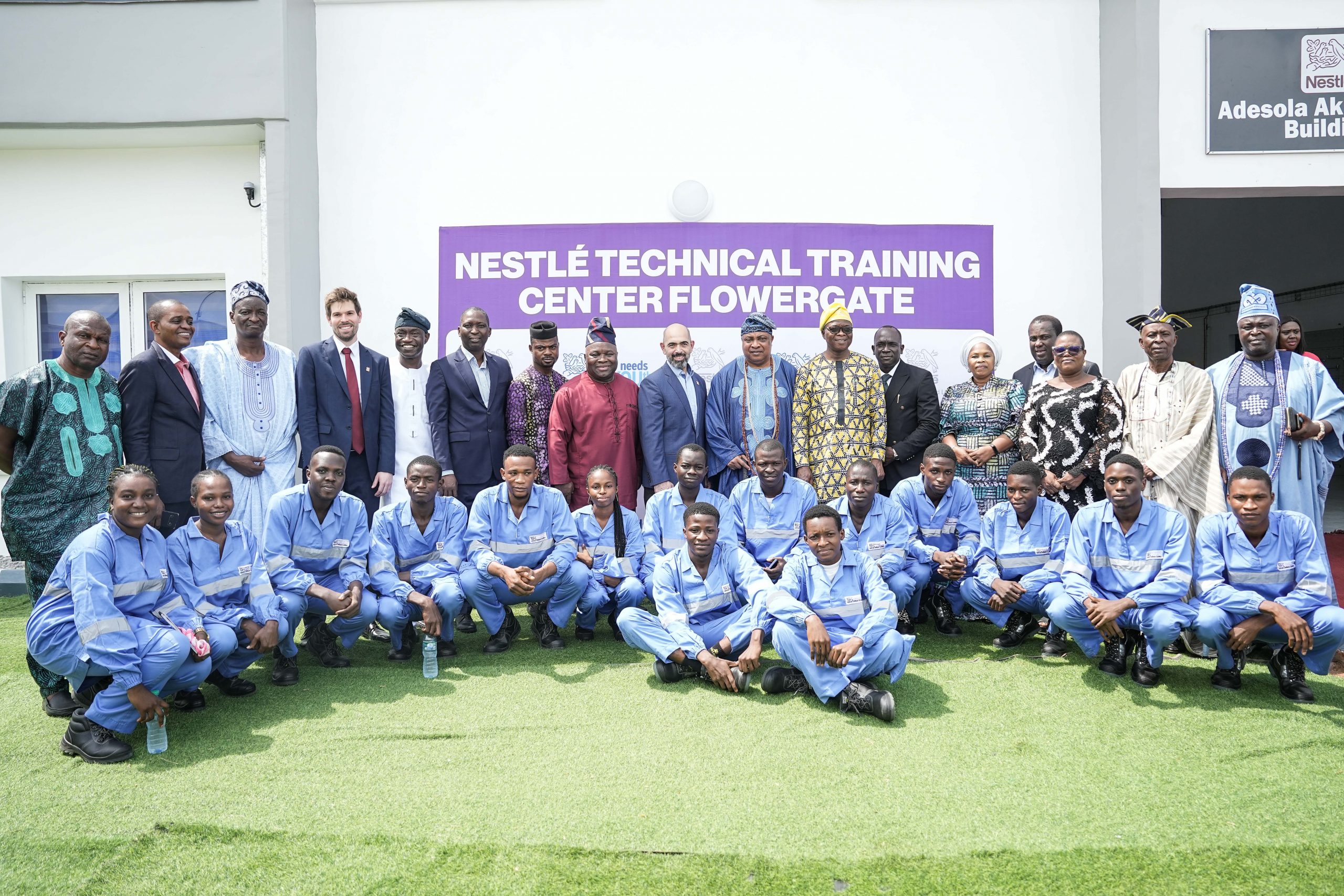
Anthonia Ehibor is one of the twenty trainees admitted into an 18-month Technical Training program at Nestlé Nigeria’s newest Technical Training Center (TTC) at the company’s Flowergate Factory in Ogun State.
Anthonia, an indigene of Edo State with an Ordinary National Diploma (OND) in Engineering from the Federal Polytechnic Auchi, aspires to develop her technical competence in order to secure a good job in her chosen field. “I need to earn an income to meet my needs and to support my family,” she said. Nestlé Technical Training Center, Flowergate is the third facility set up by Nestlé in the country, in line with her commitment to help young people build the capabilities and skills they need to contribute towards accelerating industrialization.
The first technical training centre was inaugurated in 2011 at Nestlé’s Agbara factory in Ogun State and in 2017, opened the second centre in the Abaji factory, in the Federal Capital Territory to cater for young people in the Northern part of the country. Trainees participate in an intensive 18-month program which builds their competence in machining, mechanical fitting operations, electrical operations, instrumentation operations and automation, culminating in the prestigious London City and Guilds technical certification examination.
Speaking at the commissioning of the Flowergate TTC, the MD/CEO, Nestlé Nigeria, Mr Wassim Elhusseini said, “The technical training program is an initiative of our global flagship program, Nestlé Needs Youth. The program is one of the sustainable pathways through which we contribute to meeting the technical needs in the industry while enabling young Nigerians access economic opportunities. Young people have a key role to play in shaping the future we desire. We are determined to remain at the forefront of the fight against youth unemployment by helping young people develop the capabilities and skills they need to contribute towards accelerating the industrialization we need to grow our economy”.
Participants at the ceremony included parents, the trainees, the Traditional Ruler of Remoland and community leaders, representatives of the Government of Ogun State, Industry associations, and program partners including the Switzerland Embassy and Nigerian Employers Consultative Association (NECA).
The Ogun State Commissioner for Education, Science and Technology, Prof. Abayomi Arigbagbu said, “The set-up of Nestlé’s third technical training center in the country and second in Ogun State, attests to her commitment to manpower development, capacity building and technical skills acquisition, also focus areas for the Ogun State Ministry of Education, Science and Technology. I sincerely appreciate the company for her investments towards building the competences of young people over the years and for her support and collaboration on the State Government’s effort towards improving technical education in the state”.
In his comments, Mr. Wale Oyerinde, Director General, Nigerian Employers Consultative Association (NECA) said “With the rising unemployment and challenged educational system, one of the sure paths to rapid national development is Technical and vocational skills development. We commend Nestlé for her commitment and massive investment, not only in youth development but also in skills and National development. This effort is commendable and also worthy of emulation by other companies”.
Also speaking at the event, the Ogun State Commissioner for Youth and Sports Development, Dr Kehinde Oluwadare said, “I congratulate Nestlé Nigeria as she continues to contribute to the development of young people in Ogun State and the nation by prioritizing skills development and job creation. I am particularly delighted that the vision of the company is in tandem with the focus on youth empowerment by the Prince Dapo Abiodun led Administration”.
HRM, Alaiyeluwa Oba Babatunde Adewale Ajayi, the Akarigbo and Paramount Ruler of Remoland said, “We are proud to be associated with Nestlé, particularly on the commencement of this wonderful initiative. I commend the Management of the company for investing in technical education of young people, who are the future of the country. We will make sure the company continues to have the enabling environment to continue to do good for and within this community”.
Expressing her delight on behalf of the trainees, Anthonia Ehibor, said, “We are excited to be the pioneer students of Nestlé technical training centre, Flowergate. We appreciate Nestlé Nigeria for creating this opportunity for us to gain the skills we need to be future-ready. We look forward to learning, sharing ideas and networking within the 18 months of the training. You can count on us to put in the hard work and commitment required to make you and our parents proud”.
Over 160 students have benefitted from the technical training program since its inception, with 95% of them directly employed by Nestlé Nigeria. Country HR Manager, Nestlé Nigeria PLC, Shakiru Lawal, announced the resumption of 50 new students across the three training centres at Agbara, Abaji and Flowergate in the past week


Ecobank Nigeria, a subsidiary of the leading Pan‑African financial services group, Ecobank Group, has announced the fifth edition of the Adire Lagos Experience, its flagship cultural and creative industry showcase. The event will take place from June 11–14, 2026, at the Ecobank Pan African Centre (EPAC), Victoria Island, Lagos.
The 2026 edition is themed “Threads Across Borders,” celebrating the depth and global resonance of Adire as a uniquely Nigerian art form, while positioning it within Africa’s broader textile and cultural narrative.
Rooted in Nigeria’s rich heritage, the Adire Lagos Experience continues to serve as a gateway for cross‑border cultural exchange, reinforcing Ecobank’s Pan‑African vision through culture‑led commerce.
The four‑day event will feature over 100 vendors, with the exhibition remaining predominantly Nigerian, reflecting the country’s leadership as the home and heartland of Adire production. To enrich diversity and continental collaboration, 10 percent of participating vendors will come from outside Nigeria, offering complementary African textile expressions and creative perspectives that foster knowledge exchange and cross‑border partnerships.
Speaking on the upcoming event, Omoboye Odu, Head, SMEs, Partnerships and Collaborations at Ecobank Nigeria, highlighted the intentional balance between cultural authenticity and Pan‑African inclusion.
“Adire is proudly Nigerian, and this platform remains firmly anchored in celebrating our local artisans and creative enterprises. At the same time, Ecobank’s Pan‑African mandate allows us to thoughtfully open the space to creators from other African markets, encouraging collaboration, shared learning, and trade connections that elevate African craftsmanship as a whole,” she said.
Beyond the exhibition booths, the Adire Lagos Experience 2026 will offer indigenous cuisine, African music and cultural performances, alongside curated networking and business engagement sessions designed to strengthen linkages across the Adire and wider creative value chain—from artisans and designers to merchants, buyers, and cultural enthusiasts.
As part of its ongoing commitment to supporting SMEs and the creative economy, Ecobank has opened registration for prospective exhibitors, with selected applicants eligible to receive complimentary exhibition booths. Applications close on April 28, 2026.
Through the Adire Lagos Experience, Ecobank continues to champion Nigeria’s cultural leadership while advancing Pan‑African collaboration—transforming heritage into enterprise and reinforcing its role as a truly Pan‑African institution driving impact beyond banking.
As the Central Bank of Nigeria’s (CBN) recapitaliSation exercise came to an end March 31, 2026, most banks operating in the country rose to the challenge and met the requirement ahead of time.
However, Fidelity Bank’s proactive approach paid off, and it continued to demonstrate its commitment to growth and innovation. In a remarkable display of investor confidence, Fidelity Bank opened and concluded a private placement in just one day on December 31, 2025. Leading institutions, including AFREXIM Bank and its subsidiaries, invested in the bank, showcasing their faith in Fidelity’s vision and leadership.
With the CBN’s verification process complete, Fidelity Bank’s capital base now exceeds the required N500 billion threshold. This milestone positions the bank to expand its footprint, drive growth, and deliver returns to investors.
Market analysts stated that the successful completion of the private placement underscores strong investor confidence in the bank’s growth strategy, governance framework and long-term fundamentals, even amid tightening regulatory standards and evolving macroeconomic conditions.
The lender had announced to the investing public that it has surpassed the N500billion regulatory capital threshold following the successful completion of a N259billion private placement of ordinary shares.
The Company Secretary, Fidelity Bank, Ezinwa Unuigboje in a signed statement on Nigerian Exchange Limited (NGX) disclosed that the private placement, conducted with the approval of the Central Bank of Nigeria (CBN) and the Securities and Exchange Commission (SEC), was opened and closed on December 31, 2025.
According to her, the proceeds from the exercise lifted Fidelity Bank’s eligible capital from N305.5billion to N564.5billion, subject to final regulatory approvals.
The latest capital raise positions the lender comfortably above the new minimum capital requirement of N500billion for commercial banks with international authorisation, as stipulated by the apex bank under its banking sector recapitalisation programme. According to the bank, the private placement was carried out pursuant to the mandate granted by shareholders at its Extraordinary General Meeting held on February 6, 2025.
At the meeting, shareholders authorised the board to issue up to 20 billion ordinary shares through a private placement as part of measures to strengthen the bank’s capital base and enhance its capacity to support economic growth. The N259billion raised through the private placement builds on earlier capital-raising efforts by the bank. Fidelity Bank had stolen the show by taking a bold step in June 2024, launching a Public Offer and Rights Issue to raise capital.
Fidelity Bank successfully raised N175.85billion via a combination of a public offer and rights issue, which had increased its eligible capital to N305.5billion at the time. That exercise left a capital shortfall of N194.5billion relative to the new regulatory benchmark, a gap now fully covered by the latest transaction. Fidelity Bank’s strategic moves have set it up for success, and the stage is set for the bank to make significant strides in the Nigerian banking sector. Fidelity Bank noted that the strengthened capital position will enhance its balance sheet resilience, support business expansion, and enable it to play a more robust role in financing key sectors of the Nigerian economy, in line with regulatory expectations. The bank added that it remains focused on value creation for shareholders, prudent risk management and sustained profitability as it navigates the post-recapitalisation phase of the banking sector. Meanwhile, the stock price of Fidelity Bank closed trading April 10, 2026 at N19.50 per share on the NGX.
Access Bank Plc has been named Nigeria’s Most Valuable Brand for the fifth consecutive year by Brand Finance, reinforcing its leadership position in the country’s financial services sector.
Brand Finance announced this in its Nigeria 25 2026 report, which ranks the country’s strongest brands based on brand value, brand strength, and underlying business performance. According to the report, Access Bank’s brand value stands at ₦773.2 billion, maintaining its number one ranking despite short term macro-economic and market pressures.
It attributed the marginal year-on-year decline in brand value to a deliberate strategic shift, as the Bank continues to prioritise long term growth, regional expansion, and international scale over shortterm domestic margins.
Brand Finance pointed out that Access Bank’s sustained leadership reflects a longterm brand strategy anchored on scale, trust, and regional relevance, positioning the Bank to maintain brand strength and resilience as Nigeria’s economy continues its gradual recovery and the competitive landscape evolves.
It highlighted Access Bank’s transition from a local market leader to a cross continental financial infrastructure provider, noting that stronger contributions from its African operations helped offset a decline in Nigerian income during the period. This repositioning supports the Bank’s ambition of serving as a key gateway between Africa and global financial markets.
Importantly, the Brand Finance report also recorded a strengthening of the Access Bank brand, with the Bank rising to third place nationally on the Brand Strength Index (BSI), achieving a score of 88.7/100 and retaining an AAA brand rating. Brand Finance links this improvement to stronger brand coherence across markets and clearer strategic positioning following the consolidation of international acquisitions.
Commenting, Babatunde Odumeru, Managing Director, Brand Finance Nigeria, said, a defining shift in the business environment has been the movement from survival to resilience, with brands that invested through uncertainty now emerging stronger.
“This report highlights a key trend: trust is now the fundamental driver of business growth. With consumers now more cautious about how they spend their money, brands must offer a reliability premium in order to build trust, which is an essential foundation for customer loyalty. The brands that have achieved this have not just stood out but have consistently grown their brand value and maintained their lead in the Brand Finance rankings: If you are reliable, you are valuable.”
Odumeru noted that the rankings were dominated by the banking and manufacturing sectors, driven by homegrown resilience and digital savviness required to convert engagement into customer loyalty. This dynamic, he said, reflects a collaborative strength between the two sectors that continues to underpin Nigeria’s overall brand value.
The Brand Finance Nigeria 25 report is published annually and assesses Nigeria’s leading brands using a combination of brand value, brand strength, and comprehensive market analysis.


