
Headlines
Nigerian Media Unite Against Buhari Govt’s Quest to Censor Press

- /home/rhoncare/pointblank.ng/wp-content/plugins/mvp-social-buttons/mvp-social-buttons.php on line 27
https://pointblank.ng/wp-content/uploads/2021/07/Media-1000x500.jpg&description=Nigerian Media Unite Against Buhari Govt’s Quest to Censor Press', 'pinterestShare', 'width=750,height=350'); return false;" title="Pin This Post">
- Share
- Tweet /home/rhoncare/pointblank.ng/wp-content/plugins/mvp-social-buttons/mvp-social-buttons.php on line 69
https://pointblank.ng/wp-content/uploads/2021/07/Media-1000x500.jpg&description=Nigerian Media Unite Against Buhari Govt’s Quest to Censor Press', 'pinterestShare', 'width=750,height=350'); return false;" title="Pin This Post">
Premium Times
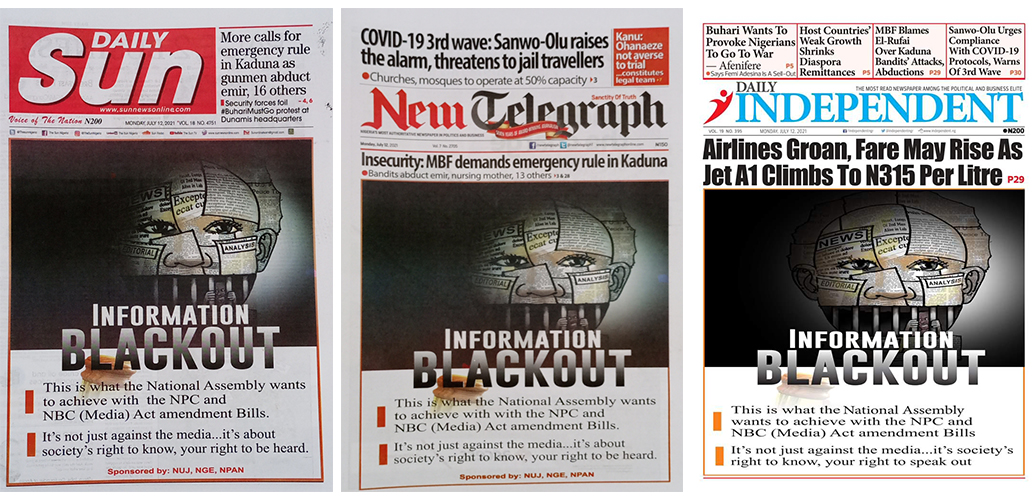
The front banners of major newspapers in Nigeria on Monday bore a picture of an individual with a sealed mouth.
“Information Blackout,” read the caption that ran with the picture. “It’s not just against the media….it’s about society’s right to know, your right to be heard.”
The message is a joint release from the Nigeria Union of Journalists (NUJ), Nigerian Guild of Editors (NGE) and Newspaper Proprietors’ Association of Nigeria (NPAN).
It is expected to be the chyron on television stations, the jingles on radio stations and the lead graphics on online media.
This is a pushback by media organisations in the country against the Buhari government’s brazen attempt to regulate social media and censor the press through controversial media bills at the National Assembly.
The controversial bills are the Nigerian Broadcasting Commission (NBC) and the Nigerian Press Council (NPC) Act amendment bills.
Existing censorship on broadcast stations persists, and instances, where the stations are ordered to stop the broadcast of programmes the government feels uncomfortable with, are rife. Heavy fines are imposed at will when there is an alleged breach.
The latter gives the president the right to appoint the chairman of the board of the Nigerian Press Council (NPC). It also empowers the president to appoint all other members of the board upon the recommendation of the information minister.
“I stand resolutely by the NUJ, NGE and NPAN in its campaign against information blackout as represented by the NPC and NBC (Media) Act amendment Bills,” a former vice president, Atiku Abubakar, wrote on Facebook Monday evening. “Freedom of the press and access to information is the oxygen of democracy and must never be compromised.”
Attempts At Stifling Free Speech
Since coming to office, the Buhari administration has made clear its preference for controlling, or possibly, silencing the media. Mr Mohammed, a lawyer and former spokesperson for the ruling All Progressives Congress, has led the effort to actualise that mandate.
Mr Buhari ran a repressive military dictatorship in the early 1980s and his government jailed journalists and critics, and enacted draconian anti-press decrees.
As a candidate seeking to return a civilian president, Mr Buhari claimed he had become a “reformed democrat”.
His government’s initial attempts to regulate social media through a bill at the National Assembly fell flat largely due to public backlash. The government has now clawed back its resolve through the newly introduced controversial media bills.
Mr Mohammed says it is the practice across the world. However, PREMIUM TIMES has shown his narrative is flawed as most of the countries Nigeria seeks to emulate are ranked poorly in the press freedom and on the human development index.
In June, the government banned Twitter after the social media platform deleted President Buhari’s post, and threatened to prosecute Nigerians who continued with its use. The administration has refused to reverse the decision despite public backlash and international condemnations. It, however, later admitted it lacked the legal backing to go after Twitter users.
Rights groups and activists have criticised the government’s move to regulate the media and have demanded greater transparency in government.
“The National Assembly should not enact any law that will deny press freedom,” the executive director of the International Press Centre, Lanre Arogundade, told PREMIUM TIMES in June.
“The public should know that an assault on the media is an assault on them. It’s not a media battle alone, it is for everyone,” Mr Arogundade added.
A coalition of civil society organisations including Amnesty International and the Centre for Democracy and Development (CDD) also lashed at the bills in a recent statement.
“The Nigerian authorities have continued to propose laws to regulate the social media, and restrict the rights to freedom of expression, access to information, and media freedom, including through legislative bills popularly known as the ‘Hate Speech Bill’ and ‘The Social Media Bill’ which both provide severe punitive sanctions such as the death penalty in some cases, for social media users convicted of ‘crimes’ provided under them.”


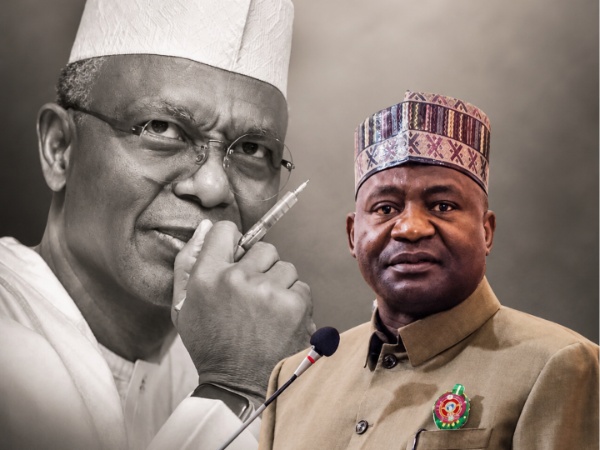
The Minister of Defence, Gen. Christopher Musa, has accused a former Governor of Kaduna State, Nasir El-Rufai, of deliberately planning the killing of people in Southern Kaduna.
Musa made the allegation while fielding questions on Channels Television’s Politics Today programme on Thursday.
The minister said El-Rufai’s administration created deep divisions in Kaduna State, alleging that the situation made it difficult for residents from Southern Kaduna to live freely in the northern part of the State and vice versa.
According to him, the administration of the current governor, Uba Sani, has made deliberate efforts to restore unity and rebuild trust among residents of the State.
“We know how it was when El-Rufai was there; it was toxic,” Musa said.
“El-Rufai did a lot of terrible things in Kaduna State. He divided the country, the State, into two. In that, if you are from the South, you cannot go to the North and live. Those ones from the North were moving to the South.
“Governor Sani within one year has been able to dissolve all that. You see, now everybody is free, everybody has a say. It’s not 100%. Let me tell you, it’s not 100%, but you can see that he’s making deliberate effort in uniting the state.”
Speaking on the feelings of people in Southern Kaduna towards the former governor, Musa said the people remained deeply pained over killings recorded in the area during El-Rufai’s tenure.
He alleged that El-Rufai deliberately planned the killing of people in the region.
“Well, I don’t know if unhappy is an issue. I think if there’s anything worse than unhappy, we can never be happy with somebody who has deliberately planned for the killing of our people,” Musa said.
“I mean, when you look at it, if you look at his videos, you know, his speeches, he was very proud of what he did.
“He told us he paid bandits. He told us he did this, he did that. He didn’t hide it. He was that arrogant to come out and tell people that this was what he did.”
The Defence Minister said residents of Southern Kaduna were still traumatised by the killings that occurred during the period, adding that the security situation in the area had improved under the current administration.
“The Southern Kaduna people are still very pained. Of course, definitely. I mean, if you look at the number of killings that was done there and what is going on now, you can’t compare at all,” he said.
Musa further accused El-Rufai of denying some people opportunities during his administration and alleged that the former governor’s policies affected even people from his own part of the state.
“I can tell you what he has done to people living in Kaduna from his own area. He did a lot of things that I’m sure even him is not proud of,” he added.
The minister, however, called on Nigerians to reject politicians who exploit religion, ethnicity and other differences to divide the country.
“We should get politicians that want to unite Nigeria. For me, any individual who is using either religion, tribe, creed, or anything to divide the state can never be a friend; can never be somebody we look up to,” Musa said.
“We shouldn’t have those kind of ones in government. Anybody who is using religion or tribe or whatever to divide Nigeria is an enemy of the State.”
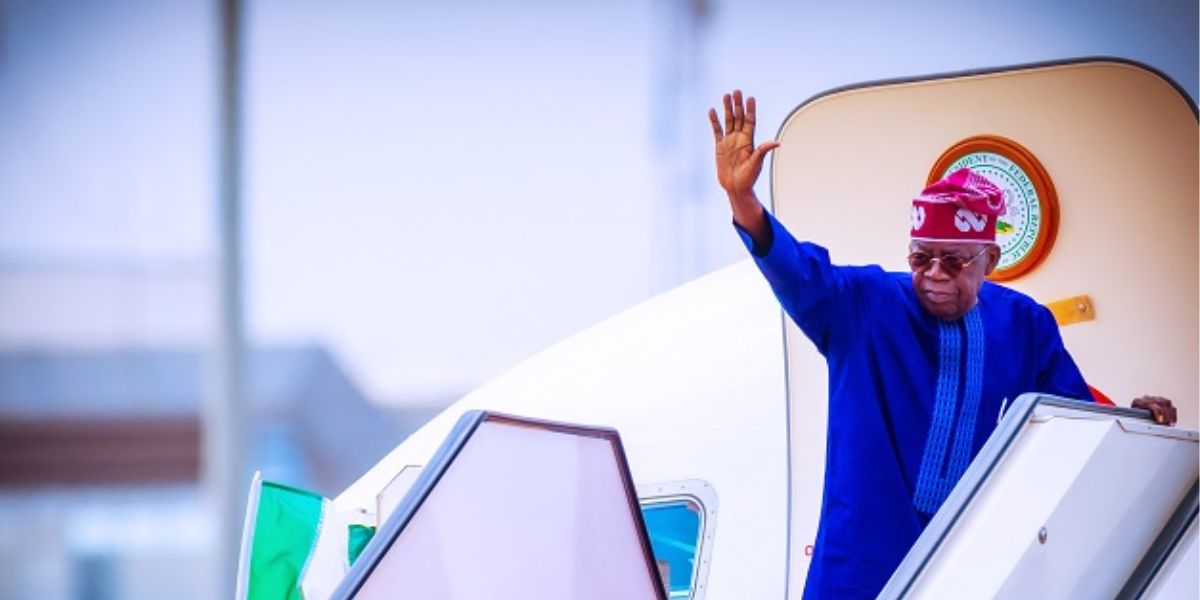
President Bola Tinubu departed Abuja, the nation’s capital on Sunday for Europe to begin a three-week vacation as part of his annual leave.
Presidential spokesperson, Bayo Onanuga, in a release disclosed that Tinubu’s first stop will be London, United Kingdom.
The President is expected to return home after the working vacation to join the hectic campaign for the January 2027 election.
Vice President Kashim Shettima had earlier this month went on two-week leave, his first since the Tinubu government assumed office over three years ago. He has since returned.
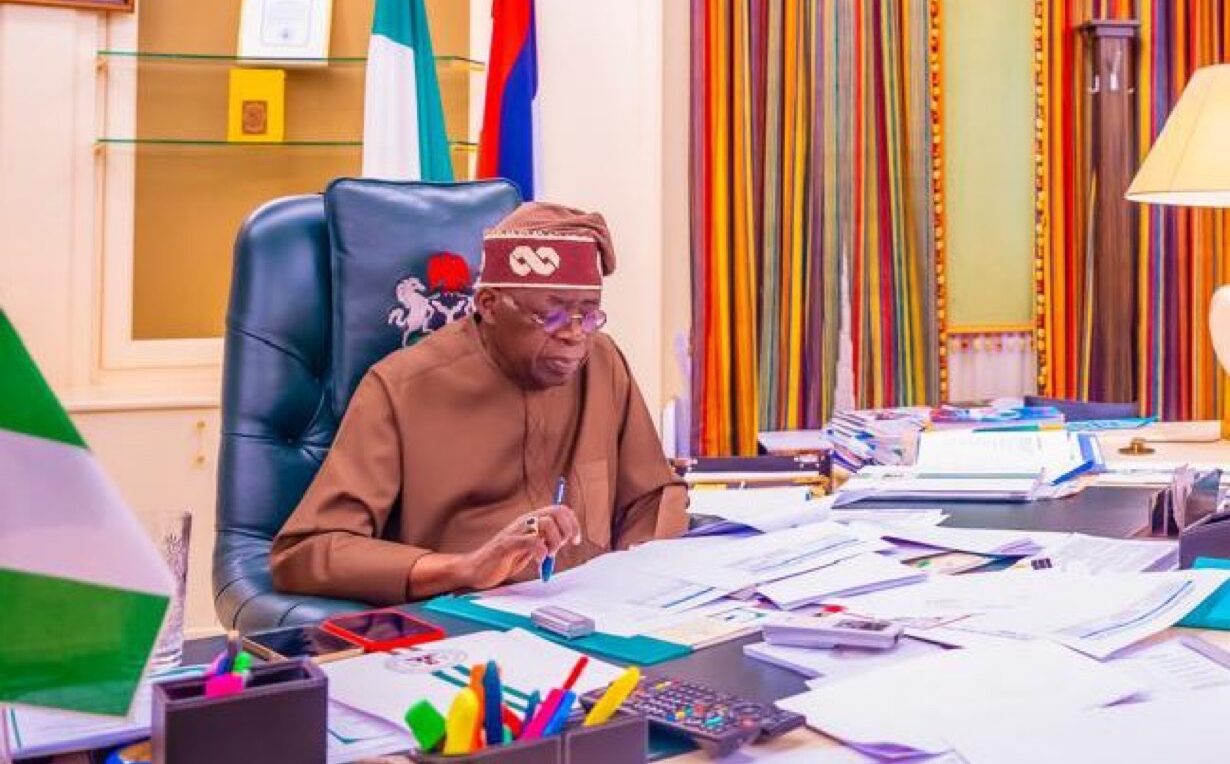
President Bola Tinubu has raised concerns with the African Union (AU) over repeated xenophobic and Afrophobic attacks against Africans and other foreign nationals in South Africa.
Tinubu urged African leaders to take collective action and include the issue on the agenda of the AU’s 40th Ordinary Session, scheduled for January 2027.
The president’s position was presented by Vice President Kashim Shettima at the 21st Extraordinary Session of the AU Assembly in Luanda, Angola.
Tinubu called on African leaders to renew their commitment to protecting the safety, dignity and rights of all Africans across the continent.
He said: “Nigeria wishes to express its concern over the recurring xenophobic and Afrophobic attacks against Africans and other nationals in South Africa.
“While recognising South Africa’s sovereign right to enforce its immigration laws and acknowledging its contributions to the continent, Nigeria stresses that such attacks undermine African solidarity, unity and peaceful coexistence, and require urgent collective attention.”
He added: “It is on this note that Nigeria calls on this august Assembly to place the matter on the agenda of the upcoming 40th Ordinary Session of the AU Assembly, scheduled for January 2027, for consideration and appropriate action.”
The president also urged the AU to strengthen efforts to tackle xenophobia and Afrophobia across the continent.
He stressed that “dialogue, preventive diplomacy, and collective action remained essential to preserving African unity.”
On Africa’s broader security challenges, Nigeria supported the adoption of the Luanda Action Plan as a way to improve conflict prevention.
Tinubu argued that preventing conflicts would be more sustainable and less expensive than dealing with them after they have started.
“For Nigeria, conflict prevention remains more cost-effective and sustainable than conflict management,” President Tinubu said.
He also warned that separate and uncoordinated peace efforts, as well as growing foreign involvement through military forces, mercenaries and private defence companies, could weaken Africa’s ability to manage its own conflicts.
Tinubu further called on countries that manufacture and export weapons to work more closely with African governments to prevent weapons and ammunition from being diverted to terrorists and other armed groups.
The president said the AU already has strong systems for preventing and resolving conflicts, but limited trust and poor implementation have continued to reduce their effectiveness.


