
Business
Nigeria’s External Debt Rises to $40bn Under Buhari


- /home/rhoncare/pointblank.ng/wp-content/plugins/mvp-social-buttons/mvp-social-buttons.php on line 27
https://pointblank.ng/wp-content/uploads/2019/04/Buhari-1-1000x576.jpeg&description=Nigeria’s External Debt Rises to $40bn Under Buhari', 'pinterestShare', 'width=750,height=350'); return false;" title="Pin This Post">
- Share
- Tweet /home/rhoncare/pointblank.ng/wp-content/plugins/mvp-social-buttons/mvp-social-buttons.php on line 69
https://pointblank.ng/wp-content/uploads/2019/04/Buhari-1-1000x576.jpeg&description=Nigeria’s External Debt Rises to $40bn Under Buhari', 'pinterestShare', 'width=750,height=350'); return false;" title="Pin This Post">
Nigeria’s total external debt has risen from $10.32bn on June 30, 2015, to $40.06bn as at June 30, 2022, according to The Punch.
This shows that there has been an increase of 288.18 per cent in seven years, according to the external debt stock reports by the Debt Management Office.
A breakdown shows that in 2015, 36 states had $3.27bn external debt while the Federal Government had $7.05bn.
By 2022, states’ external debt rose to $4.56bn, while the Federal Government’s external debt increased to $35.5bn.
The debts included loans from multilateral sources such as the World Bank, the African Development Bank and the International Monetary Fund.
They also included bilateral loans from China, France, Japan, Germany and India, as well as commercial sources including Eurobonds and Diaspora bonds.
Nigeria’s external debt ballooned as the naira lost value, increasing Nigeria’s debt service burden and worsening its ability to service debt. The International Monetary Fund recently said that the long-term rate of the depreciation of the naira equated to a loss of 10.6 per cent of its value annually since 1973.
According to the IMF, this rate was 1.5 times higher than the long-term rate of the currencies of other emerging markets and developing economies at 7.2 per cent and sub-Saharan Africa at seven per cent over the same time period.
The IMF said, “Its exchange rate underwent more persistent depreciation. Nigeria’s long-term rate of currency depreciation (on average 10.6 per cent annually since 1973) was 1.5 times higher than both EMDE (7.2 per cent) and SSA (seven per cent). Given limited availability of long-term data, it is difficult to estimate the exact reasons.”
The Bank of America recently said Nigeria’s local currency unit was set to weaken further next year as its current exchange rate to the dollar was well above fair value.
According to a report by Bloomberg, the bank said, “Three indicators, the widely-used black-market rate, the central bank’s real effective exchange rate, and our own currency fair value analysis shows the naira is 20 per cent overvalued.
“We see scope for it to weaken by an equivalent amount over the next six-nine months, taking it to as high as 520 per USD.”
During a workshop on tax expenditure organised by the ECOWAS Commission in Abuja, financial experts advised that Nigeria and other West African Countries should move away from reliance on foreign assistance to the financing of developmental projects in the region.
According to them, over-dependence on financial aid and external loans might affect long-term prosperity of the entire region.
The Special Advisor to the Director (Custom Union and Taxation in ECOWAS), Gbenga Falana, while emphasising that the debt profile of most of the countries in the sub-region was mounting, stressed the need for West African countries to look inwardly and finance local projects through effective domestic resource mobilisation.
Reacting, the Managing Director/Chief Executive Officer of Cowry Asset Management Limited, Mr Johnson Chukwu, said that high external debt would impose a huge debt service on the economy.
He said, “This will impose a huge debt service on the economy, particularly at a period when we have low revenue from oil sales. If the revenue from oil sales does not improve, then the government will be struggling to meet that debt service obligation to foreign lenders.”
However, he noted that Nigeria could service its foreign debt at the current level, but a constant increase in debt without a corresponding increase in foreign currency earnings could put the country in a difficult position.
The Punch


The United Bank for Africa (UBA) is poised to give five young Nigerians a shot at getting a share of N41million in educational grants towards their university education.
The Bank, through UBA Foundation National Essay Competition (NEC), is the much talked about life changing opportunity and it is back for with the 16th edition, and this year, with even more reason for young writers to put pen to paper and change their lives in the process.
Previously, there was a lot of talk around education not given priority or due reward as against reality shows or ephemeral activities. Now that talk is gone with the wind.
The UBA annual competition is designed to give senior secondary school students across Nigeria a platform to express their ideas, showcase their writing and critical thinking skills, which will see the top five finalists, receive financial support throughout their university education.
Most importantly, the prize pot has just gotten bigger as the first-place winner will receive a N15 million university grant, while the second and third-place winners will receive N10 million and N7.5 million respectively. It gets even more rewarding as the fourth and fifth-place winners – introduced for the first time ever in the competition – will also receive N5 million and N3.5 million each.
Participants will be expected to tackle a question that directly affects Nigeria’s future: “No nation can develop without food security. How can Nigeria deal with this problem?” That means this is a chance not just to write, but to think, question, and propose practical ideas for a challenge that affects everyone.
The opportunity is open to Nigerian every senior secondary school student.
According to a statement made available to this medium, applications close Friday, October 23, 2026.
The essay is expected to be handwritten and in not more than 750 words, with applications submitted through the competition’s digital portal, https://www.ubagroup.com/nec/
Business
Dangote Refinery Surpasses Nameplate Capacity, Strengthens Nigeria’s Energy Security, Export Position
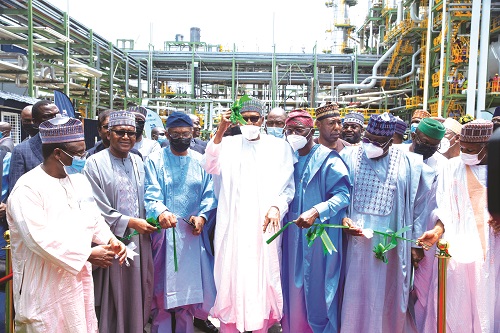
Dangote Petroleum Refinery has achieved a significant operational milestone, recording an average capacity utilization of 105.21 percent in August 2026, according to data released by the Nigerian Midstream and Downstream Petroleum Regulatory Authority (NMDPRA).
The 700,000 barrels-per-day refinery processed an average of 736,470 barrels of crude oil per day in August, a substantial increase from 497,000 barrels per day in July when utilization stood at 71 percent.
The strong performance was supported by a rebound in domestic crude oil supply, with deliveries rising by 16.75 percent to 683,000 barrels per day during the month, enabling the refinery to ramp up throughput.
The improved throughput translated into average daily production of 84.43 million litres of refined white products, including Premium Motor Spirit, PMS, Automotive Gas Oil, AGO or diesel, and Aviation Turbine Kerosene, ATK, further reinforcing its role as a major supplier of refined petroleum products across Nigeria and the wider West African region.
Speaking on the development, the Dangote Group said the achievement underscores the refinery’s growing contribution to Nigeria’s energy security, foreign exchange conservation, and industrial growth agenda.
The refinery continued to significantly reduce Nigeria’s dependence on imported petroleum products during the review period. Domestic PMS deliveries from the refinery rose by 39 percent month-on-month to 35.87 million litres per day in August, accounting for approximately 71 percent of total domestic petrol supply.
The increased local supply contributed to a sharp decline in fuel imports, with national PMS imports falling by 26 percent to 14.60 million litres per day, highlighting the refinery’s expanding impact on the domestic fuel market.
Beyond meeting a significant portion of Nigeria’s domestic fuel requirements, the refinery also strengthened the country’s export profile through robust shipments of refined products.
In August, the refinery exported an average of 9.73 million litres of PMS daily, alongside 8.75 million litres of diesel and 21.30 million litres of aviation fuel. These volumes further support Nigeria’s emergence as a net exporter of refined petroleum products and contribute to increased foreign exchange earnings for the country.
The refinery’s growing production capacity was particularly evident in the diesel market, where domestic AGO deliveries averaged 12.37 million litres per day. This level of output substantially reduced the need for imported diesel, with national diesel imports declining from 7.90 million litres per day in July to 1.30 million litres per day in August.
The development reflects the refinery’s increasing ability to support critical sectors of the economy, including transportation, manufacturing, agriculture, telecommunications, and power generation.
According to the Group, the ability to operate above nameplate capacity demonstrates the efficiency, reliability, and resilience of its operations. The milestone also reinforces investor confidence as the refinery’s ongoing public offering continues to attract significant market attention.
Dangote Group reiterated its commitment to maximizing local value addition, supporting economic diversification, and ensuring the sustainable supply of high-quality refined petroleum products to Nigeria, Africa, and global markets.
The road to the 2026 Zenith Bank NBBF Women’s Basketball League title reaches its climax as eight top teams converge on Lagos for the highly anticipated National Finals.
The finals will hold from September 28 to October 3, 2026, at the Indoor Sports Hall of the National Stadium, Surulere, Lagos.
Emerging from fiercely contested Atlantic and Savannah Conference campaigns, Nigeria Customs, AS Sky Queens, Titans, Air Warriors, MFM, First Bank, Victoria Queens, and Bayelsa Blue Whales have booked their place in the battle for national honours.
Last year’s champions, Dolphins Basketball Club, who lifted the trophy after defeating First Bank in the final, will not be in contention this year after failing to make the top four of the Atlantic Conference. Their absence leaves the title wide open for a new champion.
The trophy will however be contested by teams with rich championship pedigree. First Bank, last year’s finalist and the most successful team in the history of the competition, arrives with a record nine league titles, while MFM will be banking on its recent dominance after winning back-to-back championships in 2023 and 2024.
It is a level of competition that reflects the growth of a league that has, for more than two decades, provided a platform for Nigeria’s best female basketball talents to emerge, compete and develop. At the heart of that journey has been Zenith Bank, the sole sponsor of the National Women’s Basketball League since 2005.
Through its partnership with the Nigeria Basketball Federation (NBBF), Zenith Bank has consistently supported the development of women’s basketball, helping to provide and sustain a competitive platform where talents can be discovered, nurtured and prepared for the highest level of the sport.
The league has also served as a vital pathway to the National Women Basketball team, D’Tigress, with several players who have featured prominently for Nigeria emerging from the domestic competition.
Beyond the national team, the league continues to contribute to youth development by giving young female athletes the opportunity to build confidence, skill, discipline, teamwork and professional sporting careers.
For Zenith Bank, the sponsorship of the Women’s Basketball League represents more than support for a sporting competition.
It reflects the Bank’s broader commitment to creating platforms that provide opportunities, develop potential and make a meaningful difference in the lives of young Nigerians.
This commitment extends across several areas of community development, with notable initiatives including the reconstruction and beautification of Ajose Adeogun Street and Roundabout, the annual Zenith Bank Youth Parade and Light-Up Ceremony, the construction of ICT Centres in tertiary institutions across the country, and the construction of the ultra-modern Iga Iduganran Primary Healthcare Centre, among others.
Through these initiatives and its longstanding support for women’s basketball, Zenith Bank Plc continues to demonstrate that its commitment to society goes beyond banking, with a focus on creating opportunities and contributing to the development of communities and the next generation.


