
Headlines
Nigeria’s Loss of $9.6bn: Who’s Responsible?


By Eric Elezuo
On August 16, 2019, the Nigerian government received the greatest shock of its administration when a British Court awarded over $9 billion damages against it for failing to honour a contract in a landmark judgement.
The judgment, which was delivered by Justice Butcher of The High Court of Justice, Business and Property Courts of England and Wales, ruled against Nigeria’s objection to arbitration which in 2017 settled that the Nigerian government should pay $6.6 billion as damages to a company, Process & Industrial Development Limited (P&ID). The damages and interest add up to a figure above $9 billion.
Nigeria’s former Attorney-General, Mr. Bayo Ojo, was among the three member arbitration panel that gave judgement in favour of P&ID against the Nigerian government and at the same time secured the monetary award. While Mr. Ojo tried his best to ensure that Nigeria escaped with a paltry $250 million, the majority opinion of Lord Hoffmann and Anthony Evans, the two other members of the panel, ensured that Nigeria lost the case.
Hoffmann and Evans held that P&ID’s expenditure and income should have been about $6.597 billion if the agreement was duly performed by the government. They also insisted that the award should be paid together with interest at the rate of 7 per cent from March 20, 2013.
Ever since the judgement, blames have been traded between the present All Progressives Congress (APC) administration led by Muhammadu Buhari, and previous administrations dating back to the late Umaru Musa Yar’dua era.
Leading the blame game is the returnee Minister of Justice and Attorney General of Nigeria, Mallam Abubakar Malami. The Minister, who was reappointed by President Muhammadu Buhari, few days after the judgement described the ruling as the “consequences of the underhand dealings of the past administration”.
He said: “Sadly, in spite of the spirited and concerted efforts of the current administration to combat corrupt practices and rent-seeking in all its forms, Nigerians woke up on Friday, August 16, 2019, to the rudest consequences of the underhand dealings of the past administration that has resulted in the award of $9 billion against the Federal Republic of Nigeria, by a British court which ruled that Process and Industrial Development Limited had the right to seize $9 billion in Nigerian assets.”
The lawyer went ahead and specifically fingered the administration of former President Goodluck Jonathan as the culprit, saying he connived “with local and International conspirators in a bid to inflict grave economic adversity on the Federal Republic of Nigeria and the good people of Nigeria.”
Malami concluded his blame with a threat, stressing that the federal government would punish any government official whose action or inaction led to the award of $9 billion damages against Nigeria. He also promised that the government “will vigorously defend its rights to protect its people’s assets around the world against the enforcement of the judgement.”
It is worth knowing that the value of the penalty represents approximately a fifth of the country’s foreign reserves of $45bn. the fact of the case is itemised as follows:
- The agreement, which set the basis for the current legal action, was a Gas Supply and Processing Agreement signed in January 2010.
- If concluded, the deal would have offset a significant percentage of Nigeria’s energy deficit (Africa’s largest oil and gas producer has a notoriously epileptic power supply).
- P&ID claims about $40m were expended on the project, but Nigeria did not meet its obligations and cost the company billions in damages representing future profits it had lost.
- In 2013, after the deal failed, P&ID dragged the government to court and won a $6.6bn arbitration case against the Federal Government.
- Four years later, the firm was awarded $6.6bn, with an additional $2.4bn included as accrued interest.
- Nigeria for years resisted P&ID’s attempts to begin enforcement proceedings of the rulings in the US and the UK; the judgement by the British court now allows the firm to begin seizing Nigerian assets.
- Under the Jonathan administration, Nigeria negotiated an out-of-court settlement with P&ID for a far smaller sum of $850m. However, the president left the payment to the incoming Buhari administration, which set aside the settlement and asked its lawyers to return to litigation.
Undaunted by the threats and name calling of the Buhari government, the Jonathan camp responded, throwing the blame to the feet of the present administration. It alleged that the administration failed to pay the $850million out of court settlement with P&ID just to spite the previous administration. The government has however, denied that it did not handle the case diligently.
In a statement, signed by a former aide of Jonathan, Mr. Reno Omokri, the Jonathan camp noted as follows:
“Former President Jonathan was not president in January 2010. During that time, he was completely shut out of power by an unelected cabal that ran Nigeria during the period of the ill health of the late President Yar’Adua, before the National Assembly courageously intervened on February 9, 2010.”
Jonathan assumed office in February 2010 and, according to Omokri, the deal had by then already been set in motion by Rilwanu Lukman, Umaru Musa Yar’Adua’s Petroleum Minister. The cabinet and close allies of the late president had refused to turn over sensitive documents to his deputy because Yar’Adua hadn’t handed over to him as constitutionally stipulated.
“That same cabal has resurrected and has now coalesced around President Muhammadu Buhari, with some of them being made either ministers, or formal and informal advisers. As a matter of fact, the main man behind that cabal is now one of the closest persons to General Buhari.”
It is okay that the Attorney General has sworn to prosecute and punish everyone involved and responsible for the loss, if it is eventually executed, one thing must be established, will he also prosecute himself if given the afore-mentioned, he also had a role to play.


United States Representative Riley Moors has said further military strikes against Islamic State-linked militants in Nigeria could follow recent operations ordered by President Donald Trump, describing the actions as aimed at improving security and protecting Christian communities facing violence.
Moore made the remarks during a televised interview in which he addressed U.S. military strikes carried out on Christmas Day against militant targets in North-west Nigeria.
The strikes were conducted in coordination with the Nigerian government, according to U.S. and Nigerian officials.
“President Trump is not trying to bring war to Nigeria, he’s bringing peace and security to Nigeria and to the thousands of Christians who face horrific violence and death,” Moore said.
He said the Christmas Day strikes against Islamic State affiliates had provided hope to Christians in Nigeria, particularly in areas affected by repeated attacks during past festive periods.
According to U.S. authorities, the strikes targeted camps used by Islamic State-linked groups operating in parts of north-west Nigeria.
Nigerian officials confirmed that the operation was carried out with intelligence support from Nigerian security agencies as part of ongoing counter-terrorism cooperation between both countries.
The United States Africa Command said the operation was intended to degrade the operational capacity of extremist groups responsible for attacks on civilians and security forces.
Nigerian authorities have described the targeted groups as a threat to national security, noting their involvement in killings, kidnappings and raids on rural communities.
Moore said the strikes marked a shift from previous years in which attacks were carried out against civilians during the Christmas period. He said the U.S. administration was focused on preventing further violence by targeting militant groups before they could launch attacks.
U.S. officials have said the military action was carried out with the consent of the Nigerian government and formed part of broader security cooperation between the two countries. Nigeria has received intelligence, training and logistical support from international partners as it seeks to contain militant activity.
Moore had previously called for stronger international attention to attacks on Christian communities in Nigeria and has urged continued U.S. engagement in addressing extremist violence. He said further action would depend on developments on the ground and continued coordination with Nigerian authorities.
Nigerian officials have maintained that counter-terrorism operations are directed at armed groups threatening civilians, regardless of religion, and have reiterated their commitment to restoring security across affected regions.

World-renowned boxer Anthony Joshua on Monday survived a ghastly road accident in Makun, Ogun State.
Eyewitnesses report that the incident occurred along a busy highway of the Lagos-Ibadan expressway.
The vehicle carrying Joshua, a Lexus Jeep with the number plate, KRD 850 HN, reportedly collided with a stationary truck under circumstances that are still being investigated.
Joshua reportedly sustained minor injuries, while two persons were said to have died on the spot.
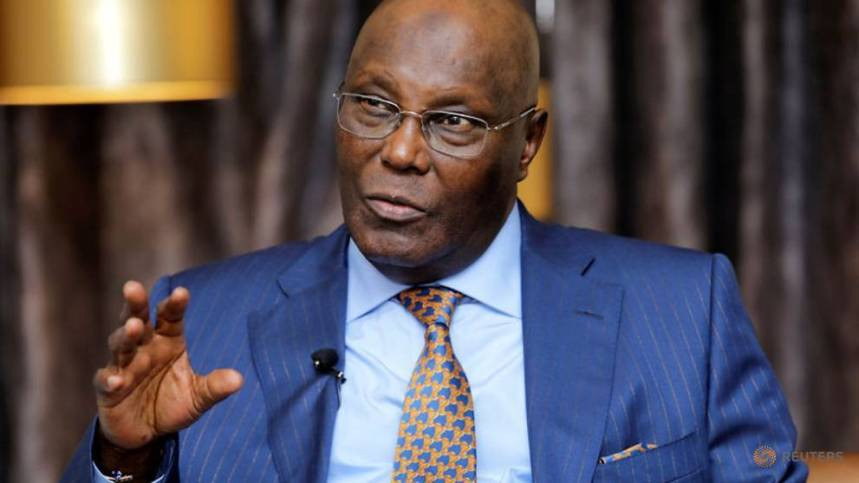
Former Vice President Atiku Abubakar has cautioned that any attempt to hurriedly re‑gazette Nigeria’s new tax laws could undermine parliamentary oversight and set a dangerous constitutional precedent.
Atiku’s warning follows public scrutiny over reports that the Tax Reform Acts signed by President Bola Tinubu differ from the versions passed by the National Assembly. Lawmakers, including Abdussamad Dasuki, raised concerns that the alterations could pose serious legal and constitutional risks, noting that they were not backed by any constitutional framework.
In a statement on X, Atiku said the directive to re-gazette the Acts effectively confirms “that the gazetted version of the Tinubu Tax Act does not reflect what was duly passed by the National Assembly,” calling it “a grave constitutional issue.”
He emphasized that under Section 58 of the 1999 Constitution, a bill only becomes law after passage by both chambers, presidential assent, and gazetting.
“Gazetting is merely an administrative act of publication. It does not create, amend, or validate a law,” Atiku said, adding that any post-passage insertion, deletion, or modification without legislative approval constitutes forgery rather than a clerical error.
Atiku further warned that rushing a re-gazetting while legislative investigations are ongoing “undermines parliamentary oversight and sets a dangerous precedent,” stressing that the only lawful approach is “fresh legislative consideration, re-passage by both chambers, fresh presidential assent, and proper gazetting.”
The former vice president clarified that his position is not opposition to tax reform but a defence of constitutional order.
“This is a defence of the integrity of the legislative process and a rejection of any attempt to normalise constitutional breaches through procedural shortcuts,” he said.
The Federal government has denied wrongdoing, insisting the laws will take effect as scheduled on January 1, 2026, while the National Assembly has directed the issuance of Certified True Copies of the Acts to ensure clarity and accuracy.


