
Headlines
Now I Know Doing Good Pays So Much – SP Celestina Kalu

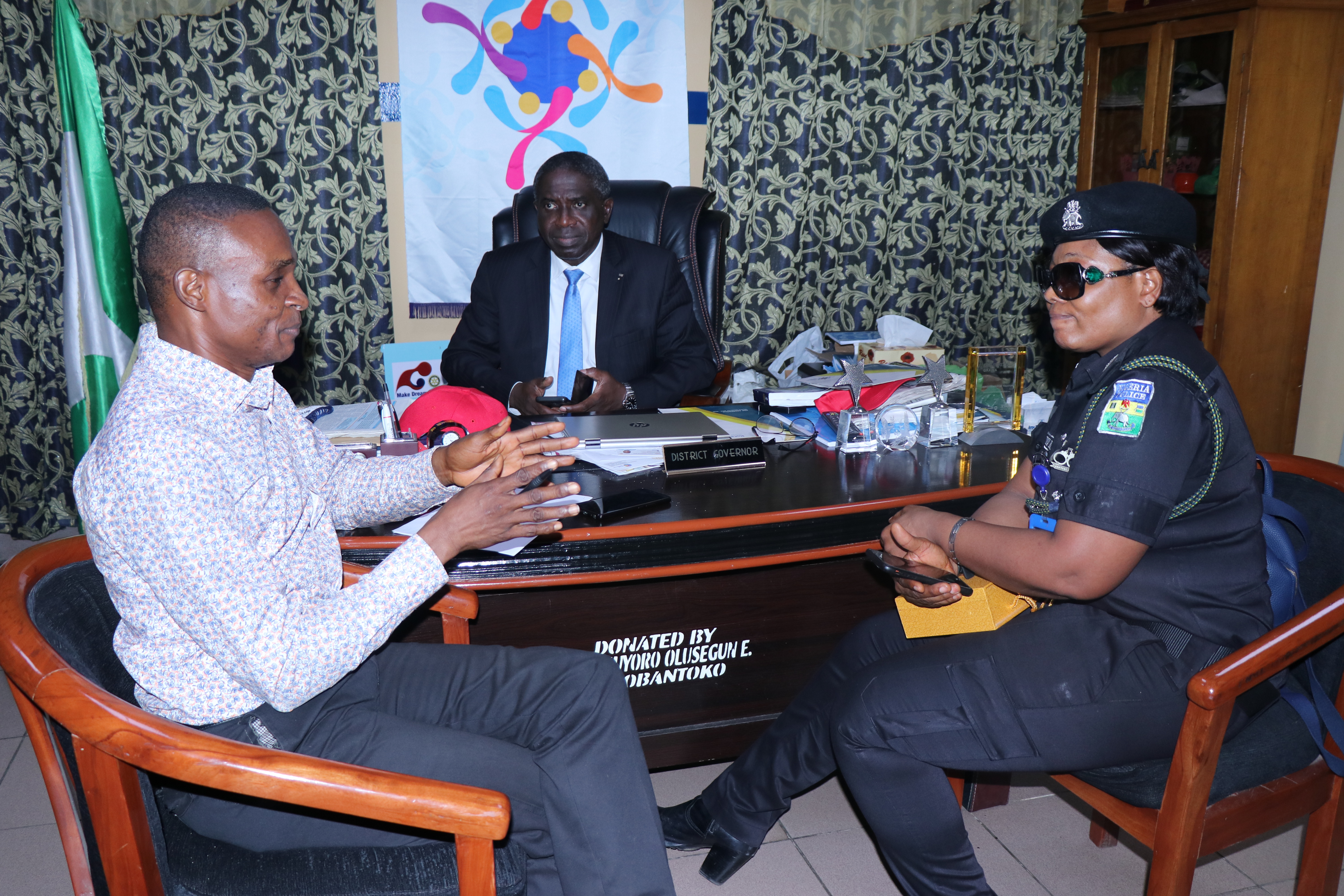
By Eric Elezuo
She hit national limelight after rescuing an armed robbery victim from imminent death. Not only did she paved his way to adequate medical attention, she also committed her resources to he tune of over a million naira to ensure that the young man was well taken care of. Ever since, Superintendent of Police Celestina Kalu, the Divisional Police Officer, Ogudu Police Station, has been receiving accolades from all and sundry for that singular act of humanity. The Anambra State-born police officer told me her story in this brief chat. Excerpt:
I know you are popular and everybody knows you but please for the benefit of hindsight, kindly introduce yourself?
Well, I have a lot of titles. I am SP Celestina Kalu and at the same time I am Rotarian Celestina Kalu.
How does it feel to be the cynosure of all eyes at the moment for what you did for that young man?
I can’t express it in words. I am really overwhelmed, and again I am very surprised. In fact, I feel I am dreaming because since October 1 when the incident went public, I’ve not known rest. People from Nigeria, and indeed all of the world have been in contact with me, some praying for me, some sending me money, others sending messages. In fact, different organisations have been coming to my office to offer me awards. Honestly, I am really humbled and at the same time excited. I never knew doing good can pay this much.
Considering the negative narrative the public has of the Police, what was it that motivated you to attend to that young man?
Passion. I think passion is it; I have passion for human beings, and every human life is important to me. Again, the ethics of my occupation was a motivation. My main objective as a police officer is to protect life and property, coupled with my Rotary background where selfless services is a watchword. So being a passionate person, police officer and Rotarian all combined to motivate me.
So what message are you sending to the public who mainly think that Police as a profession and individual sometimes have their bad side?
My Message still remains that Police is your friend; you have no other friend than the police. Do you try calling a thug whenever you are in distress? No, it’s the police you will call, and anytime you call the police they will always be there to respond to your needs.
I don’t believe this is the first act of humanity you have done in your profession, can you take us down the memory lane maybe to one or two incidents?
Sometimes ago as an upcoming officer, say 12 years ago, then I attached to the traffic section with the Ebonyi State Command. There was an accident case where I had to take the victim to the hospital, and you know the bureaucracy of the hospital, which involves going to buy card and all the rest. I had to do all these, but two hours after the guy started receiving treatment, he passed on right in my presence. I will never forget that incident. I wept that day. He was a very young man. So, when this very incident happened, I called on God and said ‘God! please, don’t let this happen again. Don’t let all my efforts to be in vain again. I want to tell a story and I thank God He answered my prayers.
Does the two incidents tell any story about our society? About 12 years ago, you took someone to the hospital, he died and no one talked about it, then 12 years after you took another person there, he made it and it went public.
I think back then the social media was not as strong as it is now. The world is a global village now. You can be anywhere and hear about what is happening everywhere; 12 years ago wasn’t like that. I think that was why it wasn’t talked about then. However, people around me know what I am capable of.
So far, many organisations and individuals have been honouring you, what has your immediate constituency, the Police done for you?
Well, we have a group, the Women Right Group that work directly with the Commissioner of Police, and they have come to my office to honour me.
Can you say that belonging to the police and being a Rotarian has a lot to do in fashioning your passionate life?
Very well
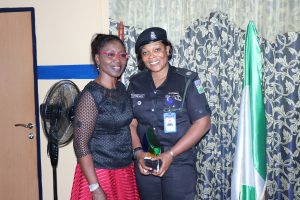
SP Celestina Kalu with Rotary club, Ikoyi president, Nkiru Balogun
How?
As a police officer, during my training, we were taught through material services, and we were trained to give first aid by the Red Cross International. We were taught a lot of things during the training, so it is part of my training. I joined Rotary in 2010, and got to know more about material services. As we all know, Police job is based on selfless and material service. Despite that, we must carry out our duties.
Kindly trace your growth in the Police force as regards positions and locations till date?
I started my career in Ebonyi State and I have served in different sections there including Traffic, Investigation and Administration. In 2010 when I was posted to Delta State, I was mobilized as a new commander in the mobile police force. There I commanded a unit of 62 men for three years.
Let’s break it down when you said men, does it have to do with masculine men because you know in the force, and men comprise male and female?
No, it is purely masculine men; they were under my supervision for the years and I never had any issues. Honestly, I had a good time in the mobile police force; it was a good experience. Every police officer should pass through the mobile training in his 35 years with the police. I was trained in Gwoza as well as Ila before I was mobilized into the mobile course for three years. For another three years, I was the spokesperson of the Delta State Police Command, that is the Police Public Relations Officer. In 2016, I got promoted to the rank of Superintendent and became the Asaba Area Crime Officer. I served for three years (2016-2018). In September 2018, I was posted to the Operation Department, of course I liked operation second to public relation. I functioned in that capacity till January 2019 when I was transferred to Lagos.
I didn’t hear you talking about going up North so far, any intention to?
I have not been posted to the north yet but I will definitely go to the north because I was born there, that is my root.
You were born in the North? Apart from being born in the north and being a Nigerian, what is your state of origin?
I am from Anambra State. I was born in Maiduguri, Borno State. I had all my education there – from nursery to university.
Question: Okay, Maiduguri explains your ability to speak more than the Igbo language?
Yes
Can you speak the Igbo Language
Yes I can speak Igbo language.
Question: Which other language do you speak?
I speak a little of Yoruba.
That means you speak Hausa and Igbo at the same time?
That’s right
Was the young man able to speak when you met him in pains? What exactly did he say to you that moved you?
He talk all through till he was wheeled to the theatre by 5am
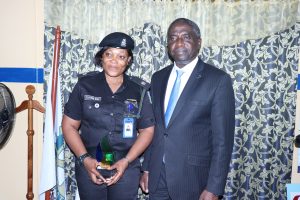
SP Kalu with District 9110 Governor, Mr. Jide Akeredolu
What did he tell you?
I actually did not take him to the hospital: my men did, and I kept in touch. He was first taken to Gbagada General Hospital where he was given first aid, they confessed that they don’t have the capacity to treat him as he would require surgery because he was shot in the stomach. So they referred to Federal Medical Centre. he was rejected at FMC as management complained of lack of space. The young man was bleeding profusely so I suggested he be moved to the Ikeja General Hospital. funny enough, we were also told that that there was no space. That was when I said ‘it’s a lie’. I ordered them to wait for me there while I drove all the way to the hospital. The time was past 12 midnight.
To my greatest surprise, the man was still sitting right inside the patrol vehicle, bleeding and hanging on a drip, when I got there. The humanity in me got angry, and I confronted the hospital saying ‘what a hell! What do you people think you are doing here; people say police is not good, now police have done their duty why can’t you people in the hospital do yours; this young man has been bleeding since God knows when’. We actually picked him up around after 9pm and it was already way past midnight and he was still in my vehicle. I asked them if they want him to die in my vehicle or die in my custody or what.
They again complained about space, but I said it was a lie, and asked my men to bring him inside the hospital because that was where he belongs not the police van or custody. They did. I therefore, approached the doctor on duty and gave him my number and N5000 with an instruction to ensure he gets treatment, no matter he does it while promising to locate his family by morning.
But as I was about leaving, the young man held me and said ‘Mummy, please I don’t want to die, please don’t leave me, please help me.’ I was transfixed. I just stood there knowing very well I couldn’t leave him alone. He was already turning white from head down. I was scared and had to go back to the doctor and asked him what he wants us to do. I know it was a matter of money so I immediately promised I will pay. That was when he told me that his his condition required surgery. I said I was ready then he started making calls and within 2 hours every doctor, surgeon and the rest were present. They told me what they needed and I started buying everything, to the last item. But getting blood became a problem; he had lost a lot of blood already was turning white. When they checked blood group it was O positive, but there was no blood in the blood bank when they checked. Incidentally, I was O positive.
You donated your own blood?
I didn’t. I volunteered to but they told me they can’t bleed in the night as there was no staff to do it. At that instant, I remembered I’ve seen in movies do watch films where they do direct transfer from a donor to a patient, so I asked them to try the method, but they declined, saying it doesn’t work that way. They said there is place where blood is sold. I took the number and called, and before I knew it, four to five bags of blood were delivered. In fact, by 5am, they wheeled him to the theatre for the operation.
Can you tell us the total amount you spent there?
I won’t know exactly, but towards the end of everything, I realised I had spent over a million naira, You will be shocked to know how the money came by
Today you are SP, are you expecting any promotion soon?
Definitely, I have to move from this position to a higher position at most in the next four years.
I mean in the shortest distance, based on this singular achievement
If promotion comes I would take it.
So what advice do you have for those who usually abandon sick people or people with bullet wounds on the road. I can see that you made progress because of your status as a ranking police officer
What happened that day has brought lots of changes, and I’m glad. I was speaking to the CMD at the hospital when I went there to recount my experience he promised me that he has changed tthe rule of ‘don’t bleed in the night or no bleeding by weekend’. The rule has been changed. Again, when Governor Babajide Sanwo-Olu was honouring me, he told me that I have inspired him to go check the hospitals at random times, to make sure that certain things are put in place in case of emergencies. The incident has brought those changes, so something good came out of it.
We join all Nigerians to appreciate your effort. Congratulations ma!
Thank you very much. Nigeria is a great country, I never knew that Nigeria could appreciate a public servant this way, honestly I really appreciate. Doing good really pays.
Is a clarion call to do good in order to attract national accolades,
Yes it’s good to be good.
I see you getting a national honour soon. Congratulations once again!
(Laughs) Thanks…looking forward to it.


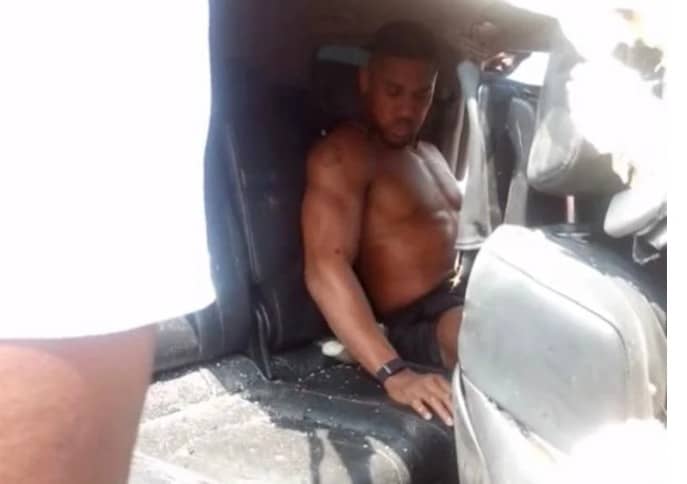
World-renowned boxer Anthony Joshua on Monday survived a ghastly road accident in Makun, Ogun State.
Eyewitnesses report that the incident occurred along a busy highway of the Lagos-Ibadan expressway.
The vehicle carrying Joshua, a Lexus Jeep with the number plate, KRD 850 HN, reportedly collided with a stationary truck under circumstances that are still being investigated.
Joshua reportedly sustained minor injuries, while two persons were said to have died on the spot.
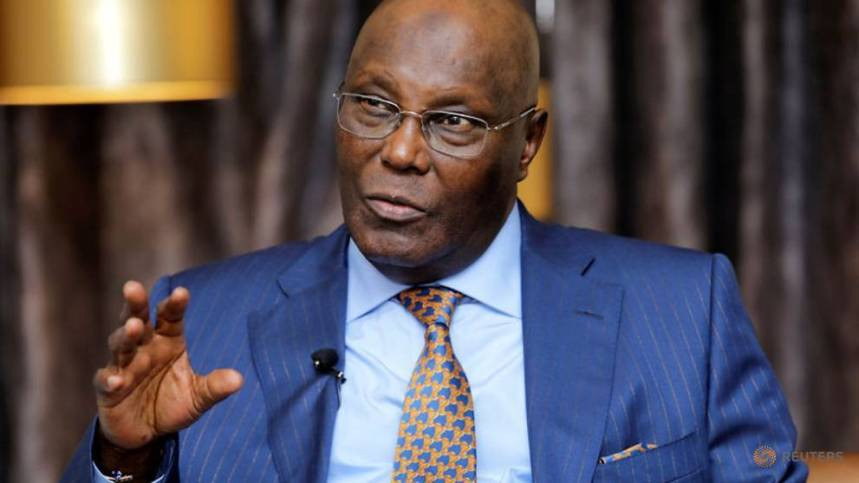
Former Vice President Atiku Abubakar has cautioned that any attempt to hurriedly re‑gazette Nigeria’s new tax laws could undermine parliamentary oversight and set a dangerous constitutional precedent.
Atiku’s warning follows public scrutiny over reports that the Tax Reform Acts signed by President Bola Tinubu differ from the versions passed by the National Assembly. Lawmakers, including Abdussamad Dasuki, raised concerns that the alterations could pose serious legal and constitutional risks, noting that they were not backed by any constitutional framework.
In a statement on X, Atiku said the directive to re-gazette the Acts effectively confirms “that the gazetted version of the Tinubu Tax Act does not reflect what was duly passed by the National Assembly,” calling it “a grave constitutional issue.”
He emphasized that under Section 58 of the 1999 Constitution, a bill only becomes law after passage by both chambers, presidential assent, and gazetting.
“Gazetting is merely an administrative act of publication. It does not create, amend, or validate a law,” Atiku said, adding that any post-passage insertion, deletion, or modification without legislative approval constitutes forgery rather than a clerical error.
Atiku further warned that rushing a re-gazetting while legislative investigations are ongoing “undermines parliamentary oversight and sets a dangerous precedent,” stressing that the only lawful approach is “fresh legislative consideration, re-passage by both chambers, fresh presidential assent, and proper gazetting.”
The former vice president clarified that his position is not opposition to tax reform but a defence of constitutional order.
“This is a defence of the integrity of the legislative process and a rejection of any attempt to normalise constitutional breaches through procedural shortcuts,” he said.
The Federal government has denied wrongdoing, insisting the laws will take effect as scheduled on January 1, 2026, while the National Assembly has directed the issuance of Certified True Copies of the Acts to ensure clarity and accuracy.
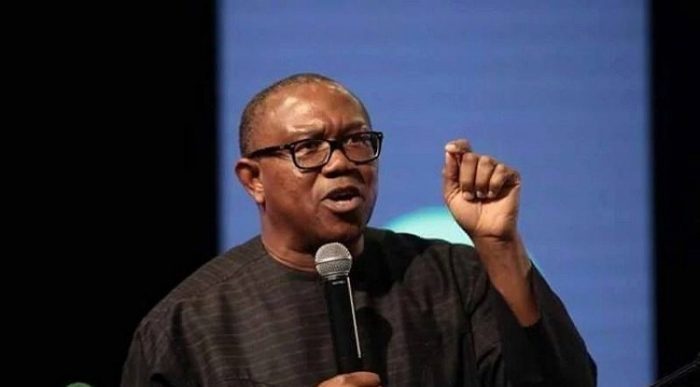
Barring unforeseen circumstances, the Labour Party (LP) Presidential Candidate in the 2023 elections, Mr. Peter Obi, is set to formally join the African Democratic Congress (ADC) on December 31, 2025.
The development would put to rest months of speculation about where the former Governor of Anambra State would pitch his tent in the coming elections.
Reports claim that Obi would be defecting with serving senators and other lawmakers elected on the platform of the LP, as well as remnants of the Peoples’ Democratic Party (PDP) in the South East region.
Specifically, Obi would be defecting alongside the Senator representing Anambra Central, Victor Umeh; that of Anambra North, Tony Nwoye; Abia South, Enyinnaya Abaribe; PDP chieftain Ben Obi; and members of the Obidient movement in the region.
It is not clear if the Abia State governor, Alex Otti, is part of the planned movement to the ADC.
The governor was recently approached by the PDP to join the party and re-contest his current position in 2027.
Further reports quoted Obi’s spokesperson, Valentine Obienyem, as confirming the planned defection of his boss to the ADC.
“Yes, it is true,” he reportedly said on Sunday.
Senator Umeh said the event would hold in Enugu, adding that it would involve all Obi’s supporters across the South East region.
“They will come from Abia, Anambra, Ebonyi and Imo states to join those in Enugu, where this exercise will hold on 31st December,” he reportedly added.
Sources hinted that Obi, who has not hidden his intention to appear on the ballot in 2027, would contest the presidential ticket of the ADC.
On his part, Chief Chekwas Okorie, reportedly said that the expected formal defection of Obi to the ADC is a healthy development that could reshape the thinking and permutations of the 2027 general elections.
“I imagine that he would be defecting along with most of his associates and followers. I believe that a fortified and strong ADC will add value to the opposition and assuage the general fear of a possible one-party option to Nigerians come 2027. The APC, ADC and possibly the PDP locking horns in the 2027 democratic encounter promises a vibrant and robust electioneering campaign that will provide Nigerians the required options to make informed choices in electing their preferred leaders at all levels. I imagine that the APC leadership will return to the drawing table to map out the strategy to confront the emerging challenge. Nigerians are in interesting times,” Okorie stated.
National President of Njiko Igbo Forum (NIF), Rev Okechukwu Obioha, vouched support for Obi to ensure he reaches the pinnacle of his political career. He, however, cautioned that the ADC should not compromise merit and integrity in the choice of its presidential candidate, stressing that Obi remains the “hope for the restoration of the country on the path of greatness.”


