
Business
Priority Investments in Infrastructure, Core Industries Will Boost Nigeria’s Economy – Dangote

- /home/rhoncare/pointblank.ng/wp-content/plugins/mvp-social-buttons/mvp-social-buttons.php on line 27
https://pointblank.ng/wp-content/uploads/2019/05/Dangote.jpeg&description=Priority Investments in Infrastructure, Core Industries Will Boost Nigeria’s Economy – Dangote', 'pinterestShare', 'width=750,height=350'); return false;" title="Pin This Post">
- Share
- Tweet /home/rhoncare/pointblank.ng/wp-content/plugins/mvp-social-buttons/mvp-social-buttons.php on line 69
https://pointblank.ng/wp-content/uploads/2019/05/Dangote.jpeg&description=Priority Investments in Infrastructure, Core Industries Will Boost Nigeria’s Economy – Dangote', 'pinterestShare', 'width=750,height=350'); return false;" title="Pin This Post">
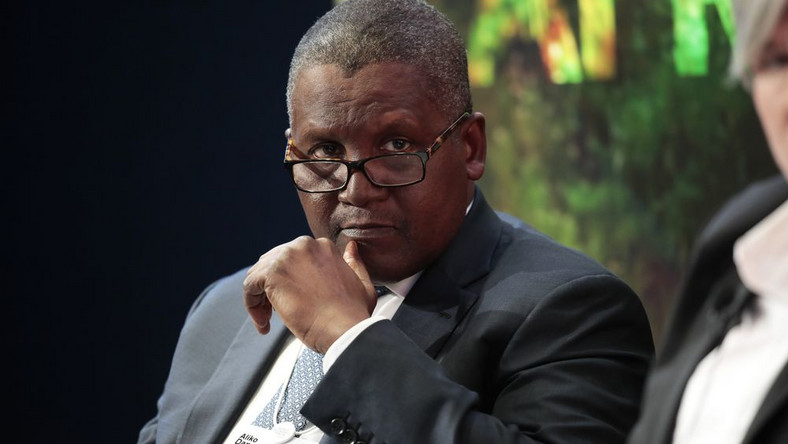
Business magnate and President of Dangote Group, Aliko Dangote has identified priority investments in infrastructure and core industries among other recommendations, as vital panaceas to boost Nigeria’s economy to its desired level among contemporary nations and in the world overall.
Against the background of the declining fortune of the manufacturing sector, the Africa’s wealthiest man urged the Federal Government to employ strategic
investments in infrastructure to reverse the trend and boost Nigeria’s economy to its desired level among contemporary nations and in the world over.
In his address as Guest Speaker at the landmark 50th Annual General Meeting of the Manufacturers Association of Nigeria (MAN) and the 2nd Adeola Odutola Lecture held in Lagos, Dangote expressed optimism that with the collective effort of all stakeholders, it is feasible to move Nigeria from “developing nation” to “newly industrialized nation”.
A statement obtained by the National Association of Online Security News Publishers (NAOSNP) quoted the Africa’s richest man as saying that it is imperative that the familiar challenges limiting the pace of industrialisation are frontally addressed while setting a clear-cut agenda for the next 10 years. He identified priority investments in infrastructure and core industries among other recommendations, as vital panaceas to boost Nigeria’s economy to its desired level among contemporary nations and in the world overall.
During the AGM, themed: “An Agenda for Nigeria’s Industrialization for the Next Decade”, where a Blueprint for the Accelerated Development of Manufacturing in Nigeria 2.0 was unveiled, the foremost entrepreneur advocated jail terms for dealers in foreign textile materials in order to discourage imports and boost local production in the textile industry. For legislative backup, he also sought the enactment of a law prohibiting the sale of imported fabrics in the country.
Dangote identified various measures which needed to be put in place to allow Nigeria speed up its industrialization process and development growth. These measures included investment in infrastructure; creation of business-enabling Policy Framework; development of core industries; macroeconomic stability; facilitation of sectoral linkages and sustaining of the federal government’s recent efforts at ensuring security of lives, properties and investments across the nation.
The business titan examined the performance of the industrial sector in Nigeria; identified the nexus between industrialization and economic development with Nigeria and China as case study; analyzed the manufacturing sector in the country with focus on its growth trajectory, current status and challenges, and set an agenda for the next ten years with an implementation roadmap.
According to him, “the experience in various parts of the world has shown that industrialization drives economic growth & development, which improves living standards as evident by the high output and per capita income in industrialized countries.
“The rate of industrialization in Nigeria has been slow as evidenced by the low contribution of manufacturing to GDP, poor capacity utilization and constrained export of manufactured products within and outside the continent. For instance, Nigeria’s share of world output of 0.41%, ranked 29th in the world which is unimpressive, considering its size and resource endowments. It ranks poorly, when compared with India at (3.1%), South Korea (3.0%) and China (28.7%).
“Nigeria’s industrialization process has been greatly challenged by structural and institutional constraints, particularly funding. These factors have over the years cumulatively contributed to its disappointing performance. For instance, in the last decade, average share of manufacturing value added to GDP in countries like China and Malaysia stood at 41% and 38% respectively; compared to 25% in Nigeria.
“In terms of capacity utilization, a major performance indicator which reflects the ability of manufacturing companies to meet rising demand without increasing cost, Nigeria achieved a rate of 55% compared to 76% and 78% in China and South Africa respectively. The country’s dwindling industrial performance has significant socio-economic implications, as poverty and unemployment continue to rise.
“From 1960 to 2003, the development trajectory of China by far outpaced that of Nigeria within the same period even though Nigeria began on a seemingly better footing. It is therefore important to track back to where Nigeria “dropped the ball” with a view to repositioning the country to the path of growth, development, and social upliftment.
“Based on the comparative analysis of Nigeria and China, one can safely make the following deductions (i) the numerical strength of a nation (population) can indeed be translated into economic wealth (ii) steady growth in manufacturing output is possible when the operating environment is conducive; (iii) no nation can easily transit from “developing” to “newly industrialized” without a vibrant manufacturing sector; (iv) effective implementation of long term plans backed with policy consistency will promote enduring economic growth and development”, the industrialist added.
According to Dangote, “Nigeria’s manufacturing sector is dominated by light manufacturing with only a few firms operating in the heavy segment of the sector. There are several factors that need to be in place to accelerate the growth of the manufacturing sector in Nigeria. These include: security and rule of law, industry-oriented government policy; adequate infrastructure; industry-oriented Research & Development (R&D); a well-developed SME sector; building of human capacity, and embrace of technology to improve efficiency through automation of manufacturing processes.
On current status of the manufacturing sector, Dangote noted that manufacturing was singled out in the Nigerian Industrial Revolution Plan (NIRP) as the driver of industrialisation and economic growth.
“The contribution of manufacturing to Real GDP in Nigeria contrasts with what was obtained in countries like China (27.16% in 2019); Germany (19.11%); Japan (20.74%) and South Africa (13.53%). To drive industrialization and sustained economic growth in Nigeria, it is important that deliberate policies that are manufacturing-specific should be designed to support manufacturing activities and address the perennial challenges of the sector. It is important to note that the current government policies, if fully implemented, are good enough to address most of the challenges we are now facing,” he said.
Among manufacturing challenges, he identified acute shortage of forex; dearth of long-term funds; limited infrastructure; policy inconsistency/implementation/ enforcement; over-regulation; multiple and high taxes for the industries (the manufacturing sector is beset with over thirty statutory taxes, levies, fees, etc. charged at multiple tiers of government), and insecurity.
According to Dangote, “In consideration of the afore-mentioned challenges, there is an urgent need for a shift in policy approach and strategy to reposition the manufacturing sector for growth over the next ten years. It is imperative that the familiar challenges limiting the pace of industrialization are frontally addressed while setting a clear-cut agenda for the next 10 years.”
While setting an agenda for the next 10 years, Dangote said, “To achieve industrialization goals, it is necessary for a nation to formulate plans and policies that will enhance and sustain industrial development. Sustainable industrial development involves establishment of a conducive environment to encourage investment and ensure efficient usage of resources to increase productivity and growth of the nation.
“Nigeria needs to henceforth intensify efforts at promoting industrialization with specific focus on the attainment of the following targets in the next 10 years: 15% manufacturing sector growth, 20% manufacturing contribution to GDP, 15% growth in export of manufactured products, 10% increase in the share of manufacturing to total export merchandise, stronger inter-industry linkage between SMEs and large corporations, improved manufacturing contribution to Government tax revenue and 20% increase in manufacturing employment”, he added.
In his conclusion, Dangote noted that, “The drive to transform Nigerian into an industrialized nation has been a consistent goal of successive governments since independence. It is therefore, imperative that we focus on sectors with great potential for inclusive growth. Sustainability must be central to our industrial development agenda.
“There is also the need for government (at all tiers) to ensure that they consult widely with relevant stakeholders when taking far reaching decisions on key sectors of the economy. This will make it much easier for manufacturers to make long-term business plans. In addition, policies that have been “tried- and- tested” should be backed with an Act of parliament to give them legal backing and make them less susceptible to arbitrary changes by successive governments.
“Industrialization, driven by manufacturing, has the capacity to facilitate enduring economic growth. The transition mechanism entails the availability of required resources, adoption of appropriate technology, provision of favourable operating environment, human capital development, stable macroeconomic environment and adequate infrastructure. With the collective effort of all stakeholders, it is feasible to move Nigeria from “developing nation” to “newly industrialized nation” status within the next 10 years,” he added.


Nigeria’s leading voices in art and architecture will converge in Lagos as AD Consulting partners Ecobank Nigeria to present The Convergence: The Iconic Architect & the Icons of Art, a landmark cultural experience celebrating Nigeria’s creative excellence, heritage and legacy.
Scheduled to run from October 1 to 7, 2026, at the Ecobank Pan African Centre (EPAC), Ozumba Mbadiwe Avenue, Victoria Island, Lagos, the event will bring together internationally acclaimed architect Olajumoke Adenowo, Founder of AD Consulting, and some of Nigeria’s most distinguished visual artists for an immersive exploration of the relationship between architecture, art and African heritage.
Among the artists whose works will feature are Abiodun Olaku, Bunmi Babatunde, Kehinde Adewuyi, Tayo Quaye, Mufu Onifade, Alex Nwokolo, Fidelis Odogwu, Kassi Nathalie, Dotun Popoola, Steve Ekpenisi, Collins Abinoro and Joshua Nmesirionye among others.
Speaking on the concept behind The Convergence, Olajumoke Adenowo, Founder, AD Consulting, said: “Architecture and art are two of the most enduring expressions of who we are as a people. They tell our stories, preserve our heritage and give form to the values we want to pass on to future generations. The Convergence brings these two powerful voices together to celebrate Nigeria’s extraordinary creative heritage while creating a space for new conversations about identity, beauty, ownership and legacy.”
She added: “This is not simply an exhibition. It is an intentional meeting of architecture, art and people who understand that some of the most valuable things we can leave behind are not merely possessions, but ideas, culture and a sense of who we are. Through NeoHeritage, The Convergence creates a contemporary expression of our heritage while looking confidently towards the future.”
Also speaking, Austen Osokpor, Head, Marketing & Corporate Communications, Ecobank Nigeria, said the partnership represents an opportunity to support African creative excellence while creating a platform where culture, creativity, private wealth and enterprise intersect.
According to Osokpor, “Africa’s wealth is not defined by financial capital alone. Our culture, creativity, intellectual capital and heritage are equally important assets that must be preserved, celebrated and passed on to future generations. The Convergence gives us an opportunity to support this broader definition of African wealth by bringing together exceptional artists, architects, collectors and cultural patrons in one powerful experience.”
He added: “For Ecobank, this is more than an event. It is about creating meaningful platforms that connect people, ideas and opportunities, while reinforcing our commitment to African excellence. We are delighted to partner with AD Consulting and Olajumoke Adenowo on an initiative that places Nigerian creativity firmly within the wider African and global cultural conversation.”
Unlike a conventional exhibition or art fair, The Convergence has been conceived as a platform for dialogue, exploring how art and architecture shape identity, preserve cultural memory and create enduring legacies.
At its heart is Adenowo’s Neo Heritage philosophy, which connects Africa’s rich cultural inheritance with contemporary creative expression.
The experience is built around three design pillars: Light, Zeitgeist and The 4th Dimension.
The Convergence will open on October 1 with an exclusive Collectors & Patrons evening curated for invited collectors, patrons, high-net-worth individuals and distinguished guests.
The opening will provide an intimate opportunity to experience the exhibition, engage with participating artists and explore the works within a setting centred on art, architecture, ownership, cultural stewardship and legacy.
The programme will include curated viewing opportunities, conversations with artists and creative leaders, and experiences designed to foster meaningful connections among collectors, patrons, architects and cultural leaders.
The wider exhibition will continue from October 2 to 7, giving a broader audience the opportunity to experience the works and engage with the ideas underpinning The Convergence.
The programme will also feature a Patron’s Preview, Founders’ Cocktail featuring an Architecture Salon by AD Consulting, and a Collectors’ Circle, offering opportunities for private viewings and deeper engagement with the artists and their work.
Nigerians at home and in the Diaspora seeking to participate in the landmark Initial Public Offering (IPO) of Dangote Petroleum Refinery and Petrochemicals can subscribe conveniently through Zenith Bank, a receiving bank for the historic transaction and a designated electronic application channel for the offer. Subscription is open through the Zenith Bank website, the Zenith mobile app, internet banking, USSD, corporate internet banking and any Zenith Bank branch nationwide.
Across all of these channels, anchored by Zenith Bank’s network of 456 branches and 84 cash centres, investors enjoy a secure, fast and reliable route into the offer from anywhere in the world, at any hour. Whether the application begins on a phone in London, a laptop in Houston or across the counter of a Zenith banking hall in Lokoja, the path to ownership opens with a few taps and carries the investor smoothly through to completion.
Every subscription is linked to the investor’s Bank Verification Number, a seal of identity and security that accompanies each application from submission to allotment.
It is service the Zenith way: first-time and seasoned investors alike enjoy a straightforward and fully protected process, and the quiet confidence that their stake in history is processed through Zenith Bank.
Applications open on Monday, 14 September 2026 and run for 30 days, closing on Tuesday, 13 October 2026. According to the prospectus, the shares are offered at ₦525 each, with a minimum subscription of 10 shares, or ₦5,250. The offer seeks to raise ₦2.15 trillion, the largest equity offering ever undertaken on the African continent, and the prospectus further provides that retail investors who subscribe and hold their shares may qualify for bonus shares under the Retail Investor Incentive Programme, subject to regulatory approvals.
Zenith Bank stands ready to make participation effortless for investors who choose to take part. Nigeria’s largest bank by Tier-1 capital and the country’s most profitable bank, Zenith has built its reputation on combining scale with innovation, and that strength is now at the service of every investor in this offer. This is proven ground for the bank: Zenith Bank’s own most recent public offering was executed mainly through digital channels, a demonstration of digital readiness built on the bank’s robust digital infrastructure. That infrastructure has since been strengthened further through a comprehensive technological overhaul, positioning Zenith to serve its retail customers with the same excellence long enjoyed by its corporate clients, precisely the capability an offer of this scale demands.
Within the wider transaction, Quantum Zenith Capital & Investments Limited serves among the joint issuing houses, while Zenith Bank itself provides the secure and dependable channels through which applications are received and processed. Having successfully taken its own landmark offer to the market through digital channels, Zenith brings that same tested infrastructure and experience to the largest equity offering in African history. It is the same combination of financial strength, digital excellence and customer devotion that has earned Zenith Bank recognition year after year as one of Africa’s foremost financial institutions, trusted by millions of customers and by the corporates and governments behind the continent’s biggest transactions.
For over three decades, Zenith Bank has been the trusted gateway to Nigeria’s defining financial moments, and its channels are open for this one. Investors who wish to participate can fund their Zenith Bank account and subscribe through any of the bank’s platforms before the offer closes on 13 October 2026.
Please note that the details of the offer are provided in the prospectus and guided by extant regulations. Zenith Bank serves as a Receiving Bank and electronic application channel for this offer. Investors are advised to carefully read the Prospectus and, where appropriate, seek independent professional advice before making any investment decision.
Ecobank Nigeria has called on young Nigerians, particularly students, innovators, entrepreneurs, and creatives aged 16 to 25, to take advantage of the ongoing registration for InnovateX 2026, the Bank’s flagship youth innovation challenge offering ₦20 million in prizes, mentorship, business development support, and access to industry experts.
Powered by Blaze by Ecobank in partnership with Verve, InnovateX 2026 is designed to identify and support the next generation of innovators and creators developing solutions across inclusive finance, as well as the creative economy.
Beyond the financial support, participants will benefit from an intensive innovation journey featuring hybrid bootcamps, expert-led workshops, mentorship sessions, networking opportunities, and a grand finale pitch competition where finalists will showcase their ideas before a panel of industry leaders and investors.
The competition is open to young Nigerians working on innovative projects in technology, engineering, science, product design, content creation, digital media, entertainment, fashion, and other creative disciplines.
Encouraging young Nigerians to register, Victor Yalokwu, Head, Products & Analytics, Ecobank Nigeria, said: “Nigeria is blessed with an abundance of young talent, creativity, and entrepreneurial energy. Through InnovateX, we are providing a platform for young people to transform bold ideas into impactful solutions and sustainable businesses. We encourage students, innovators, tech enthusiasts, creators, and entrepreneurs across the country to seize this opportunity and take their ambitions to the next level.”
He added: “The future belongs to young people who are willing to innovate, solve problems, and create value. InnovateX is designed to equip participants with the knowledge, mentorship, exposure, and resources they need to succeed in today’s highly competitive and technology-driven world.”
Yalokwu further explained that InnovateX is not just about rewarding great ideas, but also about building confidence, nurturing talent, and connecting young people to opportunities that can help them grow personally and professionally. “Whether you are developing a tech solution, building a creative brand, or working on an innovation that can improve lives, InnovateX provides a valuable platform to showcase your potential and accelerate your journey towards success,” he said.
As part of its commitment to youth empowerment, Ecobank continues to provide innovative banking solutions through the Blaze Account, a youth-focused offering that gives customers access to exclusive opportunities, a uniquely designed debit card, free monthly transfers, and participation in initiatives such as InnovateX.
Young Nigerians interested in participating are encouraged to submit their applications through www.innovatex.africa before the registration deadline.
With ₦20 million up for grabs and a unique opportunity to gain mentorship, skills, exposure, and industry recognition, InnovateX 2026 is poised to become one of Nigeria’s most impactful youth innovation and entrepreneurship programmes.


