
News
Sermon: Dreams Die: Build a Legacy


- Share
- Tweet /home/rhoncare/pointblank.ng/wp-content/plugins/mvp-social-buttons/mvp-social-buttons.php on line 69
https://pointblank.ng/wp-content/uploads/2019/05/Dreams-1000x600.jpg&description=Sermon: Dreams Die: Build a Legacy', 'pinterestShare', 'width=750,height=350'); return false;" title="Pin This Post">
By Babatunde Jose
“O Prophet! Truly We have sent thee as a Witness, a Bearer of Glad Tidings,
and a Warner, And as one who invites to Allah’s (Grace) by His leave, and as a Lamp spreading Light. (Quran 33:45-46)
In this verse of the Quran, Allah summarizes the legacy of Prophet Muhammad as the harbinger of good tidings, the warner, the summoner unto Allah, and as the lamp spreading light in a world that was plunged in darkness; a man who delivered a message to humanity that enlightened every aspect of human life, carrying with it solutions to every problem that humanity would ever face – political, economic, social, judicial, moral and spiritual – for all times, places and people, to take mankind from the darkness and oppression of man-made ways of life and systems to the light and justice of the System from the Lord of the Worlds.
There are many great characters in history, but none of their legacies impacted the world nor shaped the politics and lives of nations to the extent that the life and legacy of Prophet Muhammad. Indeed he was the most influential man in history, as agreed by many historians and writers, including Michael H. Hart, the American author, who ranked Muhammad as number 1 in his book, “The 100 Most Influential Persons in History”, writing, “Of humble origins, Muhammad founded and promulgated one of the world’s great religions and became an immensely effective political leader. Today, thirteen centuries after his death, his influence is still powerful and pervasive.”
First, is the unparalleled political system he pioneered and left behind through the Revelation of Allah – a system that was emulated by the Muslims following his death – and continued for 1300 years – right from the Khilafah Rashidun of Abu Bakr, Umar bin Al Khattab, Uthman bin Affan, and Ali ibn Abu Talib, through the Umayyad, Abbasid, and Uthmani Khilafah until the destruction of this magnificent state at the hands of the western colonialists and their agents in 1924.
It was a political system that was the embodiment of guardianship and care of the people and whose distinctive qualities were justice and accountability in governance as acknowledged by Muslims and non-Muslims alike. A system fashioned upon the words of Allah in Surah an-Nisa: “O ye who believe! Stand out firmly for justice, as witnesses to Allah, even as against yourselves, or your parents, or your kin, and whether it be (against) rich or poor: For Allah can best protect both. Follow not the lusts (of your hearts), lest ye swerve, and if ye distort (justice) or decline to do justice, verily Allah is well acquainted with all that ye do.” (Quran 4:135)
Apart from leaving a legacy of a sound political system based on justice, fairness and equity, the Prophet also left a legacy of good leadership. The Caliber of Leaders the Prophet left behind can be gleaned from the life of the Khalifs: Leaders who truly understood their heavy duty to be the guardians and servants of their people, caring for their every need. The prophet said: “Each of you is a guardian and each of you is questioned over his subjects, the Imam is responsible over the people and he is questioned over his responsibility.”
Leaders such as Khalifah Umar bin Al Khattab who during the famine in Medina refused to eat anything but coarse food. His health began to deteriorate and he was advised to take care of himself, but he replied, “If I don’t taste suffering, how can I know the suffering of others?” This was a ruler who would patrol the streets at night to ensure every single one of his citizens had their needs met and was cared for.
He left behind a legacy of leaders who would use their own wealth to make their people rich even if they died poor – like Khalifah Umar bin Abdul Aziz. Before he became a ruler he was a rich man; in fact it took 100 camels to bring his possessions to the city. But he died with only one shirt to his name despite the Khalifah enjoying economic prosperity at the time, because he had spent his wealth for the sake of his Ummah. This was a man who refused to use even a drop of public oil to fuel his lamp for his personal affairs or even use water heated with the state charcoal for his ablution due to his immense sense of accountability over state funds. Subhanallah!
Can we say these about our leaders? Do they even understand what it means to leave a legacy of service?
A leader’s legacy is established by leaving something of enduring quality behind for the organization and its people. Effective leadership occurs when the leader strengthens others’ capacity to learn, to reflect and to extract meaning from their learning.
In essence, “legacy” is what you leave behind when you’re gone. It’s that “thing” that you did either for better or worse, and it’s most often the “thing” for which you are most remembered.
Integrity is perhaps the most important principle of leadership because it demands truthfulness and honesty. … Integrity means telling the truth even if the truth is ugly. Better to be honest than to delude others, because then you are probably deluding yourself, too. Do our leaders pass this benchmark?
Legacy is fundamental to what it is to be human. Research shows that without a sense of working to create a legacy, adults lose meaning in their life. … Being reminded of death is actually a good thing, because death informs life. It gives you a perspective on what’s important.
Let us live to leave a lasting legacy. May Allah guide us a right. It is understandable then why, George Bernard Shaw, the famous British writer and political activist once stated, “I have studied Muhammad – the wonderful man – and in my opinion far from being an anti-Christ, he must be called the Saviour of Humanity. I believe that if a man like him were to assume the dictatorship of the modern world, he would succeed in solving its problems in a way that would bring it the much needed peace and happiness: I have prophesied about the faith of Muhammad that it would be acceptable to the Europe of tomorrow as it is beginning to be acceptable to the Europe of today.”
Barka Juma’at and Ramadan Kareem


National Chairman of the African Democratic Congress (ADC), Davis Mark, has said the party will adhere to electoral rules during the 2027 elections but will resist any attempt to manipulate the process.
Mark spoke on Wednesday in Abuja when the governing council of the Savannah Centre for Diplomacy, Democracy and Development, led by Olukayode Ariwoola, former chief justice of Nigeria, visited him at the ADC headquarters.
“We hold ourselves to the highest standards of good conduct as a political party. We will play by the rules,” Mark said.
The centre’s governing council, known as the council of the wise, was reconstituted in June to engage relevant institutions and political stakeholders towards fostering peaceful, free and credible elections.
The meeting with the ADC chairman was part of the centre’s ongoing engagement with political parties ahead of the elections.
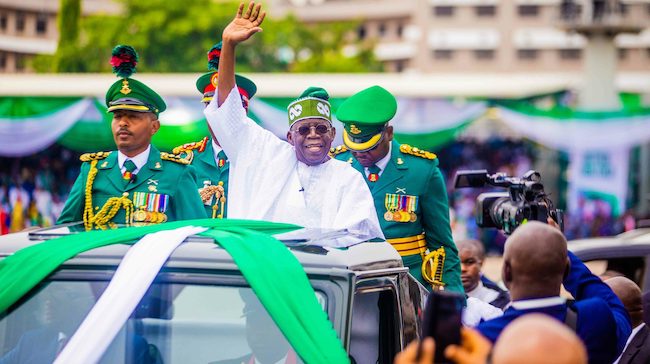
The Presidency has expressed confidence that the growing number of governors backing President Bola Tinubu gives him a stronger political structure and an advantage over opposition candidates ahead of the 2027 presidential election.
The Special Adviser to the President on Policy Communication, Daniel Bwala, said this on Channels Television’s Politics Today, arguing that the political landscape has changed considerably since the 2023 election.
Bwala said the support of governors is significant because they control political structures in their respective states and could translate their backing for Tinubu into grassroots mobilisation ahead of the election.
“Since then, President Bola Tinubu has got how many governors on his side? The governors are the Chief Executive Officers of their respective states. They coordinate the structures of the State. These people say, ‘We are putting our goodwill, our resources, our structure, and our support to the President,’” he said.
He argued that the President’s political position has also been strengthened by people who have benefited from his administration’s policies, including beneficiaries of the Nigerian Education Loan Fund (NELFund), agricultural programmes, manufacturing incentives, CrediCorp and infrastructure projects.
Bwala said the developments constitute “facts, verifiable data” which, in his view, showed that Tinubu had made progress since assuming office in 2023.
He also dismissed suggestions that the administration’s confidence ahead of 2027 is based solely on divisions within the opposition, saying its record in office would form an important part of its campaign.
His comments came amid renewed debate over Tinubu’s popularity and the ability of the opposition to challenge his bid for a second term.
Bwala dismissed an assessment by The Economist that Nigerians may re-elect Tinubu despite disapproval of his administration, arguing that claims about the President’s popularity should be backed by representative opinion surveys.
“When you make a claim that Nigerians don’t like him, without saying, also, that there are a lot of people… one million families that the children have benefited from NELFund, you think they hate him?” he asked.
He similarly cited beneficiaries of agricultural interventions, support for manufacturers and CrediCorp, arguing that such groups should be considered when assessing public sentiment towards the administration.
On concerns over rising poverty and hunger, Bwala acknowledged that more Nigerians had fallen into poverty but attributed the hardship partly to the economic reforms undertaken by the Tinubu administration.
“More people went down to poverty, I acknowledge, I’m not doubting it. But there is a ‘but’ to it. Since when the reform started to today, we have made marked progress,” he insisted.
According to him, the reforms are necessary to address longstanding economic problems, despite the short-term discomfort experienced by Nigerians.
Bwala also defended Tinubu’s statement that Nigeria has moved from the “doldrums” towards prosperity, saying the President is not suggesting that Nigerians would suddenly begin experiencing prosperity from October 1.
He cited NELFund beneficiaries, subsidised healthcare, infrastructure projects and support for small and medium-sized businesses as examples of what he described as prosperity already reaching Nigerians.
“One million families whose children have benefited from the NELFUND programme, what they are benefiting is called prosperity,” he said.
“If you go to an environment or a place where there have been no roads or any form of infrastructure, and we have established infrastructure there, what has come to them is prosperity.”
Bwala further claimed that the opposition has lost several influential political figures who played key roles in their 2023 campaigns.
He said former Vice President Atiku Abubakar no longer has the support of governors who worked for his 2023 campaign, while Peter Obi has also lost some critical political allies.
“In terms of the other candidates who say he will not win, Atiku Abubakar lost close to 25 per cent of key people that you know around him. All the governors that worked for him that time are no longer with him,” Bwala said.
“Peter Obi lost 55 per cent of the critical people that carried his campaign; they’ve all disappeared. And some of them went to Atiku, some of them went wherever they could go to.”
He consequently expressed confidence in Tinubu’s prospects in the 2027 contest, saying the political support around the President was considerably different from what existed before the 2023 election.
News
Globacom Unveils Sponsorship of 2026 Ofala Festival, Promises ‘Never Settle for Less’ Celebration
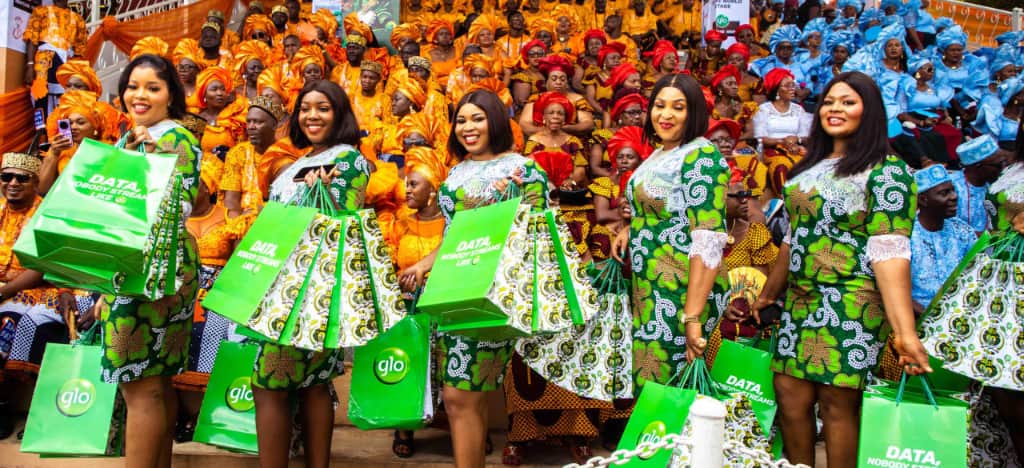
Globacom has once again demonstrated its commitment to Nigeria’s rich cultural heritage by supporting the 2026 Ofala Festival in Onitsha as the official sponsor.
The partnership, which has continued for over 15 years, highlights Globacom’s dedication to celebrating and sustaining cultural traditions that preserve identity, strengthen communities and contribute to the nation’s social and cultural development.
The 2026 edition, which marks the 25th Ofala of the reign of the Obi of Onitsha, Igwe Nnaemeka Alfred Achebe, is themed “Igba Mbo, Iga N’Iru – Strive and Advance: From Resilience to Progress.” The theme resonates strongly with the history and character of Ndi Onicha, whose story is one of resilience, enterprise, adaptability and an enduring determination to advance.
According to Globacom, its continued association with Ofala reflects the Company’s belief that cultural heritage and national development are complementary forces. “For Globacom, Ofala is more than an annual cultural celebration. It is a living expression of identity, continuity and collective aspiration. Our sustained partnership reflects our belief that preserving heritage and advancing society are not competing imperatives, but mutually reinforcing pillars of a progressive nation,” the Company stated.
The telecommunications giant added that the partnership also aligns with its “Never Settle for Less” philosophy, which encourages Nigerians to honour their foundations while continually pursuing greater possibilities. “Never Settle for Less is a philosophy of progress: to respect the foundations upon which we stand, while seeking to broaden possibilities, deepen impact and move the nation forward. We are proud to support a cultural institution that honours its roots while engaging the future,” Globacom said.
Over the years, Ofala has evolved from a sacred royal rite of renewal into a major platform for cultural affirmation, community engagement and social development. The 2026 programme features the Obi’s sacred period of seclusion and ceremonial emergence, the Medical, Health and Wellbeing Community Outreach, the international Oreze Art Exhibition, the Youth Carnival, and the grand finale of Iru Ofala and Azu Ofala.
For Globacom, supporting Ofala therefore goes beyond conventional sponsorship to represent corporate citizenship and cultural stewardship — an investment in preserving the memory, meaning and continuity of a people. The Company noted that the festival’s ability to draw strength from its ancestral foundations while embracing the future mirrors its own commitment to innovation, connectivity and digital inclusion.
As the people of Onitsha gather to celebrate another chapter in the history of the revered institution, Globacom remains proud to stand alongside them in honouring a heritage that continues to inspire generations.


