News
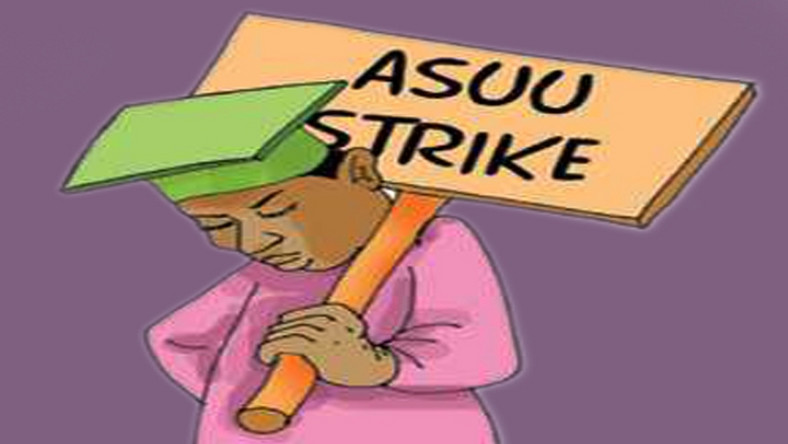
Strike: ASUU Throws Weight Behind SSANU, NASU

- /home/rhoncare/pointblank.ng/wp-content/plugins/mvp-social-buttons/mvp-social-buttons.php on line 27
https://pointblank.ng/wp-content/uploads/2019/05/ASUU.jpeg&description=Strike: ASUU Throws Weight Behind SSANU, NASU', 'pinterestShare', 'width=750,height=350'); return false;" title="Pin This Post">
- Share
- Tweet /home/rhoncare/pointblank.ng/wp-content/plugins/mvp-social-buttons/mvp-social-buttons.php on line 69
https://pointblank.ng/wp-content/uploads/2019/05/ASUU.jpeg&description=Strike: ASUU Throws Weight Behind SSANU, NASU', 'pinterestShare', 'width=750,height=350'); return false;" title="Pin This Post">
The Academic Staff Union of Universities (ASUU) has thrown its weight behind the Senior Staff Union of Nigerian Universities (SSANU) and the Non-Academic Staff Union (NASU), whose members are currently on nationwide indefinite strike.
SSANU and NASU, under the aegis of Joint Action Committee (JAC), had declared indefinite strike on Friday, May 1, 2026, protesting the Federal government’s delay in signing a new agreement with them.
The two unions, after repeated ultimata given to the Federal Government to finalise their long-standing 2009 Agreement renegotiation and come up with a new agreement and its immediate implementation, accused the Federal Government of using delay tactics to, among others, punish members for rejecting the once controversial IPPIS payment platform.
Speaking at a monthly impact dialogue organised by the Education Writers’ Association of Nigeria (EWAN) held virtually, ASUU President, Prof Christopher Piwuna, said the body language of the Federal Government delaying the signing of the new agreement with other unions in the university system called for serious concern.
He spoke on the theme “Delayed Salaries, FG Workers’ Agreement: Averting Impending Crisis in Nigerian Universities.”
The dialogue also featured the National President of SSANU, Muhammed Ibrahim, and his vice in charge of the South Zone, Dr. Abdulsobur Abdulsalam.
The Accountant General of the Federation, Dr Shamseeden Ogunjimi, as well as the Director of Tertiary Education in the Federal Ministry of Education, Joel Samuel Ojo, who were equally billed as panelists, were unable to attend.
Speaking further, Piwuna said the Federal Government should realise that industrial harmony in the university system does not mean one union is working, rather working together of all unions is required to move the entire system forward.
He noted that even though the Federal Government had already signed an agreement with ASUU and that its implementation has “remained at best rudimentary and haphazard,” leaving SSANU, NASU, and NAAT in the cold is unacceptable.
He explained why ASUU is taking that stand, saying salaries of lecturers and other workers in the system are being prepared by SSANU and NASU members and not the ASUU members.
“So, it is very unkind and unfair for the government to keep SSANU, NASU, and NAAT in the cold for four months after signing our own agreement.
“It will be very demoralizing for me, for example, to continue to prepare salaries for my colleagues in the university when I don’t even know whether my own agreement is going to be signed or not.
“And so ASUU would want to state in very clear terms and, in the clearest terms possible, that we stand with SSANU, we stand with NASU, we stand with NAAT to ensure that their collective bargaining process is ended on the table that it started.
“Even though, this position is not part of our agreement, it’s not part of what we signed with the government, I think for fairness and justice, it is very important for government to conclude with other unions without further delay.”
Piwuna, however, also expressed displeasure over the delay in salaries that ASUU members have been experiencing in the last four months, even with the signing of the agreement, declaring that ASUU is totally against such practice.
He explained that a standing resolution by ASUU is that any month salaries of members get delayed beyond the third day of a new month in any of its branches nationwide, the lecturers there should withdraw their service until their salaries are paid.
He noted, “That was the case in January when some universities sought permission from the national leadership to embark on an action, and we pacified them based on what the Minister of Education, Dr Tunji Alausa, told us then.
“The Minister told us that the delay in the full implementation of our agreement, especially salaries, was a result of the non-passage of the 2026 national budget.
“And we have stated this many times before that we don’t know which budget Nigeria operates.
“This is because recently, the government publicly claimed that some aspects of the 2024 and 2025 budgets were still in operation even at a time when passing the 2026 budget, and that part of the 2025 budget will remain operational until June or July.
“So, we don’t have a clear-cut budget cycle as a country, and this is very unfortunate.
“We were all taught, even in elementary school, that the annual budget starts and ends within one year.
“But it appears that the operators of our economy now seem to have an argument for any bad thing that they want to do.
“So, the salaries have not been consistent even though the budget has been passed.”
Piwuna, who equally accused the Federal Government of taking the issue of education development with levity, said there are lots of issues pressing for government attention to address.
He pointed out that ASUU would certainly take a concrete and comprehensive stance on each of those issues when the leadership of the union meets either on May 9 or 10.
He mentioned parts of the issues to include, but not limited to, delay in salaries payment and the establishment of the National Research Council that will be financing research and development, not setting aside the Stabilisation fund, infractions by some pro-chancellors and chairmen of governing councils, accused of interfering in the normal day-to-day running of universities, as well as a proposal to remove some academic courses from curriculum.
He said these issues are critical to the development of university education in the country and therefore need to be addressed by the government.
He declared that “ASUU is going to respond to all these issues and any other ones that may emerge before the NEC meeting.”
In his own contribution, President of SSANU, Mohammed Ibrahim, also expressed displeasure over what he described as insincerity of government in addressing challenges faced by the public universities and their workers, which the “pending new agreement is aimed to address.
According to him, university workers are supposed to be treated well to enable them to put in their best to solve part of Nigeria’s problems.
“But these delays in payment of salaries is like cancer, dampening the morale of members and generality of workers in the universities,” he stressed.
Giving insights into why JAC declared the nationwide strike, SSANU’s Vice President, Western Zone, Dr. Abdulsobur Abdulsalam, said it was simply because government had pushed them to the wall.
He accused the government of a lack of respect for collective bargaining with the unions, stating that the renegotiation process that has been taking place for more than two years could be addressed within two weeks if there is genuine intention and willingness on the part of the government.
Abdulsalam said JAC had given the government more than enough time to conclude the renegotiation process and commence implementation, but it was still delaying the process with no timeline in sight, and instead, introducing wage awards.
“So, our last ultimatum to government was till the end of April and there is nothing we can do again than to embark on strike as our last instrument to react and the action is going to be total and comprehensive,” he stressed.
Giving welcome remarks, Chairman of EWAN, Mr. Mojeed Alabi, said the move by SSANU and NASU to go on strike is not unexpected, noting that the signs were very visible for more than five months.
He, however, noted that the essence of EWAN’s monthly dialogue is to brainstorm on a workable solution to any pressing national issues as related to education with a view to moving the sector forward.
He said there is no country that can attain true economic prosperity without quality education in place.


The African Democratic Congress Presidential Campaign Council (ADC-PCC) has warned Nigerians against waiting for President Bola Tinubu to fulfil his campaign promise of providing reliable electricity.
The Council challenged the President to explain why millions of Nigerians continue to experience poor power supply despite his pledge that voters should not re-elect him if he fails to deliver electricity.
In a statement by its Director of Media and Publicity, Kola Ologbondiyan, the ADC-PCC accused Tinubu of making fresh promises during his recent campaign outings in Kaduna, Rivers and Jigawa states instead of presenting a clear account of his administration’s achievements.
Recalling the President’s campaign promise, the Council quoted him as saying: “If I don’t give you electricity, don’t vote for me for a second term.”
“Tinubu is only repeating his old electricity promise in Jigawa, while Nigerians are still waiting for answers on why reliable power supply remains out of reach,” the Council said.
The Council also questioned the whereabouts and impact of 2,000 tractors reportedly imported from Brazil under the administration’s mechanised farming programme.
It further accused Tinubu of taking credit for projects started by his predecessor, Muhammadu Buhari, while failing to show enough achievements of his own.
The African Democratic Congress Presidential Campaign Council (ADC-PCC) has declared that President Bola Tinubu will lose the 2027 election, insisting that intimidation, violence and manipulation of democratic institutions cannot prevent his exit from office.
In a statement by its Director of Media and Publicity, Kola Ologbondiyan, the Council accused the ruling All Progressives Congress (APC) of manipulating the judiciary and deploying security agencies against opposition parties.
Ologbondiyan warned that growing attacks on opposition members across the country pose a serious threat to Nigeria’s democracy.
He cited the killing of several members of the Nigeria Democratic Congress (NDC) in Delta State, allegedly following an attack on the party’s campaign venue by suspected APC thugs.
He said the incident is part of a disturbing pattern of violence against opposition parties, particularly members of the ADC, NDC and Allied Peoples Movement (APM), in Kaduna, Kogi, Katsina, Kebbi and Sokoto states.
“This is not politics. This is state-sponsored terror against democracy,” he said.
The Council also raised concerns over the preparedness and neutrality of the Independent National Electoral Commission (INEC), alleging that its voter register database had been compromised and that APC sympathisers had been deployed to sensitive positions.
It further alleged that security agencies were being used to harass, arrest and intimidate opposition members.
Ologbondiyan expressed concern over the alleged involvement of a serving director of a security agency in the APC Presidential Campaign Council as co-Director of National Security and Intelligence, describing it as a violation of the law establishing the agency.
“One thing is now very clear to all Nigerians: Tinubu is not preparing for an election. He is preparing for a coronation,” he said.
The ADC-PCC maintained that alleged manipulation of judicial processes and electoral institutions would not guarantee President Tinubu’s re-election, warning that Nigerians would resist any attempt to impose a president through compromised judicial decisions or electoral fraud.
It called on Nigerians to remain vigilant and defend their votes and democratic rights ahead of 2027.
The Council also urged the international community, civil society organisations, religious and traditional institutions to pay closer attention to what it described as the deteriorating political and security environment, warning that silence could embolden those undermining democracy.
It appealed to security agencies to remain politically neutral, stressing that their allegiance should be to the Constitution and the Nigerian people.
“Those who allow themselves to be used as tools of oppression today will answer for their actions tomorrow,” Ologbondiyan warned.

Governorship candidates of the All Progressives Congress (APC), African Democratic Congress (ADC), Nigeria Democratic Congress (NDC) and Peoples Democratic Party (PDP) in Lagos State have outlined contrasting plans to address housing, transportation, education, healthcare and the rising cost of living ahead of the 2027 elections.
At a governorship debate organised by the Nigeria Debate Consortium, the candidates, Dr. Obafemi Hamzat of the APC, Gbadebo Rhodes-Vivour of the ADC, Funsho Doherty of the NDC and Adedeji Doherty of the PDP, presented their policy blueprints and defended their credentials for seeking to govern the State.
While Hamzat, the incumbent deputy governor, pledged to sustain ongoing projects and expand infrastructure, the opposition candidates criticised the State’s development priorities, arguing that its substantial internally generated revenue had not translated into improved living conditions for ordinary residents.
Rhodes-Vivour accused successive administrations of pursuing policies that favoured the wealthy at the expense of vulnerable residents, particularly in housing and urban development.
He said Lagos needs a government that prioritises the interests of ordinary people, adding that his administration would adopt an integrated approach to urban planning, housing, transportation, education, healthcare and waste management.
The ADC candidate promised to deliver 100,000 housing units within his first four years through a combination of social housing, a proposed luxury tax and development of the state’s eastern foreshore.
He also pledged to connect Lagos’ rail lines within two and a half years through a transparent, private-sector-driven arrangement.
Rhodes-Vivour said the proposed housing programme would include a structured system allowing residents to move from smaller accommodation to larger homes as their families and financial capacities grew.
He said: “We want a cleaner Lagos. We want a safer Lagos. We want a more affordable Lagos. I want a Lagos that works for everybody, not just the privileged few.”
On urban safety, he promised to create employment opportunities for young people, particularly at the ward level, to reduce insecurity and address the activities of political thugs.
He also pledged to tackle flooding through wetland protection, improved urban design and the adoption of technologies that would allow water to flow naturally without threatening communities.
Responding to a question on Lagos’ high revenue and its impact on household welfare, Rhodes-Vivour said the government had failed to make its wealth sufficiently beneficial to ordinary residents.
He cited the demolition of structures in Makoko and the development of housing projects beyond the reach of many residents as examples of what he described as exclusionary policies.
According to him, government should concentrate on providing support for people who cannot meet their basic needs, rather than prioritising those who can afford private solutions.
He said his administration would ensure transparent allocation of housing units and prevent individuals from monopolising multiple units at the expense of other applicants.
The candidate also proposed a housing progression scheme under which young people could initially occupy affordable self-contained apartments and move into larger accommodation as their circumstances improved.
The APC candidate said his experience in government has given him an understanding of the State’s administrative systems, residents’ needs and infrastructure challenges.
He said his proposed Lagos Promise agenda is built around seven pillars, with commitments that would be measurable and open to public scrutiny.
Hamzat added that his administration would prioritise transparency, respect for residents and accountability in the implementation of policies.
He said: “I take tonight as a job interview. The job is the government of Lagos State. And you, Lagosians, will be the interviewers and the people that we actually hire.”
On transportation, Hamzat promised to complete the Blue Line to Okokomaiko and extend the Red Line towards the Trade Fair area, while integrating rail, road and water transportation.
He also pledged to provide 4,000 new compressed natural gas buses to improve mass transit and reduce the pressure on commuters.
The APC candidate said the State’s limited land area and growing population make efficient public transportation essential to its development.
On housing, Hamzat said the government has delivered 24,000 housing units over the past eight years, including 18,000 units for residents, while several projects remain ongoing.
He promised to expand access to mortgages, proposing a system requiring a 10 per cent deposit and repayment over 25 years.
According to him, the arrangement would enable residents to acquire homes without having to pay the full cost upfront.
Hamzat said the government would continue existing housing projects, including developments in Ibeju-Lekki, Badagry and other locations.
He argued that mortgage financing is necessary to make homeownership more attainable, noting that many people struggled to build houses because of the high cost of construction.
Funsho Doherty of the NDC said Lagos is operating below its potential despite its substantial revenue base and economic importance.
He argued that residents continue to face rising taxes and levies without corresponding improvements in public services.
Doherty cited the State’s budget, internally generated revenue and long period of APC administration as reasons the government should be held accountable for its performance.
He said Lagos’ challenges include inadequate healthcare, poor educational outcomes, housing affordability, water supply and electricity.
The candidate said his vision is to move the State in a new direction through policies focused on health, education, opportunity, affordable housing, jobs, small businesses and the environment.
Doherty, who said he has spent 30 years in the private sector, argued that government policies should enable residents to develop their skills, earn incomes and build sustainable livelihoods.
He promised to make public education truly free, including removing examination fees and other charges that prevent children from completing their education.
He also pledged to provide pupils in public schools with an affordable daily meal.
On housing, the NDC candidate proposed 150,000 units, supported by an ecosystem of financing, government guarantees and other measures to improve affordability.
He said the objective was to empower residents economically, adding that the prosperity of individuals would translate into the prosperity of the State.
Adedeji Doherty of the PDP said his background as a technocrat, businessman, entrepreneur and industrialist had prepared him to address Lagos’ economic and infrastructure challenges.
He said his experience in the party, which he joined in 1998, has also informed his decision to contest the governorship.
The PDP candidate identified electricity, housing and education as priority areas, arguing that inadequate power supply is limiting industrial development and economic growth.
He promised to establish a research team to develop cheaper building materials and reduce the cost of constructing homes.
Doherty also said he would focus on underserved communities, particularly the islands, which he said lack adequate primary healthcare and other essential services.
He identified the State’s debt burden, bloated ministries, departments and agencies, and inadequate support for local governments as major challenges affecting service delivery.
The candidate said his administration would reduce the number of MDAs and review government expenditure to free up resources for residents.
He argued that local governments should be adequately empowered to address community needs, while savings from reduced administrative costs could be redirected towards improving living conditions.
Doherty also promised to review electricity costs and introduce measures to put money back into residents’ pockets.