
Metro
The Trials of Leadership in National Security: Lessons, Challenges and Enduring Solutions


- /home/rhoncare/pointblank.ng/wp-content/plugins/mvp-social-buttons/mvp-social-buttons.php on line 27
https://pointblank.ng/wp-content/uploads/2025/08/DR.TOLULOPE-A.-ADEGOKE-AMBP-UN__-1-744x600.jpg&description=The Trials of Leadership in National Security: Lessons, Challenges and Enduring Solutions', 'pinterestShare', 'width=750,height=350'); return false;" title="Pin This Post">
- Share
- Tweet /home/rhoncare/pointblank.ng/wp-content/plugins/mvp-social-buttons/mvp-social-buttons.php on line 69
https://pointblank.ng/wp-content/uploads/2025/08/DR.TOLULOPE-A.-ADEGOKE-AMBP-UN__-1-744x600.jpg&description=The Trials of Leadership in National Security: Lessons, Challenges and Enduring Solutions', 'pinterestShare', 'width=750,height=350'); return false;" title="Pin This Post">
By Tolulope A. Adegoke
“True leadership in security is not measured by the strength of weapons or the reach of intelligence, but by the courage to protect the vulnerable, the wisdom to unite the divided, and the integrity to build systems that endure beyond fear — transforming the trials of today into the foundations of a safer, more just tomorrow.” – Tolulope A. Adegoke, PhD
Leadership in security matters is among the most demanding responsibilities any head of state or government can bear. It requires balancing the protection of lives and property with respect for human rights, navigating complex political pressures, managing limited resources, and responding to both visible and invisible threats. In many nations, especially in Africa, the trials of leadership in this domain reveal deep structural, historical, and human challenges. Yet, they also offer profound opportunities for authentic leadership to emerge — leadership that is ethical, strategic, inclusive, and people-centred. This write-up examines these trials through the lenses of Nigeria, broader Africa, and the wider world, before proposing comprehensive, viable, and sustainable solutions that can safeguard lives, properties, businesses, and national stability without compromising democratic values or human dignity.
The Nigerian Experience: Leadership Under Fire
Nigeria presents one of the most complex case studies of leadership trials in security. As Africa’s most populous nation and largest economy, it faces multiple, overlapping threats: Boko-Haram insurgency in the Northeast, banditry and kidnapping in the Northwest, farmer-herder conflicts in the Middle Belt, separatist agitations in the Southeast, and urban crime in major cities, which cut across the entirety.
Successive Nigerian leaders have grappled with these challenges under intense public scrutiny. The Buhari administration (2015–2023) prioritised military offensives against Boko-Haram, achieving territorial gains, but struggling with asymmetric warfare, intelligence gaps, and humanitarian consequences. The current Tinubu administration has emphasised a “whole-of-government” approach, combining kinetic operations with socio-economic interventions. However, persistent challenges such as corruption in security procurement, poor coordination between agencies, inadequate funding for intelligence, and the politicisation of security appointments continue to undermine effectiveness.
The trials here are multifaceted: limited political will in some quarters, ethnic and religious dimensions that complicate responses, inadequate technological infrastructure for modern policing, and the sheer scale of the country’s geography and population. Leadership in Nigeria’s security space has often been reactive rather than proactive, with short-term military solutions sometimes overshadowing long-term governance and development strategies.
Broader African Context: Patterns and Variations
Across Africa, leadership trials in security share common threads but manifest differently. In the Sahel region (Mali, Burkina Faso, Niger), military coups have complicated counter-terrorism efforts, with new juntas struggling to balance sovereignty concerns with the need for international support. In the Horn of Africa, Ethiopia’s leadership faced the devastating Tigray conflict, highlighting how internal political disputes can rapidly escalate into humanitarian catastrophes.
The Democratic Republic of Congo continues to battle armed groups in the East, where weak state presence, illegal mineral exploitation, and regional interference create a vicious cycle. South Sudan and Somalia illustrate the immense difficulty of building security institutions from near-zero capacity after prolonged conflict.
What unites these cases is the tension between sovereignty and effectiveness, limited state capacity, and the challenge of addressing both immediate security threats and underlying drivers such as poverty, youth unemployment, and governance deficits. Leadership that succeeds tends to combine military resolve with political inclusion and development-focused interventions. Failures often stem from over-reliance on force, exclusionary politics, or inability to coordinate national and regional responses.
Global Perspectives: Universal Lessons
Globally, leadership trials in security are equally evident. The United States has faced challenges in balancing domestic security with civil liberties, particularly in the post-9/11 era. Colombia’s long struggle against FARC and drug cartels showed how sustained leadership, institutional reform, and international partnerships can eventually yield results. Sri Lanka’s post-civil war experience highlights both the possibilities of reconciliation and the dangers of majoritarian policies that alienate minorities.
These global cases reinforce a key lesson: authentic security leadership is never purely military. It requires integrating intelligence, law enforcement, justice, development, and diplomacy. Leaders who ignore any of these elements often achieve temporary calm at the cost of long-term instability.
The Hallmarks of Authentic Leadership in Security
Authentic leadership in security matters is defined by several non-negotiable traits:
- Strategic Foresight: Anticipating threats through robust intelligence and early warning systems.
- Ethical Balance: Protecting citizens without violating their rights.
- Inclusive Approach: Ensuring security policies do not disproportionately target specific ethnic or religious groups.
- Institutional Building: Investing in professional, well-equipped, and accountable security agencies.
- Transparency and Accountability: Regular public reporting and independent oversight.
- Regional and International Cooperation: Recognising that no nation can secure itself in isolation.
Comprehensive Solutions and the Way Forward
To overcome these trials, the following integrated solutions are recommended:
For Nigeria: Building a Cohesive National Security Architecture
- Creation of a National Security and Development Council: This high-level body should bring together security agencies, economic ministries, state governors, traditional rulers, and civil society to align security strategies with socio-economic interventions. Regular town hall meetings should be institutionalised to incorporate grassroots perspectives.
- Community-Oriented Policing and Intelligence Reform: Strengthen community policing by recruiting and training local officers who understand cultural dynamics. Establish neighbourhood watch systems with legal backing and technology support (CCTV, drones, and data analytics) to improve early warning and response.
- Youth Empowerment and Deradicalisation Programmes: Launch a National Youth Security and Prosperity Initiative targeting at-risk youths with vocational training, entrepreneurship grants, mentorship, and psychological support. Partner with faith-based organisations and traditional leaders for culturally sensitive deradicalisation efforts.
- Security Sector Reform and Professionalisation: Increase funding for training, welfare, and modern equipment while introducing performance-based promotions and independent oversight boards to reduce corruption and improve accountability.
- Judicial and Legislative Strengthening: Fast-track security-related cases through specialised courts and ensure adequate funding for the justice system to reduce impunity.
For Africa: Continental and Regional Solutions
- Strengthening the African Peace and Security Architecture (APSA): The African Union should fully operationalise the African Standby Force with dedicated funding and rapid deployment protocols. Regular joint exercises with Regional Economic Communities (RECs) will improve interoperability.
- Establishment of an African Security Academy: A continental institution to train a new generation of ethical, professional security leaders in modern intelligence, counter-terrorism, cyber security, and human rights-compliant operations.
- Harmonised Migration and Border Management Framework: Develop clear, humane policies that facilitate legal labour mobility while strengthening border controls against criminal networks. Joint border posts and shared intelligence platforms between ECOWAS, SADC, and IGAD would reduce irregular migration pressures.
- Economic Integration as Security Strategy: Accelerate the African Continental Free Trade Area (AfCFTA) implementation with special focus on youth employment, women’s economic empowerment, and cross-border value chains. Shared prosperity reduces the desperation that fuels conflict and migration.
Global and Systemic Solutions
- Responsible International Partnerships: Global partners should shift from short-term military aid to long-term capacity building in governance, justice, and economic development. Support should be conditioned on transparency and human rights compliance.
- Diaspora Engagement Frameworks: African governments should create structured programmes to harness the skills, capital, and networks of the diaspora for national development and peacebuilding.
- Global Norms on Arms Control and Conflict Financing: Strengthen international cooperation to curb the flow of small arms and illegal minerals that fuel African conflicts.
Building a United Africa Mindset: Cultural and Educational Transformation
Sustainable security requires changing how citizens think. A genuine United Africa mindset can be cultivated through:
- Pan-African Education Curriculum: Teach shared African history, Ubuntu philosophy, and success stories of regional cooperation from primary school onwards.
- Youth and Cultural Exchange Programmes: Expand scholarships, sports tournaments, arts festivals, and technology bootcamps that connect young Africans across borders.
- Media and Storytelling Initiatives: Support content creators who highlight positive intra-African collaboration and shared identity.
- Citizen Diplomacy Platforms: Encourage town twinning, joint community development projects, and people-to-people initiatives between different African nations.
Conclusion: Leadership as the Bridge to Enduring Security
The trials of leadership in security matters reveal both the fragility and resilience of states. In Nigeria, Africa, and the wider world, the challenges are immense, but they are not insurmountable. Authentic leadership — courageous, ethical, inclusive, strategic, and people-centred — remains the most reliable bridge between threat and safety, between division and unity, between fragility and resilience.
The way forward demands a fundamental shift: from reactive security to proactive peace-building, from militarised responses to holistic development, and from narrow national interests to enlightened regional solidarity. When leaders embrace this higher calling, they do not merely manage crises — they transform societies.
Africa, and indeed the world, does not need perfect leaders. It needs honest, committed, and visionary ones who understand that the ultimate measure of security leadership is not the number of weapons acquired, but the number of lives protected, dignities restored, and futures secured. The time for such leadership is now.
Dr. Tolulope A. Adegoke, AMBP-UN is a globally recognized scholar-practitioner and thought leader at the nexus of security, governance, and strategic leadership. His mission is dedicated to advancing ethical governance, strategic human capital development, resilient nation building, and global peace. He can be reached via: tolulopeadegoke01@gmail.com, globalstageimpacts@gmail.com



The Edo State Special Criminal Court has sentenced four men to death for their involvement in the kidnapping of a woman at the Vegetable Market along Airport Road in Benin City.
Justice Aigbona Momodu handed down the sentences after finding the defendants guilty on multiple counts connected to the kidnapping case.
The convicts are Marvellous Isaac, Wisdom Michael, Rufus Emete Michael and Gift Raphael.
Isaac and Michael were sentenced to death on counts two through nine. They also received separate prison terms on other counts, including seven years on count one, while Isaac was sentenced to 10 years on count 10 and life imprisonment on count 11.
Rufus Emete Michael was sentenced to death on counts two, three, four, six and seven, in addition to a seven-year prison term on count one.
The fourth defendant, Gift Raphael, was sentenced to death on counts two, four, six and eight and received seven years imprisonment on count one.
Delivering the sentences, Justice Momodu ordered that the death sentences be carried out by hanging or lethal injection, in accordance with the court’s judgment.
The court also ordered the forfeiture of a JoJef pump-action firearm and ammunition tendered as exhibits during the trial.
The firearm, identified as Exhibit M, along with two unused cartridges and two spent cartridges listed as Exhibits E and E1, was ordered to be handed over to the Edo State Police Armourer at the State Criminal Investigation Department for destruction.
Justice Momodu directed that the exhibits be transferred to the police through the Deputy Director of the Criminal Division and destroyed within 30 days.
The convictions bring to an end the trial arising from the abduction of the woman at the Vegetable Market along Airport Road, an incident that added to concerns over kidnapping and armed crime in Benin City.
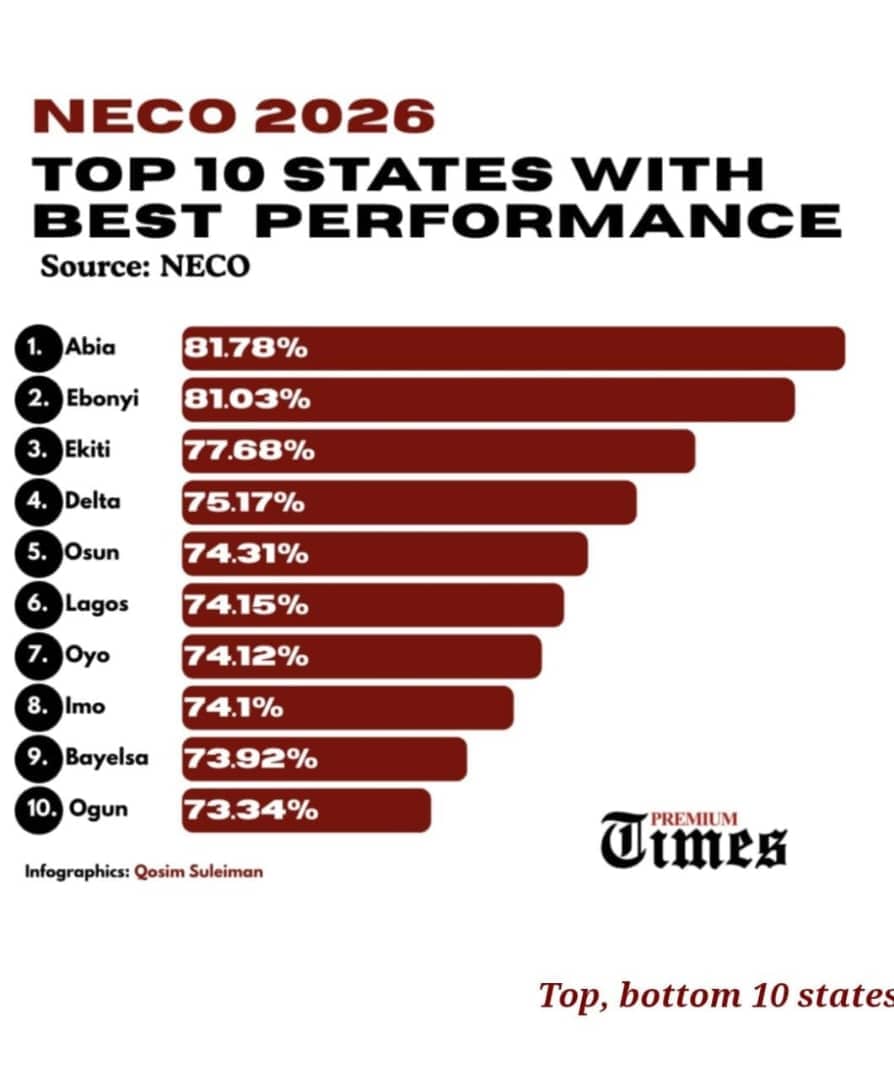
Osun State Governor, Senator Ademola Adeleke, has hailed the state’s strong performance in the 2026 National Examinations Council (NECO) Senior School Certificate Examination, describing the result as a positive reflection of ongoing efforts to reposition education in the state.
Osun placed fifth nationally in the 2026 NECO ranking, with 74.31 per cent of candidates recording at least five credits, including English Language and Mathematics.
While congratulating the students, teachers, parents, school administrators and other stakeholders, the governor noted that the state performance has been improving within a single digit rating for three consecutive years namely 2024, 2025 and 2026.
“Osun has moved from 33rd position in the 2022 NECO ranking to 5th in 2026, while improving its pass rate to 74.31 per cent. This is encouraging, and it shows that our sustained interventions in the education sector are yielding positive results,” the Governor said.
Governor Adeleke said the improved performance reflects his administration’s deliberate investment in the education sector, including the recruitment of additional teachers to strengthen the teaching workforce, while prioritising workers’ welfare and creating a more conducive environment for effective teaching and learning across public schools.
The Governor said the performance reinforces his administration’s determination to continue investing in education, noting that the objective is to build a system that gives every Osun child the knowledge, skills and opportunities needed to succeed.
“This result is encouraging, but we see it as a reason to do more. We will continue to invest in our schools, improve the learning environment, support our teachers and provide our students with the necessary tools to excel.
“We are building an education system that prepares our young people not only for examinations but for life,” the Governor said.
He assured that ongoing interventions in the education sector would be sustained and expanded, while urging students to remain committed to their studies.
His Excellency also commended teachers across the state for their dedication and sacrifices, assuring them that the administration would continue to prioritise measures that strengthen the education system and improve workers’ welfare.
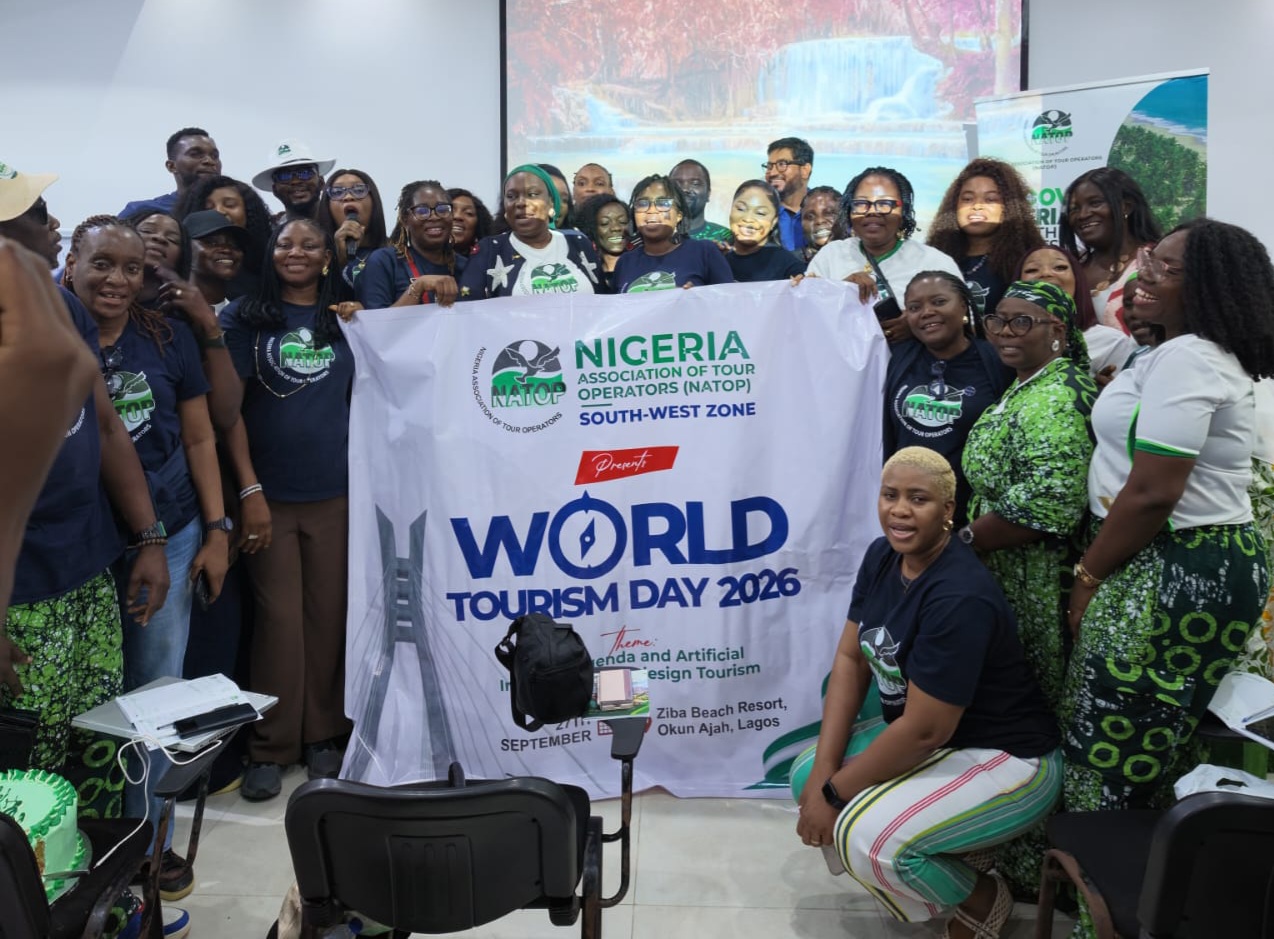
The Nigeria Association of Tour Operators (NATOP) marked the 2026 World Tourism Day with activities which capture capacity building, technology, destination promotion and domestic tourism, and celebration.
In the South West Zone, close to 200 tour operators gathered at Ziba Beach Resort, Lagos, for a special training focused on Artificial Intelligence and its application in tourism, equipping operators with digital tools to improve their businesses and destination marketing.
In Abuja, the FCT and Northern Zone, in collaboration with Naija Adventurers, staged a colourful Tourism Awareness Walk and Hike to the Centre of Nigeria.
The celebration also spread to the South-South Zone, where members marked the day with a destination tour, alongside activities to commemorate with the world tourism day celebrations.
In line with the theme for this year’s WTD celebration: ‘Digital agenda and artificial intelligence to redesign tourism’ the NATOP training on AI and application in tour operation at Ziba Beach Resort Lagos saw a large turnout of the members of the association.
The President of the association, Hajia Bolaji Mustapha explained that the idea for the location and training was to train members on how to do tour business, to know how to promote tourism digitally, using different AI tool and everything so that they will grow their businesses.
She said: “we follow the theme and, you know, blend with the old situation. Let’s do the training so that we attach it to the World Tourism Day with the theme that we have achieved something and also celebrate.”
She said the training will go a long way in helping the tour operators do greater content to digitally tell destination stories using AI, and also using the tool for expression.
Mustapha also explained why the association chose Ziba Beach Resort: “We always attach World Tourism Day to a tourism site. And definitely, if you look at this whole area and this community, that’s why we see that Ziba is a tourism site. We want to explore and of course. The resort newly launched its third phase. So, we will use this opportunity to look at their rooms, look at how we can sell this destination, to showcase it that the resort is actually in Nigeria, not Zanzibar. By using the place, we would kill two birds with one stones.
Facility tour of Ziba Beach Resort
“As tour operators who are willing to tell the good story of our Nigeria, we need to bring ourselves up to the speed, align with the digital revolution. Let everybody go digital. Because we also see the content creators are taking our business, we want to align it with what they do. We are the ones that understand the business and we’ll be able to tell the story better, so that anybody coming to Nigeria will be able to discover Nigeria with the experts.”
Also commenting on the celebration, the NATOP Vice President South West and chairman of the WTD Organizing Committee for the zone, Mrs. Wonuola Olatunde-Lamidi explained why NATOP South West’s usage of the 2026 WTD for training. She said many of the members still have a lot to learn about the tour business, and that some do not understand the foundation of the business, including how to create packages hence the need for the training.
Mrs. Olatunde-Lamidi spoke further: “Many don’t understand the foundation of what it is to create a tour package. And when you have people that are not well-trained in an industry, the industry will not grow. The kind of people that you also have will not have enough earning power to do many things. And because this is an industry that I have been in for 16 years, I run Diamonds and Pearls Travels with my husband. And I’ve seen Diamonds and Pearls Travels metamorphose into a company where people don’t just look at us as travel agents. We have become a Destination Management Company (DMC). We have become a trusted brand. We have become a company that when we talk about a destination, people want to go to that destination because of how we have portrayed the destination. And you may not realize that, as tour operators, you can actually decide where people go. You can make people go to a particular destination by marketing it, by letting them know the benefits of that destination.”
The tour operators had opportunity to tour the resort and unwind during the programme.


