
Metro
The Wars of Ego: Leadership As the Architect of Collective Possibilities


- /home/rhoncare/pointblank.ng/wp-content/plugins/mvp-social-buttons/mvp-social-buttons.php on line 27
https://pointblank.ng/wp-content/uploads/2025/08/DR.TOLULOPE-A.-ADEGOKE-AMBP-UN__-1-744x600.jpg&description=The Wars of Ego: Leadership As the Architect of Collective Possibilities', 'pinterestShare', 'width=750,height=350'); return false;" title="Pin This Post">
- Share
- Tweet /home/rhoncare/pointblank.ng/wp-content/plugins/mvp-social-buttons/mvp-social-buttons.php on line 69
https://pointblank.ng/wp-content/uploads/2025/08/DR.TOLULOPE-A.-ADEGOKE-AMBP-UN__-1-744x600.jpg&description=The Wars of Ego: Leadership As the Architect of Collective Possibilities', 'pinterestShare', 'width=750,height=350'); return false;" title="Pin This Post">
By Tolulope A. Adegoke, PhD
“The ego builds monuments to its own memory.
Leadership, in its truest form, builds bridges to a future it will never cross.”
Introduction: The Invisible Battlefield
The most consequential wars of the twenty-first century are not fought with artillery, drones, or cyber-espionage. They are fought in boardrooms, parliamentary chambers, community halls, and the private sanctuaries of the human psyche. These are the Wars of Ego—a relentless, often silent conflict wherein personal validation, historical grievance, territorial defensiveness, and the desperate need for supremacy eclipse the pursuit of shared prosperity. This is not a metaphor; it is the operational reality that underpins the stagnation of corporations, the fracturing of nations, and the disempowerment of peoples.
Ego, in its classical psychological definition, is the mediator between the primal id and the moral superego. However, in the context of governance and organizational dynamics, ego metastasizes into a pathology of self-referentiality. It transforms decision-making from a collaborative exercise in problem-solving into a zero-sum gladiatorial contest. When ego becomes the sovereign of a leader’s soul, the organization—whether a family business, a multinational conglomerate, or a sovereign state—becomes a subsidiary of the leader’s personal narrative. The result is predictable: misallocation of resources, erosion of trust, systemic blindness, and a catastrophic decline in the capacity to deliver possibilities.
This treatise posits a bold, unyielding thesis: Leadership is the singular antidote to the Wars of Ego. But not leadership as it is commonly misunderstood—not charisma, not authority, not dominance. Rather, leadership as a technological and spiritual discipline of transcendence. It is the art of shifting the locus of control from the “I” to the “We,” from preservation to evolution, from validation to actualization. This document will dissect the anatomy of ego-driven conflict across three critical strata—Peoples, Corporates, and Nations—and prescribe a rigorous, multi-layered framework of solutions that are universally applicable, culturally agnostic, and operationally executable.
Part I: The Anatomy of the Ego-War – A Psychosocial Autopsy
To prescribe a cure, we must first understand the pathogen. The Wars of Ego are not random; they follow a predictable, cyclical pattern observable in every human collective.
1. The Narcissistic Cascade
Ego warfare begins with the leader’s internal dialogue. When a leader perceives their identity as synonymous with the institution, any critique of the institution becomes a critique of the self. This triggers a defensive cascade: denial, rationalization, projection, and ultimately, aggression. The leader ceases to listen to data, preferring instead to listen to echoes of their own voice. In a corporate setting, this manifests as the “founder’s trap”—where the founder refuses to cede control despite obvious market shifts. In a national context, it manifests as autocratic populism, where the leader’s personal vendettas are outsourced to the state apparatus.
2. The Tribalism of Proximity
Ego does not operate in isolation; it recruits allies. Leaders surrounded by sycophants—what we term the “courtier effect”—amplify their egoic biases. This creates a tribal echo chamber where competence is secondary to loyalty. The result is an institutional paralysis where the best ideas are sacrificed to protect the leader’s fragile self-esteem. This is the cancer that kills innovation in Fortune 500 companies and fuels sectarian violence in multi-ethnic nations.
3. The Temporal Myopia
Ego is inherently present-centric. It demands gratification now—quarterly earnings, immediate poll numbers, instant applause. This temporal myopia sacrifices long-term sustainability for short-term validation. Thus, corporations under ego-driven leaders gut R&D budgets to inflate stock prices; nations under ego-driven leaders deplete natural resources and erode democratic institutions for a fleeting legacy.
4. The Zero-Sum Fallacy
The most insidious weapon in the Wars of Ego is the belief that one person’s gain is another’s loss. This fallacy redefines collaboration as a threat. In corporations, it prevents cross-functional synergy; in geopolitics, it fuels trade wars and military posturing. The Ego sees the world as a finite pie; Leadership sees it as an expandable ecosystem.
Part II: The Cost of Ego-War – Quantifying the Destruction
The consequences are not philosophical; they are quantifiable.
· For Peoples: Ego-driven leadership leads to the erasure of agency. Citizens become subjects, not stakeholders. Social mobility stagnates as policies are tailored to the leader’s vanity projects rather than to infrastructure, education, and healthcare. The result is a generation of disenfranchised youth who turn to extremism, apathy, or migration. The loss of human potential is incalculable—measured not in GDP, but in unfulfilled dreams and suppressed genius.
· For Corporates: Ego kills agility. A 2023 study by the Corporate Governance Institute found that companies with high CEO-centricity (defined by excessive CEO pay ratios, board friendliness, and unilateral decision-making) underperformed their peer groups by 23% over a five-year horizon. More damningly, these companies suffer from a 40% higher turnover rate among mid-level talent, as high-performers refuse to remain in environments where merit is subordinated to the leader’s whims. Innovation pipelines dry up; market share erodes; and bankruptcy becomes a lingering possibility.
· For Nations: The geopolitical cost is profound. Ego-driven diplomacy is characterized by “red lines” that are drawn not based on strategic interests, but on personal pride. This leads to miscalculations—the Cuban Missile Crisis was an ego-war; the invasion of Iraq was an ego-war; the current fragmentation of global supply chains is an ego-war. Nations lose soft power, economic leverage, and moral authority. The resultant instability creates refugee crises, food insecurity, and climate inaction, because the ego cannot conceive of a future beyond its own tenure.
Part III: The Leadership Solution – A Comprehensive Framework for Transcendence
The solution is not the elimination of ego—that is impossible and undesirable, as ego provides the drive to achieve. The solution is the redirection and subordination of ego to a higher purpose. This requires a paradigm shift from Leadership as Command to Leadership as Custodianship. Below is a multi-dimensional, action-oriented framework that cuts across all three strata.
Solution 1: The Protocol of Institutionalized Humility (For Corporates and Nations)
Humility is not weakness; it is strategic intelligence. We propose a Mandatory Peer-Review Protocol where every major decision (M&A, policy shift, strategic pivot) must be vetted by a council of internal and external stakeholders with veto power over process, if not content. This does not dilute authority; it validates it. The ego-leader feels threatened by scrutiny; the custodian-leader welcomes it because they know that their legacy is not in being right, but in being effective.
· Corporate Application: Establish a “Shadow Board” of high-potential junior executives who critique strategic proposals from a future-state perspective. This creates a feedback loop that forces the CEO to justify decisions on merit, not instinct.
· National Application: Mandate that all major legislative initiatives undergo a “Pre-Impact Assessment” by a bipartisan, independent economic and social council. This insulates policy from the whims of a single administration.
Solution 2: The Institutionalization of “Succession by Design” (For All Levels)
Ego-warriors fear successors because successors imply mortality. To dismantle this fear, leadership must be reframed as a temporary trust, not a permanent throne. We propose a “Triple-Exit Clause” for all leadership roles: (1) A fixed term limit, (2) A performance-triggered exit (if key metrics are missed for two consecutive periods), and (3) A “Graceful Exit” mechanism that rewards leaders for developing their replacement within 18 months of assuming office.
· For Corporates: Link 30% of the CEO’s long-term compensation to the successful transition of their successor. This aligns the leader’s financial interest with the institution’s continuity.
· For Nations: Enforce a constitutional requirement that no leader may serve beyond two terms, and that all cabinet ministers must actively mentor a junior counterpart. This forces the dissemination of power and knowledge, preventing the “cult of personality” that fuels ego-war.
Solution 3: The Decentralization of Decision Rights (For Peoples and Corporates)
Ego thrives on concentration. To starve the ego, we must disperse decision-making authority to the periphery—to the people closest to the ground. This is not democracy for its own sake; it is functional optimization.
· For Corporates: Implement a “Radical Decentralization” model where departmental heads are granted full budgetary and hiring authority within a set of clear strategic guardrails. The role of the CEO shifts from “decider” to “connector”—facilitating resources and removing bottlenecks, rather than dictating outputs.
· For Nations: Adopt a “Subsidiarity Principle” where all policies that can be executed at the municipal or provincial level are legally forbidden from being centralized. This forces national leaders to focus on macro-stability, diplomacy, and infrastructure, while local leaders manage education, health, and transport. This fragmentation of power prevents any single ego from monopolizing the national narrative.
Solution 4: The “Mirror-Feedback” System for Self-Awareness
The most dangerous ego is the one that does not know it exists. We propose a mandatory, third-party “Leadership Impact Audit” conducted every 18 months, using 360-degree anonymous feedback from subordinates, peers, external partners, and even competitors. This audit is not a performance review; it is a distortion check. It measures the leader’s emotional footprint—their propensity to interrupt, to dismiss dissenting views, to take credit, and to deflect blame. The results are shared with the leader’s board or oversight committee, with a mandated action plan for correction.
· Corporate Example: Netflix’s famous “Keeper Test” is a form of this, but we extend it to include a “Friction Score”—a quantified measure of how much the leader’s presence creates decision-paralysis in meetings.
· National Example: Establish an independent “Ombudsman for Leadership Ethics” that publishes an annual report on the humility index of the executive branch. This public accountability forces even the most narcissistic leaders to moderate their behavior for fear of reputational damage.
Solution 5: The Recalibration of Incentive Structures (The Economic Cure)
The Wars of Ego are sustained by perverse incentives. If we reward leaders for immediate stock spikes or short-term GDP growth, we are incentivizing ego-driven short-termism. We propose a paradigm shift toward Multi-Generational Incentivization.
· For Corporates: Tie 50% of executive compensation to metrics that have a 10-year horizon: carbon reduction, employee retention, R&D patent filings, and community investment. This forces the leader to think like a steward, not a conqueror.
· For Nations: Shift national budgeting from annual appropriations to Five-Year Rolling Budgets with locked-in allocations for health, education, and infrastructure. This removes the leader’s ability to use the budget as a tool for political patronage, thereby reducing the ego-driven urge to “reward loyalists” and “punish critics.”
Solution 6: The Cultivation of “Anti-Fragile” Cultures (For Peoples)
Ultimately, the most potent solution is cultural. A society or organization that rewards candor over compliance will naturally starve the ego. We propose a formalized “Safe Dissent” protocol.
· Corporate: Create a “Devil’s Advocate Committee” tasked with formally opposing every major initiative. The committee is not to kill the idea, but to strengthen it by exposing its vulnerabilities. The CEO is required to respond in writing to all committee findings.
· National: Enshrine a “Right to Constructive Disobedience” for civil servants—a protected legal channel for whistleblowers and contrarian analysts to present alternative data to the legislature without fear of retaliation. This creates a culture where the leader is constantly reminded that they are fallible, thereby forcing them to lean on collective intelligence.
Part IV: The Synthesis – Delivering Possibilities Across the Board
When these solutions are applied concurrently, they create a virtuous cycle. The Leader becomes a servant of the system, not its master. The result is an explosion of possibilities.
For Peoples:
The decentralization of power and the institutionalization of feedback mean that the average citizen is no longer a passive recipient of policy; they become a co-creator of their destiny. Education systems pivot from rote memorization to problem-solving. Healthcare systems become preventive, not reactive. The narrative shifts from “What can my leader do for me?” to “What can we achieve together?” The ego-war is replaced by a peace of collective agency. Unemployment drops, as local economies are empowered to innovate. Crime reduces, as community trust rebuilds. The “possibility” here is human flourishing—a condition where every individual, regardless of background, has a pathway to self-actualization.
For Corporates:
The shift to multi-generational incentives and decentralized decision-making unlocks a level of agility that is impossible under ego-centric rule. Innovation cycles shorten from years to months. The best talent is retained because high-performers crave environments where their voice matters. Collaboration across silos becomes the norm, not the exception. Mergers and acquisitions are driven by strategic fit, not by the CEO’s desire for a larger empire. Profitability becomes a byproduct of purpose, not a singular obsession. The “possibility” here is sustainable market leadership—a company that outlasts its founder, adapts to every disruption, and serves as a pillar of community prosperity.
For Nations:
The application of humility protocols and independent oversight transforms diplomacy from a theater of posturing into a practice of pragmatic problem-solving. Geopolitical rivals find common ground in climate action, trade harmonization, and pandemic preparedness, because leaders are freed from the need to “save face” and are instead incentivized to “save lives.” The nation becomes a beacon of soft power, attracting investment, talent, and global respect. The “possibility” here is strategic immortality—a nation that remains relevant and prosperous for centuries, not merely for the tenure of a single leader.
Part V: The Deeper Dive – Addressing the Uncomfortable Truths
To be comprehensive, we must address the cynics who argue that these solutions are utopian. They will say: “You cannot change human nature.” This is a fallacy. We do not seek to change human nature; we seek to channel it. The ego is like a river—it will flow. Our task is to build levees, canals, and turbines that convert its destructive energy into productive force.
The Challenge of Implementation:
The primary obstacle to these solutions is that they require ego-wielders to voluntarily reduce their own power. This is the “Theater of the Absurd”: the very people who need these reforms the most are the least likely to adopt them. Therefore, we must rely on external catalysts:
1. Market Forces: Institutional investors must mandate ESG (Environmental, Social, and Governance) metrics that include leadership humility scores. When capital flows away from ego-centric companies, the market itself becomes the regulator.
2. Civil Society: Grassroots movements must demand transparency, using digital platforms to track and publish real-time decision-making data. For example, a “Leader’s Decision Log” can be made public, showing exactly who influenced which policy.
3. Intergenerational Contracts: Young employees and citizens must refuse to participate in ego-driven systems. The rise of the “Great Resignation” and the “Quiet Quitting” phenomenon are early indicators that the workforce is voting with its feet against narcissistic leadership. This is a powerful lever for change.
The Role of Technology:
Artificial Intelligence can be a neutral arbiter of ego. We propose an AI-driven “Bias Detection System” that analyzes meeting transcripts, decision memos, and budget allocations to flag patterns of personal favoritism, disproportionate credit-taking, and exclusionary language. This system acts as a silent, non-judgmental observer, providing data that the leader cannot refute. It removes the emotional charge from feedback, replacing it with cold, hard evidence. This is not surveillance; it is a mirror.
The Spiritual Dimension:
Finally, we must acknowledge the spiritual dimension. Leadership, at its highest echelon, is a form of karma yoga—selfless action. The leader must cultivate an internal practice of detachment: regular journaling, meditation, or executive coaching that focuses on the question: “If I were removed from this position tomorrow, what would remain?” If the answer is “nothing,” the leader is operating on ego. If the answer is “an enduring institution, a competent team, and a clear roadmap,” the leader is operating on vision. We recommend that every leader undergo an annual “Existential Audit” with a seasoned philosopher or spiritual counselor, to decouple their self-worth from their positional power.
Part VI: A New Lexicon for Leadership
To sustain this transformation, we must change our language. Words shape reality. We propose the adoption of a new vocabulary:
· Replace “My Strategy” with “Our Shared Horizon.”
· Replace “I Decided” with “We Converged.”
· Replace “My Legacy” with “Our Inheritance.”
· Replace “My Critics” with “Our Dialectical Partners.”
This linguistic shift is not cosmetic; it is neurocognitive. Repeated use of collectivist language rewires the brain’s default mode network, reducing the amygdala’s threat response to dissent and increasing the prefrontal cortex’s capacity for integrative thinking.
Part VII: The Ultimate Metric – The Possibility Index
We conclude with a proposal for a global standard: the Possibility Index (PI) . This is a composite metric that measures the aggregate potential of a people, a corporation, or a nation. It includes:
· The Ratio of Idea Generation to Idea Suppression (measured by the number of proposals submitted vs. rejected with valid rationale).
· The Trust Quotient (measured by employee/citizen engagement surveys and voluntary retention rates).
· The Generational Handover Score (the percentage of institutional knowledge successfully transferred to the next cohort).
· The Adaptability Velocity (the time taken to pivot strategy in response to external shocks).
When the PI rises, the Wars of Ego fall. This is not a utopian dream; it is a tangible, measurable reality. The data is clear: organizations with high PI consistently outperform their peers by every financial and social metric. The same applies to nations. The Nordic countries, Singapore, and New Zealand are not perfect, but their consistent investment in institutional humility, decentralized decision-making, and long-term incentivization places them at the pinnacle of global prosperity.
Conclusion: The Choice Before Us
The Wars of Ego are not inevitable. They are a choice—a collective choice to elevate the individual over the collective, the immediate over the enduring, and the self over the species. Leadership is the only force powerful enough to reverse this choice. But it requires a fundamental redefinition: Leadership is not the power to command; it is the courage to surrender—to surrender the need for credit, the need for control, and the need for validation.
When a leader steps back, the people step up. When the ego retreats, possibility advances. This is the central paradox of effective stewardship: The more a leader diminishes their own ego, the larger their impact becomes. They become a lens, not a source—focusing light, not emitting it. Through this lens, the challenges of the twenty-first century—climate change, inequality, geopolitical tension, technological disruption—become not existential threats, but engineering problems. They become solvable. They become opportunities.
The Peoples will no longer wait for a savior; they will become their own salvation. The Corporates will no longer chase quarterly glory; they will build century-spanning legacies. The Nations will no longer compete in a tragic zero-sum contest; they will collaborate in a magnificent win-win ecosystem.
This is the promise of Leadership. This is the end of the Wars of Ego. This is the beginning of a new epoch—not of kings, but of custodians; not of conquest, but of cultivation; not of ego, but of empathy. The door is open. The solutions are clear. The only question that remains is whether we—as individuals, as organizations, and as societies—have the wisdom to walk through it.
Let us choose wisely. Let us choose We. Let us choose Tomorrow. Let us choose Possibility.
Dr. Tolulope A. Adegoke, AMBP-UN is a globally recognized scholar-practitioner and thought leader at the nexus of security, governance, and strategic leadership. His mission is dedicated to advancing ethical governance, strategic human capital development, resilient nation building, and global peace. He can be reached via: tolulopeadegoke01@gmail.com, globalstageimpacts@gmail.com



The Edo State Special Criminal Court has sentenced four men to death for their involvement in the kidnapping of a woman at the Vegetable Market along Airport Road in Benin City.
Justice Aigbona Momodu handed down the sentences after finding the defendants guilty on multiple counts connected to the kidnapping case.
The convicts are Marvellous Isaac, Wisdom Michael, Rufus Emete Michael and Gift Raphael.
Isaac and Michael were sentenced to death on counts two through nine. They also received separate prison terms on other counts, including seven years on count one, while Isaac was sentenced to 10 years on count 10 and life imprisonment on count 11.
Rufus Emete Michael was sentenced to death on counts two, three, four, six and seven, in addition to a seven-year prison term on count one.
The fourth defendant, Gift Raphael, was sentenced to death on counts two, four, six and eight and received seven years imprisonment on count one.
Delivering the sentences, Justice Momodu ordered that the death sentences be carried out by hanging or lethal injection, in accordance with the court’s judgment.
The court also ordered the forfeiture of a JoJef pump-action firearm and ammunition tendered as exhibits during the trial.
The firearm, identified as Exhibit M, along with two unused cartridges and two spent cartridges listed as Exhibits E and E1, was ordered to be handed over to the Edo State Police Armourer at the State Criminal Investigation Department for destruction.
Justice Momodu directed that the exhibits be transferred to the police through the Deputy Director of the Criminal Division and destroyed within 30 days.
The convictions bring to an end the trial arising from the abduction of the woman at the Vegetable Market along Airport Road, an incident that added to concerns over kidnapping and armed crime in Benin City.
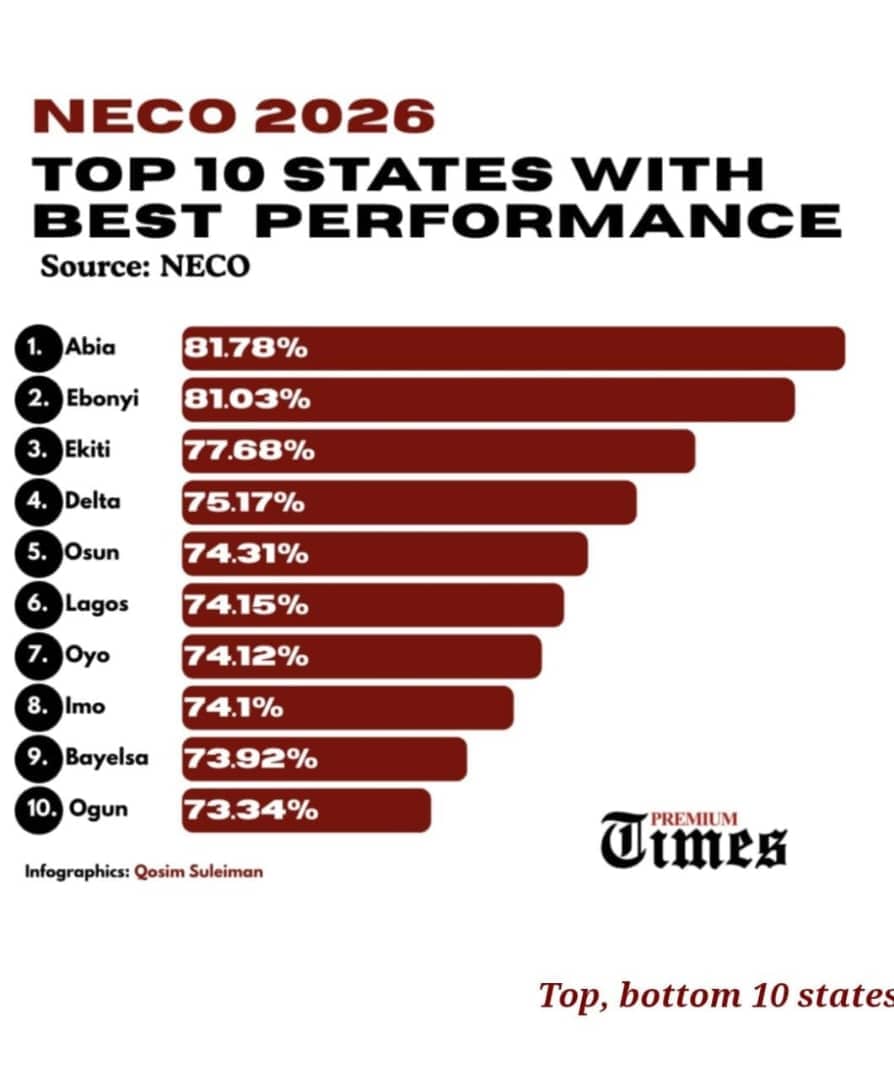
Osun State Governor, Senator Ademola Adeleke, has hailed the state’s strong performance in the 2026 National Examinations Council (NECO) Senior School Certificate Examination, describing the result as a positive reflection of ongoing efforts to reposition education in the state.
Osun placed fifth nationally in the 2026 NECO ranking, with 74.31 per cent of candidates recording at least five credits, including English Language and Mathematics.
While congratulating the students, teachers, parents, school administrators and other stakeholders, the governor noted that the state performance has been improving within a single digit rating for three consecutive years namely 2024, 2025 and 2026.
“Osun has moved from 33rd position in the 2022 NECO ranking to 5th in 2026, while improving its pass rate to 74.31 per cent. This is encouraging, and it shows that our sustained interventions in the education sector are yielding positive results,” the Governor said.
Governor Adeleke said the improved performance reflects his administration’s deliberate investment in the education sector, including the recruitment of additional teachers to strengthen the teaching workforce, while prioritising workers’ welfare and creating a more conducive environment for effective teaching and learning across public schools.
The Governor said the performance reinforces his administration’s determination to continue investing in education, noting that the objective is to build a system that gives every Osun child the knowledge, skills and opportunities needed to succeed.
“This result is encouraging, but we see it as a reason to do more. We will continue to invest in our schools, improve the learning environment, support our teachers and provide our students with the necessary tools to excel.
“We are building an education system that prepares our young people not only for examinations but for life,” the Governor said.
He assured that ongoing interventions in the education sector would be sustained and expanded, while urging students to remain committed to their studies.
His Excellency also commended teachers across the state for their dedication and sacrifices, assuring them that the administration would continue to prioritise measures that strengthen the education system and improve workers’ welfare.
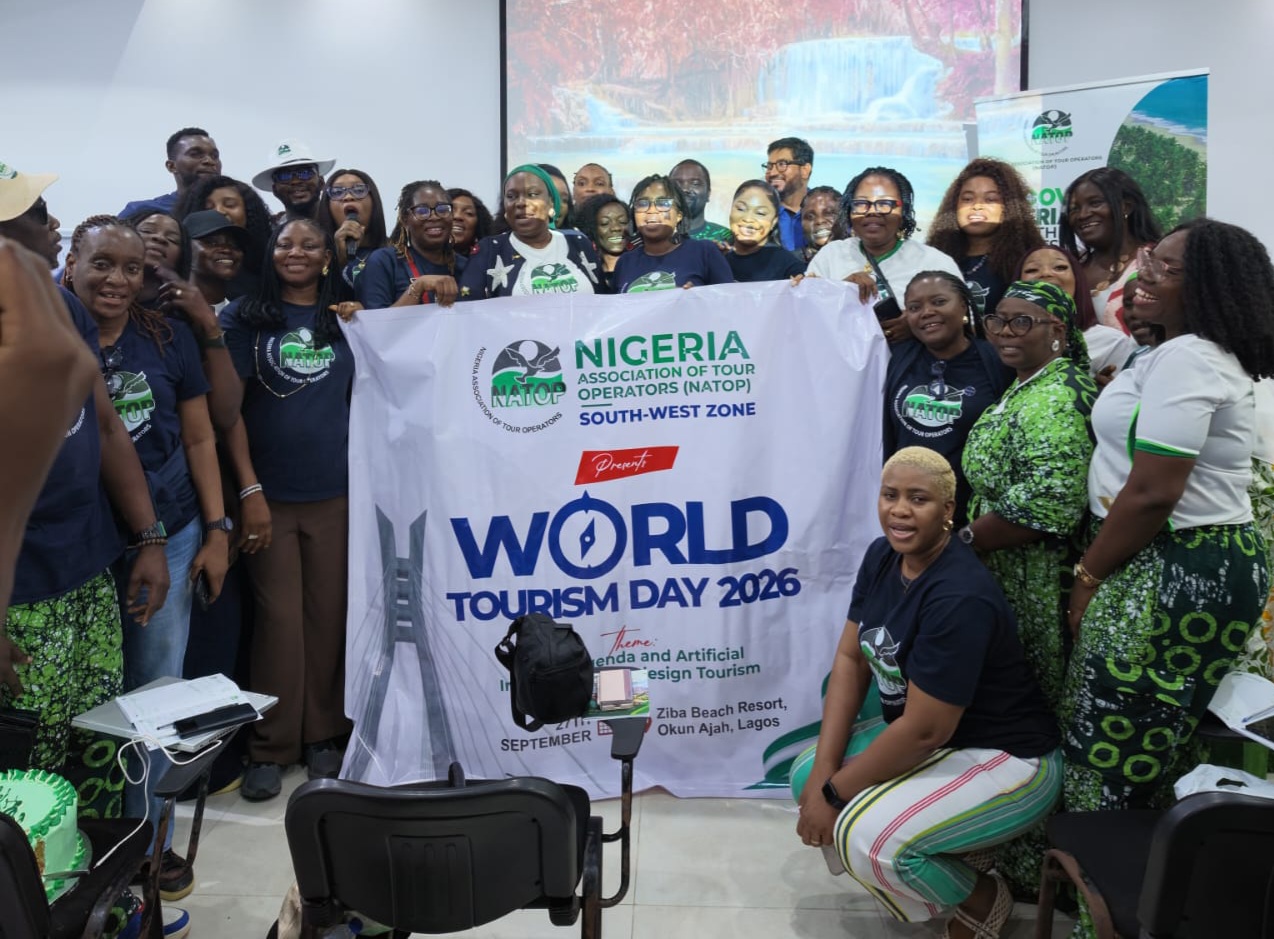
The Nigeria Association of Tour Operators (NATOP) marked the 2026 World Tourism Day with activities which capture capacity building, technology, destination promotion and domestic tourism, and celebration.
In the South West Zone, close to 200 tour operators gathered at Ziba Beach Resort, Lagos, for a special training focused on Artificial Intelligence and its application in tourism, equipping operators with digital tools to improve their businesses and destination marketing.
In Abuja, the FCT and Northern Zone, in collaboration with Naija Adventurers, staged a colourful Tourism Awareness Walk and Hike to the Centre of Nigeria.
The celebration also spread to the South-South Zone, where members marked the day with a destination tour, alongside activities to commemorate with the world tourism day celebrations.
In line with the theme for this year’s WTD celebration: ‘Digital agenda and artificial intelligence to redesign tourism’ the NATOP training on AI and application in tour operation at Ziba Beach Resort Lagos saw a large turnout of the members of the association.
The President of the association, Hajia Bolaji Mustapha explained that the idea for the location and training was to train members on how to do tour business, to know how to promote tourism digitally, using different AI tool and everything so that they will grow their businesses.
She said: “we follow the theme and, you know, blend with the old situation. Let’s do the training so that we attach it to the World Tourism Day with the theme that we have achieved something and also celebrate.”
She said the training will go a long way in helping the tour operators do greater content to digitally tell destination stories using AI, and also using the tool for expression.
Mustapha also explained why the association chose Ziba Beach Resort: “We always attach World Tourism Day to a tourism site. And definitely, if you look at this whole area and this community, that’s why we see that Ziba is a tourism site. We want to explore and of course. The resort newly launched its third phase. So, we will use this opportunity to look at their rooms, look at how we can sell this destination, to showcase it that the resort is actually in Nigeria, not Zanzibar. By using the place, we would kill two birds with one stones.
Facility tour of Ziba Beach Resort
“As tour operators who are willing to tell the good story of our Nigeria, we need to bring ourselves up to the speed, align with the digital revolution. Let everybody go digital. Because we also see the content creators are taking our business, we want to align it with what they do. We are the ones that understand the business and we’ll be able to tell the story better, so that anybody coming to Nigeria will be able to discover Nigeria with the experts.”
Also commenting on the celebration, the NATOP Vice President South West and chairman of the WTD Organizing Committee for the zone, Mrs. Wonuola Olatunde-Lamidi explained why NATOP South West’s usage of the 2026 WTD for training. She said many of the members still have a lot to learn about the tour business, and that some do not understand the foundation of the business, including how to create packages hence the need for the training.
Mrs. Olatunde-Lamidi spoke further: “Many don’t understand the foundation of what it is to create a tour package. And when you have people that are not well-trained in an industry, the industry will not grow. The kind of people that you also have will not have enough earning power to do many things. And because this is an industry that I have been in for 16 years, I run Diamonds and Pearls Travels with my husband. And I’ve seen Diamonds and Pearls Travels metamorphose into a company where people don’t just look at us as travel agents. We have become a Destination Management Company (DMC). We have become a trusted brand. We have become a company that when we talk about a destination, people want to go to that destination because of how we have portrayed the destination. And you may not realize that, as tour operators, you can actually decide where people go. You can make people go to a particular destination by marketing it, by letting them know the benefits of that destination.”
The tour operators had opportunity to tour the resort and unwind during the programme.


