
Featured
Women of Substance Hosts Maiden Sisters’ Hangout


- /home/rhoncare/pointblank.ng/wp-content/plugins/mvp-social-buttons/mvp-social-buttons.php on line 27
https://pointblank.ng/wp-content/uploads/2025/11/IMG-20251118-WA0150-1000x600.jpg&description=Women of Substance Hosts Maiden Sisters’ Hangout', 'pinterestShare', 'width=750,height=350'); return false;" title="Pin This Post">
- Share
- Tweet /home/rhoncare/pointblank.ng/wp-content/plugins/mvp-social-buttons/mvp-social-buttons.php on line 69
https://pointblank.ng/wp-content/uploads/2025/11/IMG-20251118-WA0150-1000x600.jpg&description=Women of Substance Hosts Maiden Sisters’ Hangout', 'pinterestShare', 'width=750,height=350'); return false;" title="Pin This Post">
Women of Substance, founded by renowned media consultant Chief Ify Onyegbule (Ada Di Ora Mma), is set to host the maiden edition of the “Sisters’ Hangout”, a strategic networking and empowerment gathering for women across diverse sectors, designed to foster collaboration, visibility, personal growth, and impactful partnerships.
Scheduled as an exclusive lunch-table conversation for Women, by Women, and powered by Women, the Sisters’ Hangout brings together established and emerging voices in journalism, business, education, media, fintech, philanthropy, data science, food services, and grassroots development.
The Hangout has already confirmed an extraordinary lineup of accomplished women, each bringing unique perspectives and deep industry insights.
1. Petra Akinti Onyegbule — Corporate Communications Strategist
Petra is an authority in leadership communication, storytelling, and brand clarity. She will lead conversations on how to keep a brand alive, relevant, and competitive in a saturated marketplace.
2. Theresa Moses — Journalist, Humanitarian & Media Leader
Theresa Moses, Convener of Pad Me A Girl Initiative, Head of Gatmash Media, Chairperson of Nigeria Online Media Alliance (NOMA), and CEO of Vita Baites Foods (makers of premium Kuli-Kuli), will share how she successfully combines media leadership with running a fast-growing FMCG brand.
3. Anthonia Ojenagbon — Founder, Silton African Kitchen
A food service expert specializing in large-scale catering, Anthonia will discuss navigating the pressures of cooking for large events and remaining excellent outside one’s comfort zone.
4. Chioma Iroabuchi — Digital Transformation Leader
Chioma, a driver of fintech-enabled process optimization, will break down the beginner steps into opportunities in the fintech sector, especially for women exploring tech.
5. Oluwatomisin Adebukola — Award-Winning Broadcast Journalist
A leadership coach and community development advocate, she will highlight realities of working in grassroots spaces, and how passion-driven initiatives bring hope to underserved communities.
6. Olayinka Mayaki-Yusuf — General Manager, Shipshape Cleaners Limited
Olayinka will share the business of professional cleaning, project management, and what it takes to thrive in a highly competitive service industry.
7. Temitayo Oluwatobi Adetoba — Data Scientist & Girls’ Education Advocate
Tayo will educate attendees on how data shapes decision-making and why women must tap into the booming data ecosystem.
8. Cordy Nachi Opara — Educator & Relationship Coach
Cordy will shed light on nurturing children with different personalities, and how mothers can be intentional leaders in the home.
9. Chief Yinka Kenny — Broadcast Journalist & Gender Champion
Yinka brings decades of media experience and will reveal the behind-the-scenes challenges faced by women in media, along with strategies for thriving in the industry.
10. Ijeoma Uzozie Mark-Abii — Estate Surveyor & Travel Expert
Ijeoma will demystify the business of tourism and hospitality, sharing what most people are never told about the travel industry.
11. Anusiem DO (Nwachukwu Delphine Onyinye) — Author & Humanitarian
The visionary behind Brisa Women Foundation will highlight stories of women impacted through empowerment programs and the importance of community-driven action.
12. Wemimo Adebiyi — Therapist & Child Mental Health Advocate
UK-trained therapist and educator, Wemimo will engage women on child mental health, school systems, and the power of effective communication at home.


Featured
How Boost Africa is Turning Development Finance into Growth Opportunities for African Businesses
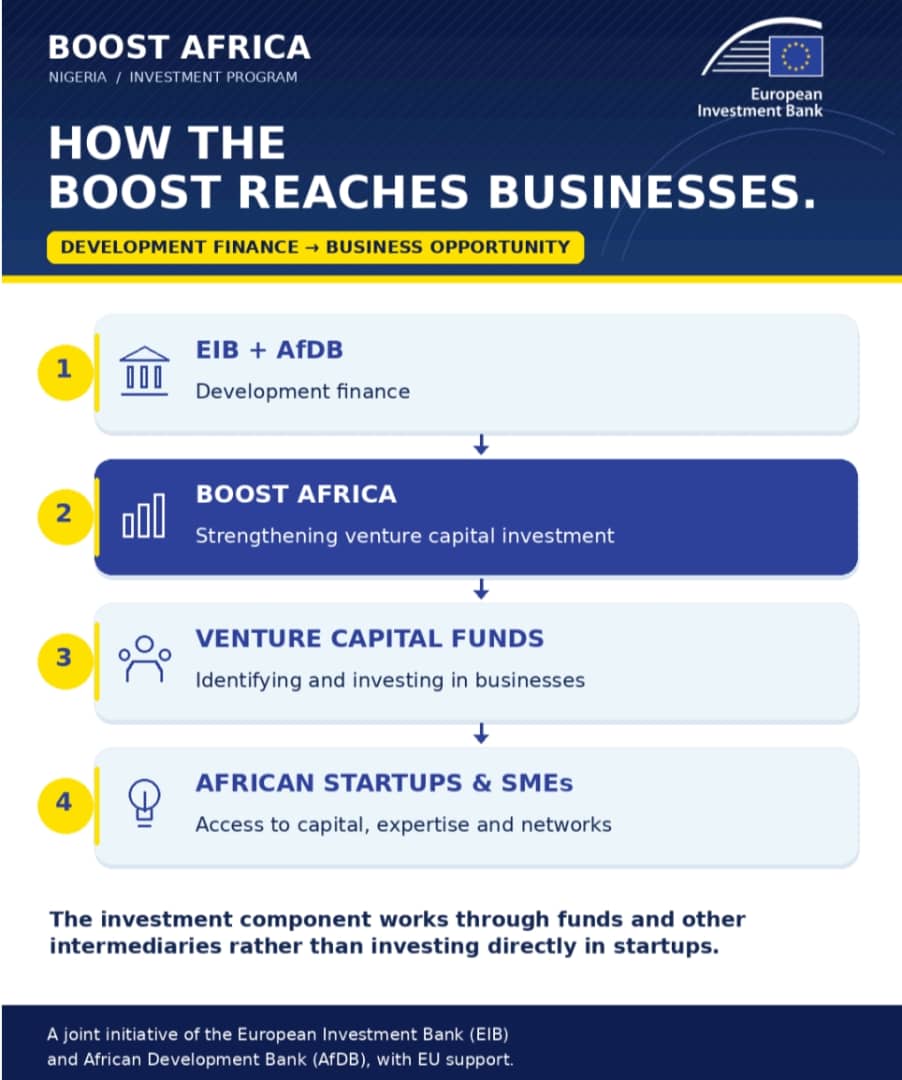
How does development finance help promising businesses grow?
Through Boost Africa, the European Investment Bank (EIB), with support from the European Union (EU), backs venture capital funds that identify and invest in promising African businesses.
This investment model combines development finance with private capital and investment expertise, helping entrepreneurs access the resources, networks and support they need to build stronger businesses and expand into new markets.
The infographic illustrates how capital moves through this investment model, from development finance to venture capital investment and, ultimately, business opportunities.
One example is Daya, which received investment through Janngo Capital, a venture capital fund backed by Boost Africa.
Hear Daya’s co-founders share the company’s journey and ambitions, and discover how investment is helping connect African businesses to global markets.
Explore the infographic and watch Daya’s Boost Africa story:
▶ https://youtu.be/2U-EIoN-VgA
#BoostAfrica #EIB #VentureCapital
A member of the Nigeria Union of Petroleum and Natural Gas Workers (NUPENG), Comrade Tope Ajagbe, has described as lies reports been circulated by the National Union of Edible Oil Tanker Drivers of Nigeria (NUEOTDN).
According to a statement, the member said “their baseless allegations, seen in the online edition of The Nation newspaper of Wednesday, September 16, 2026, are malicious, misleading, and deliberately intended to create panic within Nigeria’s product supply and distribution chain.”
He further wrote:
We strongly urge the Federal Government, law enforcement agencies, regulatory authorities, and other critical stakeholders to treat this orchestrated falsehood as an act of economic sabotage. NUEOTDN must be cautioned to desist from overheating the polity and maligning the reputation of NUPENG.
It is important to note that NUPENG leadership has consistently sought peaceful resolution of disputes between NUEOTDN and the Amalgamated Union of Wharf Truck Owners of Nigeria/Wharf 302 Products and Beverages Association of Tanker Drivers, who operate dedicated food-grade trucks. Unfortunately, NUEOTDN has repeatedly rejected conciliation efforts and continues to spread misinformation.
NUPENG operations are conducted with strict compliance to all relevant safety, environmental, and regulatory frameworks. We work closely with Federal Road Safety Corps (FRSC), Nigerian Midstream and Downstream Petroleum Regulatory Authority (NMDPRA), and other statutory agencies to ensure our practices meet the highest standards of public safety and consumer protection.
Our drivers undergo regular training, inspections, and certification to guarantee adherence to national and international best practices.
We categorically condemn NUEOTDN’s falsehoods and reaffirm that NUPENG remains a legally recognized and responsible union committed to professionalism, integrity, and the welfare of Nigerians.
We call on the Federal Government, regulators, law endorsement agencies and the public to disregard these unfounded claims and recognize NUPENG as a union that stands for responsibility, compliance, and national development.
It is also important to emphasize that any dedicated petroleum tanker found engaging in illegal activities, particularly in the lifting or distribution of edible products, must be apprehended by law enforcement agencies and made to face the full weight of the law. NUPENG remains a law-abiding union and will not condone any member involved in acts of illegality.

President Bola Ahmed Tinubu has been projected to emerge victorious in the 2027 presidential election, with a new political forecast giving him 20 states against nine for former Vice President Atiku Abubakar and eight for NDC candidate Peter Obi.
The projection was made by the Political Intelligence Group (PIG) of Politico.ng, which assessed the current political landscape and projected how the three major political figures could perform if the presidential election were conducted under the circumstances prevailing at the moment.
According to the projection, Tinubu would have a clear advantage over his major rivals, although the group acknowledged that the political situation could change significantly before the actual election.
The forecast places Tinubu strongly in the South-West while also giving him important victories outside the region. Atiku is projected to maintain considerable strength across parts of Northern Nigeria, while Obi is expected to retain support in selected areas where he performed strongly during the 2023 presidential election.
Tinubu Projected to Win 20 States
According to PIG, Tinubu is currently projected to win 20 states, making him the leading candidate in the forecast.
The president is expected to dominate the South-West, with all six states in the region projected to fall into his column. The region remains politically significant because of its voting strength and Tinubu’s long-standing political influence there.
Tinubu is also projected to win Lagos State in the 2027 presidential election. This would mark a change from the 2023 presidential election, when Tinubu lost Lagos State to Peter Obi.
The latest projection says that Tinubu would regain the state in 2027. Lagos has been central to his political career and remains one of the country’s most important electoral territories.
The inclusion of Kano among the states projected to go to Tinubu is one of the more striking aspects of the forecast. Kano is one of Nigeria’s largest states by voting population and has traditionally been an important battleground during presidential elections.
A victory in Kano would provide Tinubu with a major northern foothold and could strengthen his ability to build a broad national coalition beyond his traditional South-West base.
Tinubu’s eventual performance, however, could depend heavily on how Nigerians assess his administration by 2027.
Economic conditions, inflation, employment, security, infrastructure and the cost of living could influence voters’ decisions. The administration’s policies and its ability to communicate its achievements may also become important campaign issues.
Religion and ethnicity could also play a role in the political calculations. Nigeria’s voting patterns are sometimes influenced by regional, ethnic and religious considerations, although these factors compete with economic and political issues.
Atiku Projected to Win 9 States
PIG projects that Atiku Abubakar would win nine states in the 2027 presidential election.
The former vice president is expected to perform strongly in Northern Nigeria, with Kaduna State projected to go to him alongside several states in the North-East and North-West.
Atiku’s strength in the region could be connected to his established political network and his previous presidential campaigns. His ability to mobilise support across northern states could make him one of Tinubu’s strongest competitors in the region.
Another issue that could influence Atiku’s support is his position on fuel subsidy.
Atiku has advocated a review of the current fuel subsidy policy and has spoken about measures aimed at reducing the burden of petrol prices on Nigerians. If the high cost of transportation and living remains a major concern by 2027, such a promise could appeal to voters who want immediate relief from rising household expenses.
However, the fuel subsidy debate is likely to be more complicated than simply promising cheaper petrol.
Voters may want to know where the money required to fund the subsidy would come from and whether restoring or expanding the policy would be financially sustainable. Questions surrounding government revenue, public spending and the opportunity cost of subsidy payments could therefore become major campaign issues.
Religion and ethnicity may also influence Atiku’s support in some areas, particularly where regional identity remains politically important. However, these factors cannot be assumed to determine how every voter will behave.
The strength of Atiku’s campaign could ultimately depend on whether he can combine his northern support with meaningful backing from other parts of the country.
Obi Projected to Win 8 States
Peter Obi is projected to win eight states, according to the Politico.ng forecast.
The projection also places the Federal Capital Territory in Obi’s column. Edo State is another state where the Labour Party candidate is expected to emerge victorious.
Obi’s projected support reflects the political base he developed during the 2023 presidential election, when he performed strongly in several parts of the country.
His campaign has continued to appeal particularly to voters seeking political change and a different approach to governance. Economic management, accountability, public spending and the need for greater efficiency in government are likely to remain central to his political message.
However, Obi’s challenge could be expanding his support beyond the areas where he has historically performed strongly.
The 2027 election is expected to be highly competitive, and the emergence of new political alliances could significantly change the distribution of votes.
If opposition parties eventually cooperate or form a coalition, the calculations surrounding Tinubu, Atiku and Obi could change dramatically. Likewise, defections, the choice of running mates and the strength of party structures could influence the final outcome.
Religion and ethnicity could also feature in the contest, particularly as politicians seek to build geographically and demographically balanced tickets. Nevertheless, voters could also prioritise issues such as economic hardship, security, employment and government performance.
Projection Could Still Change
PIG’s forecast should not be interpreted as the final result of the 2027 presidential election.
The group reportedly indicated that if the election were held in September under the political circumstances currently prevailing, the APC would win.
Under that scenario, Tinubu would secure 20 states, Atiku would win nine, while Obi would take eight.
However, the actual election is still ahead, giving the major political players considerable time to change the current political equation.
The economy could improve or deteriorate. Petrol prices could become a bigger or smaller issue. New alliances could emerge, and candidates could gain or lose popularity.
The debate over fuel subsidy could become particularly important if Nigerians continue to struggle with transportation costs and the broader cost of living. Atiku’s position could therefore become a significant campaign talking point, while Tinubu would likely defend the economic direction of his administration.
Beyond economic issues, regional interests, religion, ethnicity and political identity are likely to remain part of the broader electoral calculations.
For now, however, the Politico.ng projection places Tinubu in the strongest position with 20 states, followed by Atiku with nine and Obi with eight.
The coming months and eventual campaign season will determine whether those numbers remain intact or whether Nigeria’s political landscape produces another major realignment before voters finally head to the polls in 2027.



