The government accepted a recommendation to extend the president’s tenure from four to five years and agreed in principle that Parliament should serve a corresponding five-year term.
Headlines
Credit Switch Boss’ Widow Narrates How Cook Killed Husband
- /home/rhoncare/pointblank.ng/wp-content/plugins/mvp-social-buttons/mvp-social-buttons.php on line 27
https://pointblank.ng/wp-content/uploads/2019/05/Bademosi.jpg&description=Credit Switch Boss’ Widow Narrates How Cook Killed Husband', 'pinterestShare', 'width=750,height=350'); return false;" title="Pin This Post">
- Share
- Tweet /home/rhoncare/pointblank.ng/wp-content/plugins/mvp-social-buttons/mvp-social-buttons.php on line 69
https://pointblank.ng/wp-content/uploads/2019/05/Bademosi.jpg&description=Credit Switch Boss’ Widow Narrates How Cook Killed Husband', 'pinterestShare', 'width=750,height=350'); return false;" title="Pin This Post">
The wife of the late Chairman of Credit Switch Technology, Chief Ope Bademosi, who was murdered at his Parkview Estate residence in the Ikoyi area of Lagos State, on Tuesday narrated to a Lagos State High Court in Igbosere how her husband was allegedly murdered by their 22-year-old Togolese cook, Sunday Anani.
The widow, Ebunoluwa , told the court that she had gone to Polaris Bank at the Falomo area to transfer money to Dubai and China when the deceased angrily called her, asking why the defendant was knocking at his room’s door.
She added that by the time she came back, she saw blood flowing from her husband’s room.
Anani was alleged by the police to have stabbed his boss with a knife on Wednesday, October 31, 2018, three days after he was employed.
It was alleged that the suspect fled the home with some valuables belonging to his boss after committing the crime.
Anani was arrested by the Ondo State Police Command around 9.30am on November 2, 2018, in the Yaba area of Ondo town.
The suspect, who denied involvement in the murder, claimed that he and the victim were attacked by robbers, who demanded money from his boss.
He claimed that when the assailants were not satisfied with what they got, they killed the Credit Switch boss.
The cook is facing two counts of murder and armed robbery preferred against him by the Lagos State Government.
Ebunoluwa, at Tuesday’s proceedings, while being led in evidence by the Director of Public Prosecutions, Ms Titilayo Shitta-Bey, told the court that before she left for the bank, she had told the defendant that her husband was sleeping and that he should not be disturbed.
She said, “I left the bank and drove through Bourdillon and went home; the security man opened the gate and I drove in and went through the kitchen’s door to gain access into the building, but it was locked. I knocked several times, calling on the defendant, but he didn’t come to open the door.
“While waiting, I got a call from my sister in Ibadan and we spoke for about six minutes. I called my husband but the phone was picked and nobody responded. I called him twice and the same thing happened; so, I went downstairs and decided to pass through the front door, thinking that if I got there, there would be somebody at the door, but by the time I got to the front door, it was left ajar.
“I entered the apartment and saw blood flowing out from my husband’s bedroom. I couldn’t enter the bedroom, but the door was a bit opened and I saw his body lying on the floor, so I ran out of the building and started screaming and calling neighbours for help.”
The widow added that she inquired the whereabouts of the cook from the security man, who told her that the defendant informed him that he was sent on an errand.
She added that she passed out when she was informed by her neighbours, who went into the bedroom, that her husband was dead.
Ebunoluwa added that 10 days after the incident, she discovered that her husband’s five wristwatches and phone had been stolen by the defendant.
The presiding judge, Justice Mobolanle Okikiolu-Ighile, adjourned the case till June 11 for the continuation of trial.
Earlier the defendant’s counsel and Director of the Office of the Public Defender, Olayinka Adeyemi, informed the court that they would be opting for a plea bargain.
The Punch
Headlines
Tinubu’s “Prosperity” Exists Only in His Head – Atiku
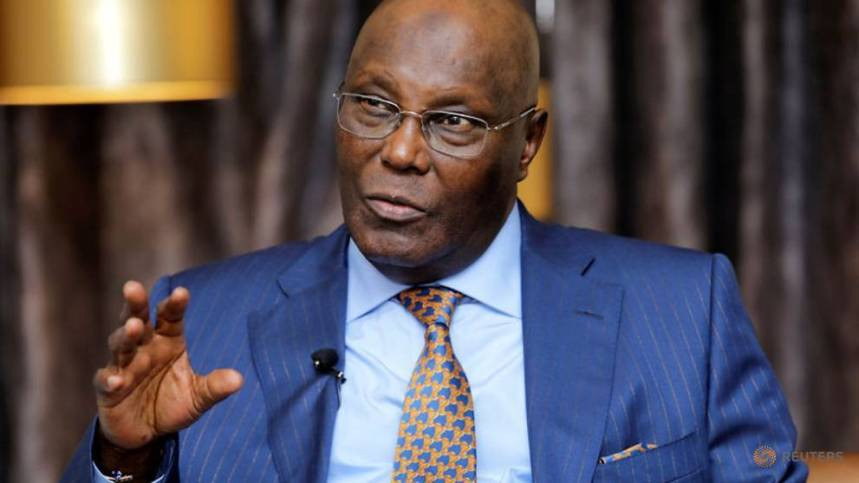
Former Vice President of Nigeria and Presidential Candidate of the African Democratic Congress (ADC), Atiku Abubakar, has expressed bewilderment over President Bola Tinubu’s latest claim that “prosperity is on the horizon” and that “the quality of life is improving,” asking whether the President was referring to another country or the Nigeria that millions of citizens endure every day.
In a statement issued by his Senior Special Assistant on Public Communication, Phrank Shaibu, Atiku said the President’s remarks reveal a troubling disconnect between those who govern and the people they were elected to serve.
“Mr. President says prosperity is on the horizon. Nigerians are asking: whose horizon? Certainly not that of the market woman whose capital has been wiped out by inflation. Not that of the civil servant whose salary now expires before the month begins. Not that of the manufacturer struggling under crushing energy costs. Not that of the unemployed graduate who sees no future. Certainly not that of farming communities forced off their ancestral lands by terrorists and bandits, families mourning loved ones slaughtered in senseless attacks, or countless Nigerians who now live in daily fear of kidnappers who have turned human lives into commodities. And certainly not that of millions of households that have quietly reduced the number of meals they eat each day simply to survive.”
Atiku said that while no serious person disputes that President Tinubu inherited challenges, no President is elected to inherit excuses.
“The Constitution did not swear President Tinubu into office to explain history. It swore him into office to change it. Every administration inherits problems. Great leaders are remembered for solving them, not for endlessly rehearsing them.”
The former Vice President noted that after more than three years in office, the Tinubu administration can no longer govern by blaming its predecessors.
“The Nigerian people are not interested in who created the problem. They want to know who will solve it. A government that still blames its predecessors after years in office is, by its own conduct, admitting that it has run out of ideas. President Tinubu may find comfort in blaming those before him, but history will remember his administration as the one under which Nigerians endured unprecedented hardship, institutionalised fiscal recklessness, and one of the greatest appropriation scandals in the annals of our nation. The suffering of Nigerians today is driven not by the past, but by an administration that has elevated opacity over transparency, rewarded a privileged circle of cronies, and condemned millions to deepening economic pain, insecurity, and despair.
“It is even more astonishing that a President who constantly invokes China now blames Nigeria’s population for the country’s difficulties. China did not become an economic superpower by complaining about the size of its population. It became prosperous because visionary leadership transformed that population into its greatest economic asset through sustained investment in manufacturing, infrastructure, education, technology, and export-led industrialisation. Great leaders convert challenges into opportunities. They do not convert opportunities into excuses.
“That is precisely what an Atiku Abubakar administration will do. We will invest aggressively in manufacturing, modern infrastructure, quality education, skills acquisition, agriculture, and export-driven industries to unlock the enormous productive capacity of our people. Nigeria’s youthful population is not a burden; it is our greatest strategic advantage. Our people are not the problem. President Tinubu’s failed leadership is.”
He said it was particularly insensitive for the President to suggest that because hunger existed before his birth, Nigerians should somehow accept the unprecedented hardship confronting them today.
“Nobody ‘elected’ Tinubu to eliminate the hunger of 1940. Nigerians ‘elected’ him to confront the hunger of today. The fact that previous generations endured hardship is not a licence to deepen the suffering of the present generation.”
Atiku stressed that hope is not manufactured through speeches but earned through purposeful leadership and policies that improve lives.
“Hope cannot be preached to a hungry stomach. It cannot be legislated into existence. It cannot substitute for affordable food, stable electricity, productive jobs, quality education, accessible healthcare, or security for families to sleep with both eyes closed. Government inspires hope through performance, not rhetoric.”
He urged President Tinubu to step outside the comfort of official briefings and carefully choreographed ceremonies and reconnect with the realities confronting ordinary Nigerians.
“If the President truly believes that the quality of life is improving, then one must respectfully remind him that the Nigeria he is talking about exists only in his head. It is certainly not the Nigeria where families are choosing between food and medicine, where communities are fleeing armed violence, where kidnappers dictate the rhythm of daily life, and where hope is becoming more expensive than bread.”
Headlines
Ghana Pushes for Sweeping Constitutional Reforms
Ghana has backed five-year presidential terms as part of a sweeping constitutional reform programme that could reshape elections, political eligibility, public appointments and institutional accountability in one of West Africa’s most stable democracies.
It argues that Ghana’s current electoral cycle leaves governments with too little time to implement and assess major policies because the early months of an administration are dominated by transition arrangements, while the final year is largely consumed by election preparations.
“The early months of every administration are consumed by transition matters, and the final year is largely consumed by elections,” Attorney-General and Minister for Justice Dominic Ayine said while announcing the government’s position.
The proposal forms part of a much broader attempt to rewrite important sections of Ghana’s 1992 Constitution, which came into force in January 1993 and established the country’s Fourth Republic.
Unlike constitutional changes elsewhere in Africa that have been used to remove presidential term limits or extend an incumbent’s stay in office, Ghana’s proposal does not alter the existing two-term limit. It would instead increase the length of each term from four to five years.
President John Dramani Mahama is also serving what the present Constitution treats as his second and final presidential term. He first led the country between 2012 and 2017 before returning to office in January 2025.
The government also accepted in principle a proposal to lower the minimum age for presidential candidates.
Ghana’s Constitution currently requires candidates to be at least 40 years old. The review committee recommended reducing the threshold to 30, but the government settled on 35, arguing that the existing rule excludes qualified citizens on the basis of what it described as an arbitrary age restriction.
Presidential and parliamentary elections would also move from December to the first week of November, creating a longer period between voting and the inauguration of a new government on January 7.
That change is intended to give the Electoral Commission more certainty and provide additional time for transitions and electoral disputes to be resolved.
Under another accepted proposal, presidential election petitions would have to be filed within 14 days of the declaration of results and decided by the Supreme Court within 30 days.
But the five-year term and lower presidential age represent only a small part of the reform package.
The government’s position paper responds to more than 147 proposed amendments and about 59 proposed new constitutional provisions.
The committee behind the report consulted more than 500 experts and practitioners, engaged groups representing more than 21,500 people and received 785 written submissions. Among the most consequential proposals is a plan to cap Parliament at 300 members.
Ghana presently has 276 constituency MPs. Under the government’s model, those 276 seats would remain, while another 24 would be filled through proportional representation and allocated among women, young people and persons with disabilities.
The government described the cap as a cost-saving measure that would stop the continuing proliferation of constituencies. It plans to commission a study on how the additional proportional-representation seats would be allocated.
The government also accepted a recommendation that Ghanaian citizens by birth should no longer be barred from Parliament simply because they hold another nationality.
Qualifying dual citizens would be permitted to contest parliamentary elections without first renouncing their second citizenship.
The government said the present restriction is inconsistent with Ghana’s growing engagement with its diaspora and reduces the pool of qualified candidates.
Another proposal would create a constitutional right of abode for people of African descent in the diaspora, subject to conditions established by Parliament.
The government linked the measure to Ghana’s Year of Return and Beyond the Return initiatives, which have sought to deepen ties with Africans and people of African heritage outside the continent. It said Parliament would determine the conditions for residence and any pathway to citizenship.
The package also reaches into the management of the economy and public institutions.
The review committee proposed stronger disclosure rules covering public debt, government guarantees, public-private partnerships and liabilities arising from state-owned companies.
It also recommended allowing Parliament to establish an independent fiscal council to scrutinise the sustainability of government finances.
However, the government concluded that several of those objectives could be achieved through existing public financial management laws rather than being written into the Constitution.
This reflects a broader pattern in its response: some recommendations were accepted as constitutional amendments, while others were redirected towards ordinary legislation to avoid creating rigid or expensive new institutions.
The government similarly supported creating a Public Ethics Commission and a body to regulate political parties and campaign financing, but rejected proposals to constitutionally establish some other commissions, saying their responsibilities could be handled by existing institutions or legislation.
It acknowledged that creating several new constitutional bodies would carry significant staffing, accommodation and operating costs at a time when Ghana must balance institutional reforms against spending on infrastructure, health, education and social protection.
The reform process is not Ghana’s first attempt to revise the 1992 Constitution.
A commission established in 2010 submitted its report in 2011, followed by a government White Paper in 2012 and the creation of an implementation committee.
However, the recommendations were not fully implemented. A later attempt to hold a referendum on local government reforms in 2019 was cancelled after political consensus collapsed.
The latest proposals are therefore, not yet law; Ghana’s government plans to appoint a Constitution Review Implementation Committee to prepare two amendment bills simultaneously: one covering non-entrenched provisions and another dealing with entrenched sections of the Constitution.
Non-entrenched amendments require the support of at least two-thirds of all members of Parliament. Entrenched provisions must go through a national referendum.
For a referendum to pass, at least 40% of registered voters must participate and at least 75% of the valid votes cast must support the proposed amendments.
The bills are expected to be ready by October 2026, while the referendum on entrenched provisions is expected in 2027.
That difficult approval process means the government’s endorsement is only the beginning.
But after two earlier reform efforts failed to deliver substantial constitutional change, the five-year presidential term will test whether Ghana can build the political and public consensus required to make its most extensive governance reforms in years a reality.
Source: Inside Africa
Headlines
Police Release Osun SSG
The Secretary to the Osun State Government, Teslim Igbalaiye, has been released by the Osun State Police Command.
Igbalaiye’s release was announced by Pelumi Olajengbesi, the spokesperson for the Imole Campaign Council, the group leading the re-election campaign of Governor Ademola Adeleke.
Olajengbesi shared the development on his verified Facebook page on Thursday.
“We sincerely appreciate the Inspector General of Police and the Commissioner of Police, Osun State Command, for listening to the voice of reason despite pressure and for responding to the people’s demand regarding the unlawful arrest of the Secretary to the State Government, Chief Igbalaye Teslim.
“The Nigerian Police Force best serves the nation when it stands against oppression and upholds justice and the rule of law. Welcome back, Chief Igbalaye Teslim. Your courage and sacrifice for the people of Osun State will not be forgotten. Our SSG is out, back and solid,” Olajengbesi wrote.
The spokesperson for the Osun State Police Command, Abiodun Ojelabi, also confirmed the release in a telephone conversation with journalists in Osogbo.
Igbalaiye and five others were arrested and detained by the state police command after a raid on his residence in Osogbo on Wednesday.
The police stated that among those arrested at the SSG’s residence was a suspect on the police watchlist in connection with criminal offences, Oladele Abiodun.
Ojelabi also said a sum of N4,810,500, two Permanent Voter Cards, a voter register, a Dynabook laptop, one photocopy machine and one printer were recovered from Igbalaiye’s residence.
Others arrested with Igbalaiye include Akande Taiwo, 60; Adeyemo Lukman, 45; Olaoye Muftau, 50; and Aderemi Musliu, 40
The PPRO said a police team, acting on intelligence that a criminal gang was hibernating at a location in Osogbo, carried out a lawful raid and apprehended the suspects.
He said, “During the operation, officers recovered exhibits comprising a cash sum of four million, eight hundred and ten thousand, five hundred naira (N4,810,500), one Dynabook laptop, one photocopy machine, one printer, two voter cards and a voter register for Wards 1-15.
“These exhibits have been secured and are currently in police custody for detailed forensic examination and further investigation.
“The recovery of the cash and the register containing voters’ details raises serious concerns regarding possible electoral offences and other criminal activities.
“While investigations are still ongoing, the facts presently available disclose reasonable grounds to investigate the commission of offences, which may include:
“Bribery of voters (vote buying), contrary to Section 121 of the Electoral Act, 2022, arising from the alleged distribution of money or other inducements to registered voters for the purpose of influencing their voting decisions.
“Criminal conspiracy, where two or more persons are found to have agreed to commit an unlawful act; harbouring or concealing a wanted criminal, where any individual is found to have knowingly sheltered or assisted a fugitive from justice; and any other offences that may be disclosed upon the conclusion of the ongoing investigation.”
The release came hours after the Speaker of the Osun State House of Assembly, Adewale Egbedun, alleged that the arrest of the SSG was ordered by the state Commissioner of Police, Ibrahim Gotan, following an incident at an Independent National Electoral Commission stakeholders’ meeting.
Egbedun claimed the commissioner directed the arrest after he was booed by some attendees and noticed Igbalaiye laughing during the incident.
He also alleged that the SSG was later informed that police officers were waiting at his residence. The police, however, maintained that the raid and arrests were based on intelligence linking the suspects to alleged criminal activities and possible electoral offences.
Source: The PUNCH