
Metro
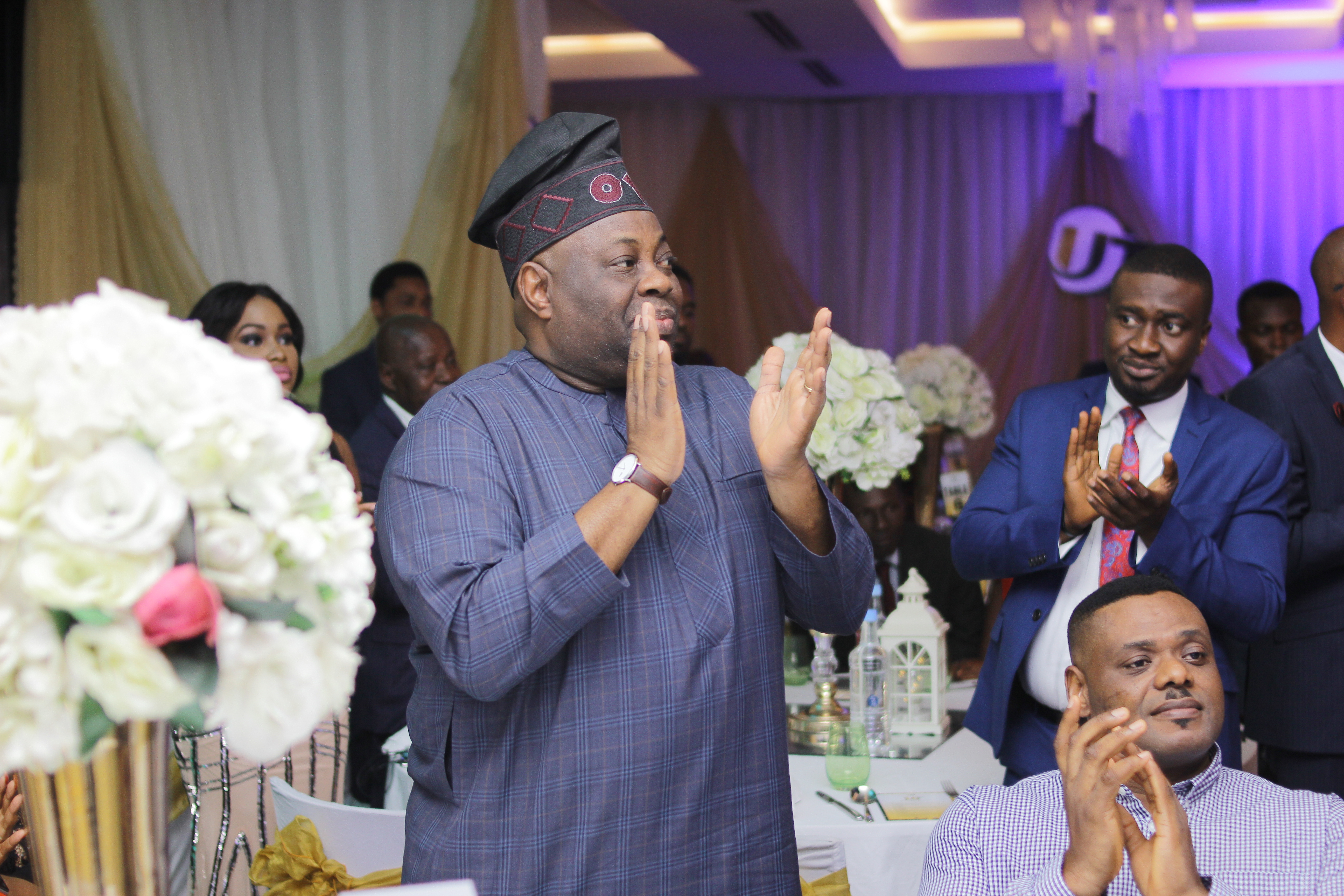
Now that Buhari Has Cowed Nigerians, What Next by Dele Momodu

- /home/rhoncare/pointblank.ng/wp-content/plugins/mvp-social-buttons/mvp-social-buttons.php on line 27
https://pointblank.ng/wp-content/uploads/2019/06/IMG_1578-1000x600.jpg&description=Now that Buhari Has Cowed Nigerians, What Next by Dele Momodu', 'pinterestShare', 'width=750,height=350'); return false;" title="Pin This Post">
- Share
- Tweet /home/rhoncare/pointblank.ng/wp-content/plugins/mvp-social-buttons/mvp-social-buttons.php on line 69
https://pointblank.ng/wp-content/uploads/2019/06/IMG_1578-1000x600.jpg&description=Now that Buhari Has Cowed Nigerians, What Next by Dele Momodu', 'pinterestShare', 'width=750,height=350'); return false;" title="Pin This Post">
Fellow Nigerians, let me take you back to the year 1998, the 7th day of the month of July to be precise. Chief Moshood Abiola had just been pronounced dead, just like that, and everything, and everywhere, was topsy-turvy. We were numb beyond words. A new leader had taken power the month before, after the sudden death of the maximum ruler, General Sani Abacha. How can two antagonists die in similar fashion, one month apart, we wondered, ponderously.
Anyway, as with everything Nigerian, life soon moved on, without much ado. A few irate students, led by Omoyele Sowore, ranted and raved but their fireballs soon disintegrated and dissolved into ashes. Those of us in exile were left stupefied. In all honesty, we had all individually and collectively given our best to the struggle, but our best was simply not enough. Man and God had contrived to deprive us of our greatest democratic moment as a nation. It does not appear that our democratic nous and ethos will ever reach the dizzying heights of those glorious days! We lost Abiola and we lost the mandate freely given to him by the good people of Nigeria. So, we were back to square one.
Tokunbo Afikuyomi and I offered ourselves as Guinea pigs and meandered our way back home the same way we had navigated our ways through the forest of a thousand daemons to escape from the Gulag and what appeared at the time a the most brutishly ruthless dictatorship in Nigeria. What we found out on our return was unbelievable and shocking. Our politicians had barely waited for Abiola to be interred before they started their stock in trade, jostling for power and lucre.
We returned to London, very frustrated about our experience at home. What we suffered through the labyrinth of madness called Seme border is another matter entirely and a story for another day. Back in England, some of our compatriots were still blowing grammar. Saying we must fight the military. We no go gree, like students’ union leaders love to chant every now and then, during Aluta struggles in our diverse universities. The difference was we were not students, and this was real life, off campuses.
We decided to tell our elders in the Diaspora the gospel truth. Those at home were not in sync with those fighting from abroad. The exposure and experience we had all gained during our sojourn and desperate struggle for truth and justice seemed totally lost on our compatriots at home. Our vision and mission were quite clearly totally divergent. One thing led to another and many of the NADECO Chieftains agreed to return home. It was over, as simple as that. That was the reality.
The regime of General Abdulsalami Abubakar decided it would hand over government to a civilian government under one year and it stuck rigidly to its transition timetable despite serious temptations to extend its set tenure. If we thought the military reign was reaching its terminal end, we were dead wrong. The military was merely beginning to prepare for tenure elongation albeit in civilian toga. The first election was therefore won by a retired military General, Chief Olusegun Obasanjo. And it became obvious that the military establishment was not yet ready to relax and reduce its iron grip on Nigeria’s jugular. Most of those who paraded the corridors of power were military men in civilian garb. Four years later, President Obasanjo sought another term and got it. Meanwhile, throughout all this, there was no provision for the inclusion of the NADECO fighters as reparation for the dastardly acts against Abiola and his supporters.
Let’s fast forward a little. After a controversial third term attempt for President Obasanjo by some political jobbers fell flat, a brother of a former military General, Alhaji Umaru Musa Yar’Adua was brought on board to take over the reins of power. It was like a change of baton in an exclusive relay race by the military. By sheer act of providence, President Yar’Adua took critically I’ll and died in office. This was how fate threw up a complete stranger to the military establishment and virtual lone ranger on the balcony of power, Dr Goodluck Ebele Jonathan, as President.
It was obvious some members of a most powerful cabal were not happy about the emergence of Jonathan, a man from one of the politically disadvantaged and handicapped regions of Nigeria, the South South. The Ijaw heritage of Jonathan was meant to be his Achilles heel but the man trudged on till he completed the tenure of his departed boss. Of course, against all odds, he contested for his own term and won. That was in 2011. I was privileged to have been a Presidential candidate at that time.
President Jonathan’s tenure was marred by many turbulent upheavals, the worst being the Boko Haram menace. There were also instances of reckless looting of the national treasury and well documented profligacy by his PDP apparatchiks. President Jonathan shot himself in the foot and incurred the wrath of the people when in the midst of horrendous poverty, he sharply increased prices of petroleum products, astronomically. That was the moment many felt he had goofed beyond repair. I was one of those who participated in global protests against his government. I wrote copiously, granted interviews and generally became a thorn in the flesh of the Jonathan administration along with several others. Jonathan was so derided and became butts of jokes everywhere. It was only a matter of time before Jonathan and his motley crew of pillaging merry men would be sacked from power.
I must confess that at the height of our stupidity and naivety, in retrospect, we threw caution to the winds. We wrote off Jonathan despite occasional flashes of genius and inspiration by some members of his team. In the meantime, former Nigerian Head of State, Major General Muhammadu Buhari (RTD.) was repackaged to smell like roses and we all fell for the promise of Eldorado he seemed to hold at the time. I was one of those who jumped on the bandwagon to describe him as a born-again Democrat, despite some strident and persistent warnings by then Governor of Ekiti State, Ayodele Fayose and others. Perhaps we were fooled by the fact in quick succession he had picked Pentecostal pastors in his running mate in Pastor Tunde Bakare in 2011 and Professor Yemi Osinbajo in 2015. Those who told us that our Hallelujah Choruses were premature and that a leopard can never change its spots were castigated and hounded by those of us who had been converted to what we believed was the new Buhari. We sang in unison that anyone but Jonathan. The rest is history.
Step forward, President Buhari, and take a bow. You rode back triumphantly to power, 30 years after you were sacked by General Ibrahim Babangida. What a feat! The world rejoiced at the final collapse of the PDP behemoth. Our Messiah had come. Most of our prominent challenges would soon evaporate and vamoose. Praise the Lord.
Let me not bore you with how those four years were spent, again, just like that. I leave the judgment of what happened to fellow Nigerians. Excuses became the art and science of governance. The past governments and its ruling party, PDP, was blamed for virtually everything under the sun. No worries. We didn’t expect Buhari to fix the accumulated problems of 16 or more years in a short while. Initially, we thought he would eventually settle down and make inroads into the problems that he had inherited. In any event, we also didn’t expect him to add more to those problems. The little we expected was for Buhari to bring stability to the polity. Again we were wrong.
Everything fell apart and the issue of security which was supposed to be easy meat for our President being a respected, respectable and retired General has become an albatross for the government. So, again, foul. We goofed. I don’t know how to put it any better. With excellent performance, no one would have taken note of a few human rights infringements here and there. We would have tolerated it as the price we probably needed to pay for the stellar performance that we are getting. However, the converse became the case. There are more and more human rights abuses and less and less convincing performances.
Slowly but steadily, a supposed Democratic government began its relentless assault on what our Constitution had enshrined as a government of separation of powers. President Buhari took up the role of an avuncular leader and school headmaster. He simply encroached into territories that were clearly not his to tamper with. If Jonathan had tried a small fraction of this, hell would have known no bigger fury. Yet most of our leaders and elders have disappeared from the radar without as much as a whimper.
You brood of hypocrites! Jonathan was our whipping boy and we trounced, thrashed and trashed him mercilessly. But now, we have lost our voices, it is not just that our criticism has become muted, they have become practically non-existent because the Presidential trolls have been relentless in the way and manner that they have traduced the few honourable critics. Our pen tigers have stopped writing. Our loquacious activists have since absconded and abdicated their once noble responsibilities. Such is life. The oppressed, according to Paulo Freire, only fears and respects his oppressors. We have all seemingly been cowed (no pun intended) into submission. Heaven forbid! That is neither the Nigerian spirit nor psyche!
Was this the Democracy we fought for with sweat and blood. When our human rights crusaders were preaching and pontificating and condoning extrajudicial treatment against the so-called sinners and looters and a few of us pleaded for caution, we were attacked as supporting and promoting corruption. When the government goons went after the judges in the dead of the night and we raised alarm, we were called by names our parents did not give us at birth. When the hooded ones invaded the National Assembly in order to obliterate their sworn enemy, Dr Abubakar Bukola Saraki, they said we have been bought and should shut up. But today the chickens have come home to roost.
Our dear friend, Omoyele Sowore, has been captured, detained and is about to be guillotined for using a word that was just one in the arsenal and vocabulary of this government when it was in opposition. The impugned language is one APC leaders have all used in the past, indeed they have said worse. They have rallied, railed and planned a road demonstration that they had joined openly in the past without any repercussion. The lesson in this for me is that we must all stand firm for the rights of every man at all times, be it saint or sinner. The resort to jungle justice and rabid impunity is what has made it possible for any government to pounce on Omoyele Sowore, a man whose tongue is sharper than razor blade and a pen mightier than atomic bomb but who in reality can never carry a physical weapon and has not encouraged anyone to do so in this ‘revolution’ that he has called for. Indeed, it is only those who are blood-thirsty that would see what is said as anything other than a clamour for a peaceful and democratic change in government within constitutional means. As a matter of fact, the revolution Sowore called for, whatever your interpretation, was not as popular on the streets until a panic stricken government elevated and catapulted it to a dizzying height, a free and cheap publicity that was unsolicited by the conveners.
Now we have succeeded in diverting attention from the killer herdsman who have been on rampage. Is it not an irony that Sowore was arrested for doing virtually nothing bigger than what he and many of us did to support Buhari when he was still one of us. Let us hope in the spirit of this Sallah, that the Federal Government will change its mind, and possibly its style, of killing flies with a sledgehammer…
Barka de Sallah to all our dear Muslims…
Culled from TheBoss Newspapers


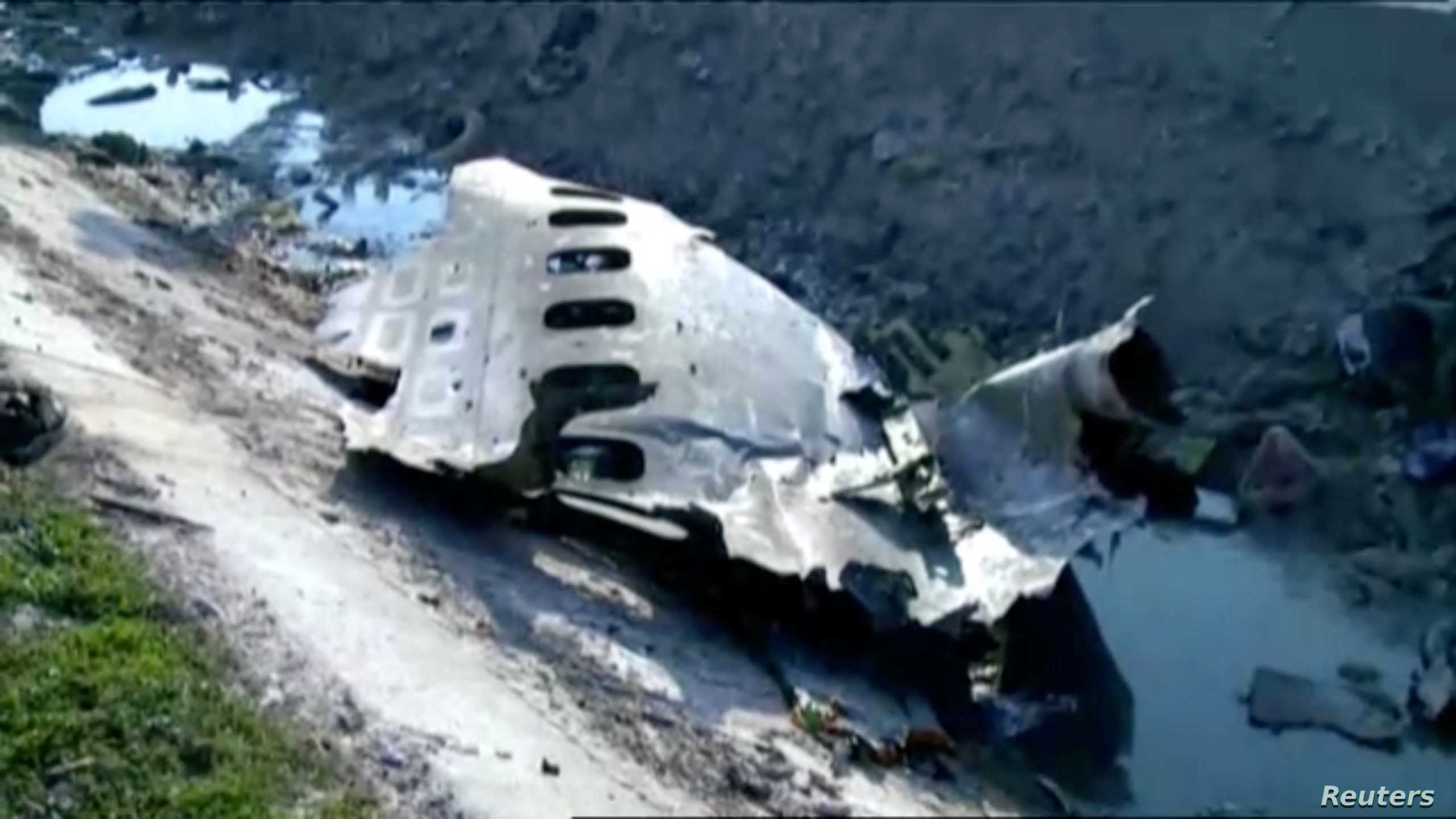
An helicopter crashed into a swamp near Naval Base in Igbokoda, the headquarters of Ilaje Local Government Area of Ondo State, on Monday.
The incident occurred at about 11.00a.m during heavy down pour, throwing the coastal community into panic.
The number of people on board of the helicopter was yet to be officially confirmed, while the condition of possible survivors cannot be confirmed.
Confirming the incident, Maurice Oripenaiye, the Chairman of the local government, told the News Agency of Nigeria (NAN) in a telephone interview that he could not ascertain the number of the victims.
Oripenaye also said he was yet to ascertain the identity of the crashed helicopter and the passengers.
“It happened during the heavy rainfall at about 11.00a.m. I cannot confirm the number of the people on board. I have deployed some youths to the area for rescue purpose,” he told NAN.
Similarly, the Police Command in Ondo State while confirming the crash, said details surrounding the incident were still emerging.
The command in a statement by its spokesperson, Abayomi Jimoh, a deputy superintendent of police, in Akure, said efforts were ongoing to establish the full circumstances surrounding the crash.
“The command urges members of the public, particularly residents of Igbokoda and adjoining communities, to remain calm and refrain from circulating unverified information.
“The public will be duly informed as soon as further credible information becomes available,” it stated.
(NAN)
By Eric Elezuo
All Lagos State-owned universities through their Joint Action Committee (JAC) of staff unions have embarked on an immediate and indefinite strike in fulfilment of their threat to do same last Friday.
The institutions are downing tools over the non-Implementation of the renogotiated ASSU/FGN agreement of 2026 as involves the Lago State government.
The affected universities include Lagos State University, Ojo, the Lagos State University of Education, the Lagos State University of Science and Technology and the Lagos State University College of Medicine.
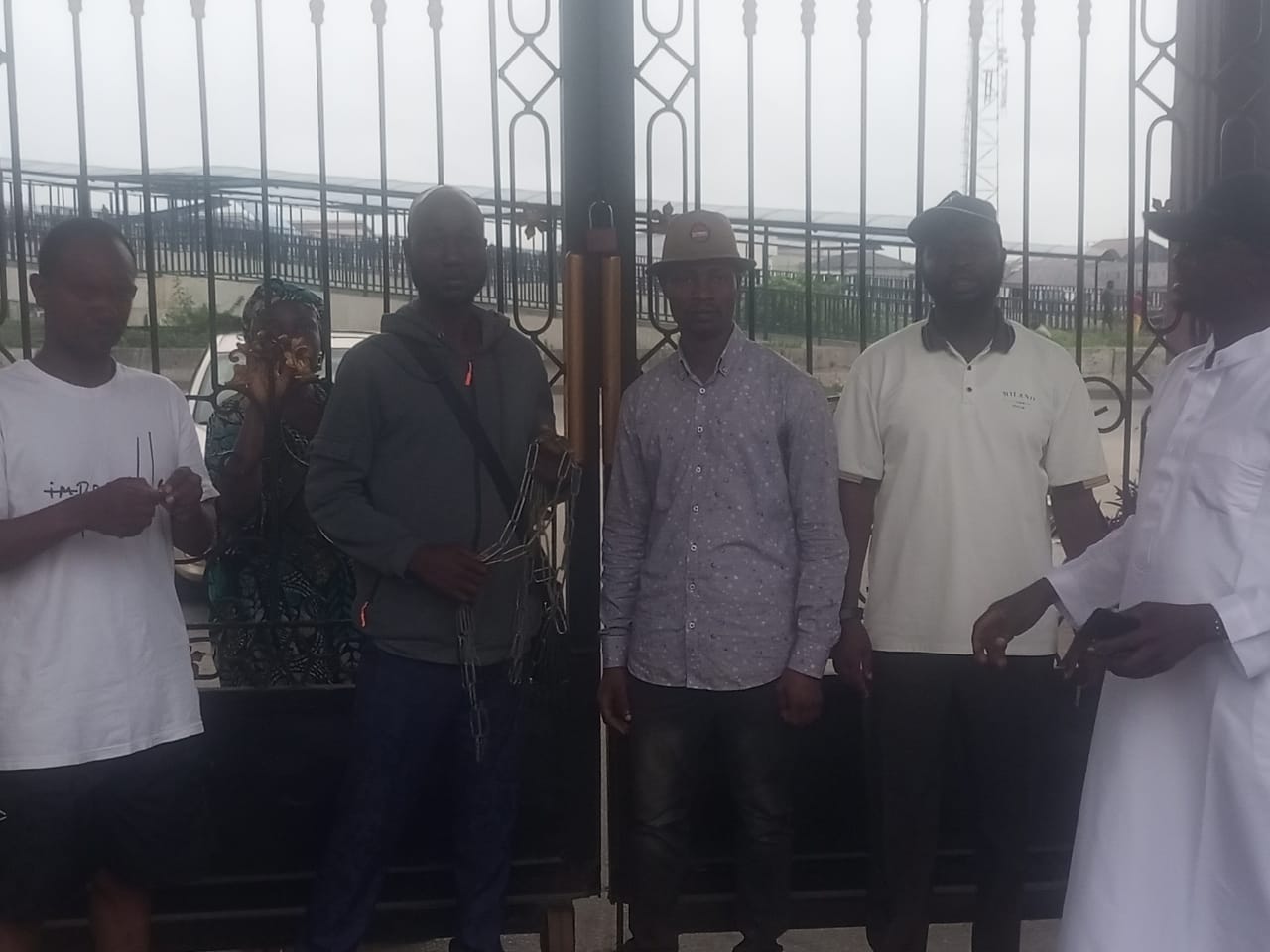
Our correspondent reports that major entrances of the institutions have been put unde lock and key with restrictions to entry into the campuses.
At LASU, members of the JAC were seen in their numbers locking up gates, and enforcing the strike action.
Recall that the unions issued a threat on Friday during a press conference held at the Lagos State University (LASU), Ojo Campus.
The conference was addressed by the Chairman of JAC and Academic Staff Union of University (ASUU-LASU), Prof. Ibrahim Bakare.
JAC comprises the Academic Staff Union of Universities (ASUU), the Senior Staff Association of Nigerian Universities (SSANU), the National Association of Academic Technologists and the Non-Academic Staff Union of Educational and Allied Institutions (NASU).
In his address during the briefing, Bakare said the unions’ final seven-day ultimatum to the Lagos State Government expired at midnight of Friday.
He said the unions had exhausted all avenues of dialogue over the implementation of the 2026 Federal Government and staff unions’ agreements.
“We have exhausted every possible means to avert declaration of industrial action across state-owned universities in Lagos State,” Bakare said.
He said the crisis resulted from bureaucratic delays, shifting goalposts and a lack of executive action on the agreements.
According to him, JAC had engaged relevant government ministries since July 30 to resolve the issues through dialogue.
He said a technical committee comprising government and JAC representatives reached consensus on the implementation of various allowances on Aug. 18.
Bakare said the agreed terms included 40 per cent Consolidated Academic Tools Allowance for ASUU and 35 per cent allowances for SSANU and NASU.
He said the parties subsequently signed a communiqué on Aug. 31, committing to implementation from September 2026 and payment of eight months’ arrears.
“September salaries were paid without the implementation of the agreed rates and the outstanding arrears,” he said.
Bakare said the non-implementation had increased the outstanding arrears to nine months, covering January to September 2026.
He said JAC was demanding immediate executive approval and implementation of the signed 2026 agreements without further alteration or delay.
Bakare said the unions also demanded payment of nine months’ arrears, non-taxation of applicable allowances and implementation of the 15 per cent Lagos factor.
He added that the unions demanded fulfilment of outstanding commitments, including a 20 per cent salary increment and release of five Marcopolo buses promised to state-owned universities.
Bakare said the unions had demonstrated restraint and repeatedly chosen dialogue in spite of the challenges, instead of disrupting academic activities.
“However, our patience has been pushed to the absolute limit,” he said.
He had warned that failure of the state government to act before midnight of Friday would trigger “an immediate, total and indefinite strike” across Lagos State-owned universities.
Bakare had also appealed to traditional rulers, religious leaders, parents and students to urge the government to resolve the matter before the deadline.
Much as the unions maintained open channel for further negotiations and interventions, the Lagos State government nor any other body was not forthcoming before the final shutdown of the universities on Monday.
The Lagos State government is yet to issue a statement in response as at press time.
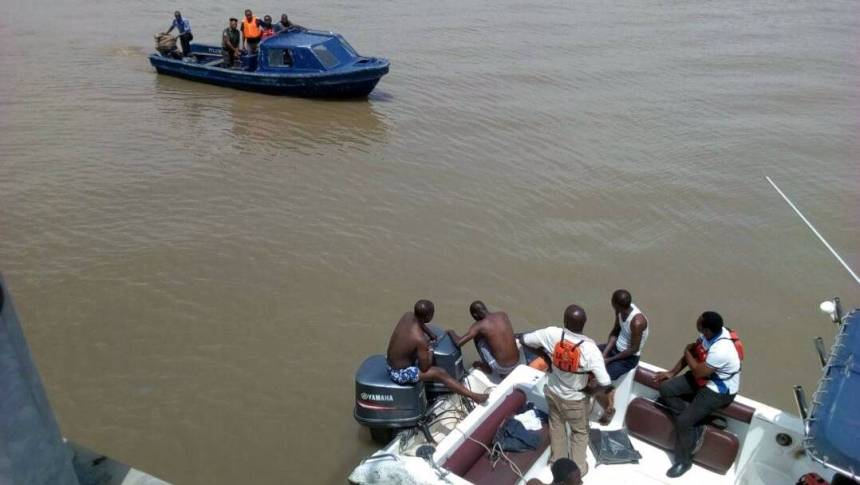
Several persons have so far been missing after a wooden boat carrying more than 70 mourners and over 30 motorcycles overturned while crossing the River Katsina-Ala in Buruku Local Government Area of Benue State.
The incident reportedly occurred around 11am on Saturday, October 3, 2026, at the Buruku River crossing point.
The passengers, most of whom were said to be from Mbayon in Gboko Local Government Area, were returning after attending the burial of a relative on the opposite side of the river when the boat capsized.
Several occupants were reportedly rescued from the water, while search and rescue personnel continued efforts to locate those who remained unaccounted for as of Saturday afternoon.
Reports said the wooden boat was severely overloaded with passengers and motorcycles before its engine reportedly developed a fault during the journey.
“The boat was overloaded with many people and over 30 motorcycles, and they were coming from the Logo LGA side of the River at about 11am when the incident happened.
“Many persons have been rescued, but as we speak, I cannot tell you the actual number of persons that have not been seen or rescued from the river because the search is still ongoing. But many persons have not been seen as we speak,” an eyewitness said.
The Chairman of Buruku Local Government Area, Raymond Zege, confirmed the mishap, explaining that the passengers were mourners from Gboko who had travelled across the river for a burial ceremony.
Zege said the boat was carrying more than 70 people when its engine stopped working in the middle of the return trip, causing panic among those on board.
“The victims were mourners from Gboko who went for a burial on the other side of the river.
“They boarded a boat which was overloaded with over 70 persons. In the middle of the journey the engine of the boat failed, and they became panicky.
“And they also ran into a heavy wave, and the boat capsized before the boat that was sent to rescue them got to them,” he said.
The council chairman said authorities had yet to determine the precise number of missing persons, although more than 60 passengers had reportedly been rescued.
“At the time we speak, we do not know the number of persons missing. So far we have not seen about six persons, but we have rescued over 60. Search and rescue operations are ongoing,” he said.
Zege urged passengers using the waterway to observe maritime safety guidelines, particularly by wearing life jackets during crossings.
He disclosed that the local government had supplied life jackets for people using the route, but said enforcement had sometimes been difficult because some commuters declined to use the safety equipment.
“People can be very difficult. There is a law, and we have provided life jackets for every commuter crossing that route. When they come and the maritime workers try to enforce the law, some commuters complain that they have health issues or that they do not want to share life jackets used by other people.
“We have provided the jackets, and the state government is also supporting efforts to ensure that maritime safety regulations are enforced,” he said.
The chairman further said maritime officials regularly conduct enforcement operations and urged commuters to cooperate with them.
“Sometimes the maritime officials come for enforcement, including at night. People should cooperate with them because the safety measures are meant to protect lives,” he said.
Meanwhile, the Benue State Commissioner for Marine and Blue Economy, Denis Iyaghigba, also confirmed the incident in a statement issued on Saturday.
Iyaghigba said his ministry had received preliminary information about the accident and appealed to relatives of the passengers and members of the public to remain calm while rescue teams worked to establish the number of people involved.
“I have received preliminary reports of an unfortunate boat mishap at the Buruku crossing point this morning, Saturday, 3rd October, 2026,” Iyaghigba said.
“I wish to assure members of the public, particularly families of those who may have been aboard the boat, to remain calm and await verified information from the appropriate authorities. No effort will be spared to ensure their safety.”
The commissioner said he had instructed boat operators and their union downstream to join the ongoing rescue operation.
“I have directed the boat operators and their union downstream to mobilise and assist in the ongoing search and rescue operation,” he said.
He assured that “further details will be communicated as the rescue operation progresses.”
As of the time of filing this report, rescue operations were still underway, with authorities yet to provide a final account of the total number of people aboard the boat or the confirmed number of those still missing.


