
Headlines
Tinubu Confers Posthumous Honours on Ogoni Four, Calls for Reconciliation, Unity

- /home/rhoncare/pointblank.ng/wp-content/plugins/mvp-social-buttons/mvp-social-buttons.php on line 27
https://pointblank.ng/wp-content/uploads/2025/09/1000427749.jpg&description=Tinubu Confers Posthumous Honours on Ogoni Four, Calls for Reconciliation, Unity', 'pinterestShare', 'width=750,height=350'); return false;" title="Pin This Post">
- Share
- Tweet /home/rhoncare/pointblank.ng/wp-content/plugins/mvp-social-buttons/mvp-social-buttons.php on line 69
https://pointblank.ng/wp-content/uploads/2025/09/1000427749.jpg&description=Tinubu Confers Posthumous Honours on Ogoni Four, Calls for Reconciliation, Unity', 'pinterestShare', 'width=750,height=350'); return false;" title="Pin This Post">
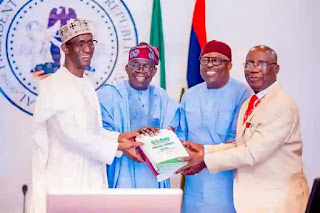
President Bola Tinubu on Wednesday conferred national honours of the Commander of the Order of the Niger posthumously on four late Ogoni leaders.
They are Albert Badey, Edward Kobani, Theophilus Orage, and Samuel Orage, popularly remembered as the Ogoni Four.
Tinubu announced the conferment when he received the report of the Ogoni Consultations Committee at the State House, Abuja, on Wednesday.
He urged the people of Ogoniland to embrace reconciliation and unity after decades of division.
“May their memories continue to inspire unity, courage and purpose among us.
“I urge the Ogoni people across classes, communities and generations to close ranks, put this dark chapter behind us and move forward as a united community with one voice,” Tinubu said.
Wednesday’s meeting comes 16 months after the President, in May 2024, promised to “pursue diligently and honourably” the Ogoni cleanup and increase the number of its indigenes benefitting from its empowerment programmes.
Tinubu also pledged his commitment to unlocking the human and natural resource potential of Ogoniland while ensuring the environmental and economic security of Nigerian communities.
At the meeting, the President assured stakeholders that his administration would support the journey of Ogoniland towards peace, environmental remediation, and economic revival, while also facilitating the return of oil exploration to the area.
He stated, “I am encouraged by the overwhelming consensus of the Ogoni communities to welcome the resumption of oil production.
“The government will deploy every resource to support your people in this march towards shared prosperity.”
Tinubu cited developments in 2022 when the Buhari administration transferred the operations of the Ogoni oil field to the Nigerian National Petroleum Company Limited and its joint venture partners.
He argued that his government would honour and build on Buhari’s decision.
In his closing remarks, Tinubu called on the people to seize the moment, saying, “Let us together turn pain into purpose, conflict into cooperation, and transform the wealth beneath Ogoni soil into a blessing for the people and for Nigeria.”
Consequently, he directed the National Security Adviser, Nuhu Ribadu, to commence engagement between the Ogoni people, NNPCL, its partners, and all relevant stakeholders to finalise modalities for restarting operations.
“A dead asset is not valuable to the community, the country or the people.
“The longer we procrastinate, the worse it is for everyone,” the President said.
He also directed the Minister of Environment to integrate pollution remediation and environmental recovery into the broader framework of dialogue with the people.
The National Security Adviser, Nuhu Ribadu, who presented the report, said the consultations included all four Ogoni zones, with input from local communities, traditional leaders, and the diaspora.
Ribadu said, “In all aspects of our national life, Ogoni is one, thirty-something years of very unfortunate history rewrite the wrong now,
“To us was instruction, then we carry out this dialogue, community engagement, talking with the people and getting to understand how to move forward. It has succeeded like what you have seen today.
“He gave directives to all government agencies and institutions and also directly to our office that we must implement everything that have been agreed and we have taken it.”
Ribadu affirmed that his office, alongside all relevant agencies, is committed to restoring peace in Ogoniland.
“We will make sure that we follow his own directives and his instructions.
“We are going to make sure that peace is restored already, it is, and hopefully you will see the benefit of it not just in Ogoni land but the entire Niger Delta and by extension Nigeria,” he said.
Meanwhile, Chairman of the Dialogue Committee, Prof. Don Baridam, noted that the committee ensured all stakeholders were carried along in the process, noting that the report reflects the collective will of the Ogoni people.
Baridam said the report captured the people’s demands for structured participation in oil production, renewed environmental cleanup, and a framework for sustainable development.
Oil was first commercially discovered in Oloibiri, Ogoniland, in 1958. However, exploration stopped in 1993 following sustained protests against environmental degradation and injustice.
The Ogoni Four refers to four traditional chiefs from the Ogoni community in Rivers State who were murdered on May 21, 1994, in the village of Giokoo.
The killings took place against the backdrop of the Movement for the Survival of the Ogoni People campaign, led by writer and activist Ken Saro-Wiwa, which had been mobilising the Ogoni against oil companies, particularly Shell, and the Nigerian state.
The subsequent struggles of Ogoni leaders to protect their environment from harmful oil exploration were met with severe repression, culminating in the hanging of Ken Saro-Wiwa and nine other leaders by the Abacha regime in 1995.
The Punch


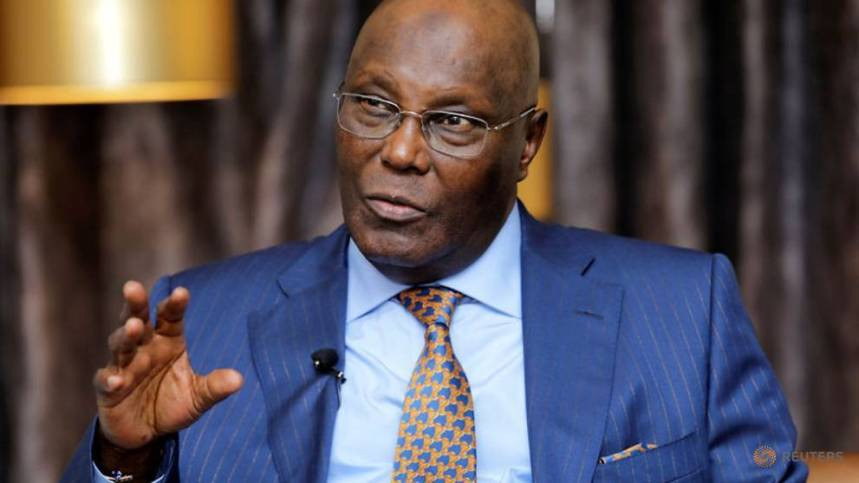
Former Vice President Atiku Abubakar has unveiled a 12-point policy agenda he says will guide his administration if he wins the 2027 presidential election on the platform of the African Democratic Congress (ADC).
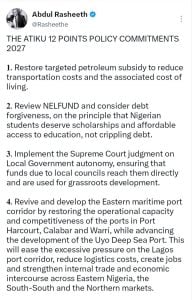
The policy commitments were published by AbdulRasheed Shehu, Special Assistant on Broadcast Media to Atiku, as part of the former vice-president’s campaign message ahead of the election.
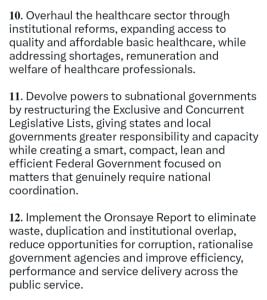
The agenda focuses on the economy, education, local government autonomy, transportation, electricity, job creation, security, agriculture, healthcare and the restructuring of the federal system.
Atiku proposed the restoration of a targeted petroleum subsidy as part of measures to reduce transportation costs and ease the pressure of rising living expenses on Nigerians.
He also promised to review the operations of the Nigerian Education Loan Fund (NELFUND), including consideration of debt forgiveness for beneficiaries. The proposal is based on the position that Nigerian students should have access to affordable education and scholarships rather than being burdened with debts.
On local government administration, the former vice-president pledged to implement the Supreme Court judgment on local government autonomy. Under his proposal, funds meant for local councils would be paid directly to them and deployed for development at the grassroots.
Atiku also identified the development of Nigeria’s maritime infrastructure as a major part of his economic agenda. He proposed reviving the Eastern maritime port corridor by restoring the operational capacity and competitiveness of ports in Port Harcourt, Calabar and Warri, while supporting the development of the Uyo Deep Sea Port.
According to the policy document, strengthening the eastern and southern ports would reduce pressure on the Lagos port corridor, lower logistics costs, create employment and improve trade between the South-East, South-South and northern markets.
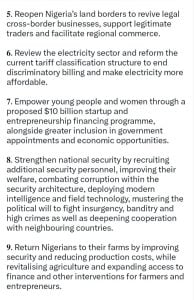
The former vice-president further promised to reopen Nigeria’s land borders to legitimate commercial activities. He said the move would help revive legal cross-border businesses, support traders and strengthen regional commerce.
Atiku also proposed changes to the electricity sector, including a review of the existing tariff classification system. His campaign said the reform would address what it described as discriminatory billing and make electricity more affordable to consumers.
Young Nigerians and women also feature prominently in the proposed agenda. Atiku plans to establish a $10 billion startup and entrepreneurship financing programme aimed at providing greater access to capital, while also increasing the participation of youths and women in government appointments and economic opportunities.
The security sector is another major focus of the policy commitments. Atiku proposed recruiting more security personnel, improving their welfare and strengthening the use of modern intelligence and field technology.
His plan also includes tackling corruption within the security system, confronting insurgency, banditry and other serious crimes with greater political will, and strengthening security cooperation with neighbouring countries.
In agriculture, Atiku said his administration would seek to encourage Nigerians to return to farming by improving security in farming communities and lowering production costs. The plan also includes greater access to financing and other forms of support for farmers and agricultural entrepreneurs.
The former vice-president equally proposed a major overhaul of the healthcare sector through institutional reforms and increased access to quality and affordable basic healthcare. The agenda also promises to address shortages of medical personnel, as well as their remuneration and welfare.
On governance, Atiku proposed devolving more powers to states and local governments by restructuring the Exclusive and Concurrent Legislative Lists. He said the federal government should become smaller and more efficient, concentrating on responsibilities that require national coordination while giving subnational governments greater capacity to manage local affairs.
He also pledged to implement the Oronsaye Report as part of efforts to reduce government waste and eliminate duplication among federal institutions. The proposal is intended to rationalise government agencies, reduce institutional overlap and corruption opportunities, and improve efficiency and service delivery across the public service.
The release of the 12-point agenda comes days after Atiku’s wife, Titi Abubakar, urged Nigerian youths to support her husband in the 2027 presidential election.
Speaking at the ADC All Support Groups Town Hall Meeting in Abuja, Titi said Atiku’s experience would enable him to begin governing without having to learn the responsibilities of the presidency on the job.
“Atiku is a sellable material. That is why I am so proud of my husband. Atiku is a philanthropist. Atiku has done it before. Atiku is not going to learn on the job. And Atiku is not a novice,” she said.
She also said Atiku was seeking the presidency to improve the lives of Nigerians rather than to enrich himself.
“Atiku is a man of honour, a man of his word. Atiku is not coming to chop government money. Atiku wants to give back to you people. Atiku wants you people to know what it is all about government,” Titi said.
She further highlighted Atiku’s proposed inclusion of young people and women in government, recalling his pledge to reserve 40 per cent of appointments for the two groups.
Titi also urged young voters to protect their votes and reject attempts to buy their support ahead of the election.
“Don’t allow them to come and give you money and you sell your conscience. If you sell your vote, you are selling the vote of your generation yet unborn,” she said.
She acknowledged that the ADC might not have the financial resources of some political opponents but urged youths not to exchange their votes for temporary financial benefits.
“ADC don’t have that money to give you. Don’t be a sellout. Because these people, they have all our money in their kitties,” she said.
Titi had also criticised the state of governance and the economy, saying, “Nothing is working. Our economy is in shambles.”
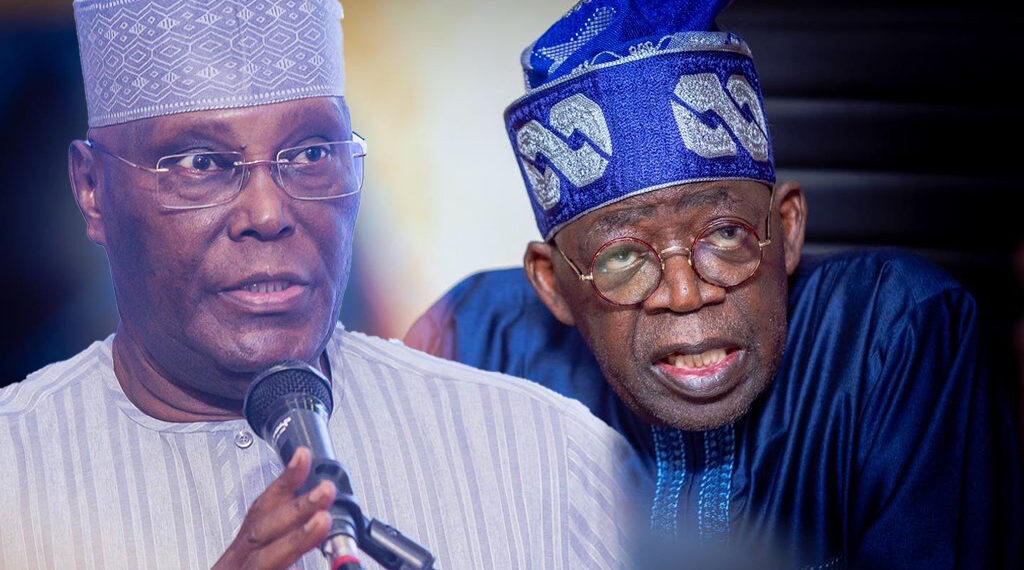
Former Vice President Atiku Abubakar has called on the Tinubu administration to provide clarity on how savings from the removal of fuel subsidy have been applied, following renewed concerns raised by the Academic Staff Union of Universities (ASUU) over unpaid entitlements and unresolved agreements.
Speaking on Sunday through his Senior Special Assistant on Public Communication, Phrank Shaibu, Atiku said the subsidy removal imposed significant costs on households through higher fuel prices, transport fares, food prices and school fees.
The presidential candidate of the African Democratic Congress (ADC) noted that the policy was also presented to Nigerians as a step that would release resources for education, healthcare, infrastructure and other essential services.
“If the subsidy has been removed and Nigerians have borne the attendant costs, then Nigerians deserve a clear explanation of how the savings are being applied,” Atiku said.
He said public universities continue to face funding challenges, with lecturers raising concerns about unpaid entitlements and outstanding agreements, while students face the risk of disruptions to the academic calendar.
Atiku added that the administration has cited increased allocations to State governments as part of the benefits of subsidy removal.
He, however, asked why public education across the federation still faces severe pressure, with both Federal and State-owned universities experiencing industrial disputes and infrastructure gaps.
“If more resources are reaching the federal government and states, citizens are entitled to ask how those resources are translating into improved classrooms, laboratories, hostels and teaching facilities,” he said.
The former vice president also raised questions about the government’s student loan scheme, NELFund.
He said the rising cost of education has put additional strain on families and that the loan programme should be matched with measures to expand access and reduce the cost burden.
“Every year, more young Nigerians seek university education. The physical capacity of the system needs to expand to meet that demand. We need to see more classrooms, laboratories, hostels and expanded admission spaces,” he said.
Atiku further said that while government has asked citizens to make sacrifices, it must also ensure transparency and equity in the application of public resources, including the use of waivers and concessions.
He called for accountability in the management of proceeds from subsidy removal, and urged the government to prioritise investment in education, healthcare and infrastructure.
“ASUU is again raising concerns over unpaid entitlements and outstanding agreements. State universities have also experienced disruptions. Students are taking loans to fund education, while infrastructure in many universities remains inadequate.
“The sacrifice has been made by Nigerians. The expected improvements in public services must now be seen and felt,” he said.
Atiku urged President Bola Tinubu to address the concerns raised by ASUU and other stakeholders, and to ensure that commitments made at the time of subsidy removal are fulfilled.
Arsenal left the Stadium of Light with another three points, but Mikel Arteta was far from satisfied with one of the major refereeing decisions in the champions’ 2-0 win over Sunderland.
The turning point came early in the second half when Sunderland were awarded a penalty following a physical battle between Arsenal’s Ezri Konsa and Dan Ballard.
Although VAR reviewed the incident, the original decision stood. Arteta strongly disagreed, insisting that the footage showed no offence worthy of a penalty and warning that such calls could have serious consequences in a Premier League title race.
Sunderland had a chance to capitalise, but Raya came to Arsenal’s rescue. The goalkeeper guessed correctly to keep out Le Fée’s penalty and turned the ball onto the post.
Arsenal needed only a short time to make the save count.
Guimarães, introduced at half-time, collected the ball outside the area and unleashed a curling strike that flew into the top corner. It was his first goal since joining Arsenal and gave the visitors the breakthrough they needed.
Sunderland refused to collapse and continued to test the visitors, but Arsenal’s defence survived the pressure. Saka then put the result beyond doubt from the spot in stoppage time after Reinildo was sent off for a second yellow card.
The victory means Arsenal have won all four of their Premier League matches this season, maintaining their flawless start and moving to 12 points.
For Arteta, however, the result did not erase his concerns about the penalty decision.
He argued that football’s extensive use of VAR should ensure such controversial calls are corrected, saying the incident was not acceptable at the highest level.
Arsenal ultimately had Raya’s heroics, Guimarães’ brilliance and a resilient defensive performance to thank for turning a potentially difficult night into another important victory.


