
Metro
Get Acquainted with Principles of Effective Service Delivery – Police Ministry Charges Staff


- /home/rhoncare/pointblank.ng/wp-content/plugins/mvp-social-buttons/mvp-social-buttons.php on line 27
https://pointblank.ng/wp-content/uploads/2020/10/Police-1000x600.jpeg&description=Get Acquainted with Principles of Effective Service Delivery – Police Ministry Charges Staff', 'pinterestShare', 'width=750,height=350'); return false;" title="Pin This Post">
- Share
- Tweet /home/rhoncare/pointblank.ng/wp-content/plugins/mvp-social-buttons/mvp-social-buttons.php on line 69
https://pointblank.ng/wp-content/uploads/2020/10/Police-1000x600.jpeg&description=Get Acquainted with Principles of Effective Service Delivery – Police Ministry Charges Staff', 'pinterestShare', 'width=750,height=350'); return false;" title="Pin This Post">
The Police Affairs Ministry has tasked its officials to imbibe the basic principles and philosophy of service delivery to be up to date in serving the Nigerian public.
A statement signed by the Ministry’s Deputy Director (Press & Public Relations Unit), Balaji Kazeem, and made available to the National Association of Online Security News Publishers (NAOSNP) quoted the Permanent Secretary, Ministry of Police Affairs, Dr. Nasir Sani-Gwarzo, as urging the staff of the Ministry to get acquainted with the philosophy and principles of service delivery and public service reform initiatives to effectively and efficiently implement the mandate of the Ministry.
Sani-Gwarzo gave the charge during the sensitization workshop on service delivery initiatives for officers on Salary Grade Level 10-14 at the Office of the Secretary to the Government of that Federation Conference Hall, Phase 1, Federal Secretariat, Abuja.Dr Sani-Gwarzo stated that the adoption of the SERVICE COMPACT with all Nigerians signals a realization that the Public Service could do better and needs to do better to serve the public adequately. In his words,
“Nigeria has been playing and will continue to play important roles in International Fora and as such will have to seek to self-improve its Governance processes through initiatives that focus on enhancing Public Service efficiency that will significantly contribute and propel the country towards achieving the desired reform agenda”. The Permanent Secretary recalled that the leadership of all MDAs are into SERVICE COMPACT with all Nigerians. Hence, all Civil Servants are expected to be consciously and deliberately committed to rendering prompt and efficient services to the citizenry.
According to him, “This Can only be possible if all eschew corruption and inefficiency. Stakeholders Should work harder to bring the vision of the Ministry to fruition, through upholding positive values, follow-up processes, ensuring absolute discipline, and giving recognition to competency, transparency, and accountability in the discharge of staff duties, so that citizens are not short-changed in their expectations of the standard of service provided by Government institutions.”
He reiterated the Management’s Commitment to employ the SERVICOM platform in making things work in the Ministry so that stakeholders will always enjoy doing business with the Ministry.Dr. Sani-Gwarazo said that the new initiative is aimed at breaking away from the old model to a new paradigm of productive, result-driven, world-class Civil Service for accelerated National Development.
The Permanent Secretary urged the participants to pay attention to the presentations and participate actively, hoping that the desired culture change would yield maximum benefits towards qualitative service delivery. In his welcome address, the Director of Reform Coordination and Service Improvement, Mr. Mshelbwala Ibrahim Musa pointed out that the concept of SERVICOM intends todrive Reform change, Innovation, and Improvement efforts within the Ministry incompliance with the framework set by the Office of the Head of Civil Service of the Federation (OHCSF) and Bureau of Public Service Reforms (BPSR).
He added that the structure will identify processes, systems, and service gaps develop interventions to eliminate such challenges, and manage as well as drive SERVICOM aims and initiatives within the Ministry.The Head of Operations(SERVICOM) Mrs. Ngozi Akinbodewa in her presentation stated that the “Service COMPACT with All Nigerians” objective is to institutionalize a culture of continuous performance improvement and citizen-centred/customer focus in MDAs as well as promote transparency and accountability.
In her words, “Its allows for an open and transparent approach that all citizens can understandand can work with, it covers key information about organization servicedelivery approach and the relationship the customer will have with the MDAs”.


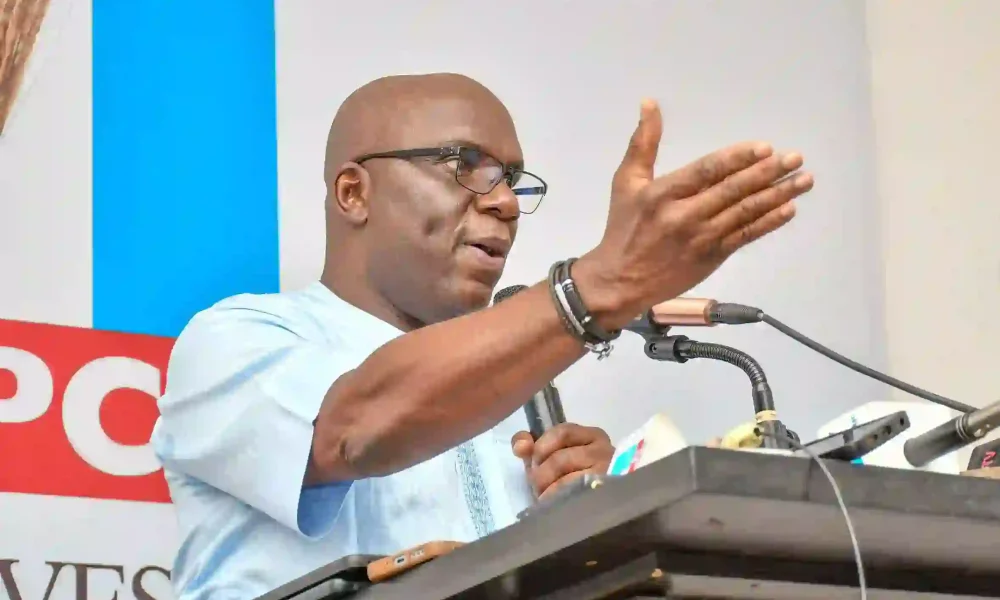
The National Publicity Secretary of All Progressives Congress (APC), Felix Muoka, has insisted that Nigeria and Nigerians are better off than ever before, saying the party will win the 2027 presidential election based on its positive records.
Muoka said the APC is working hard to secure voters’ support, adding that the party would not take Nigerians’ votes for granted.
Speaking on Politics Today, a Channels Television programme, Thursday, Muoka said the party’s preparations and campaign efforts are aimed at securing as many votes as possible in the next general elections.
He said: “Qualitatively speaking, our country is better. Nigerians are better today than they have ever been. Is there a country that has transited from this depressed economy, like we have had for decades, to that level of prosperity that didn’t go through these stages?
“Nigerians also understand that. So what the president has done is to give this country a fighting chance, not just at recovery, but at building the prospects for sustainable prosperity.”
On the inauguration of the APC Presidential Campaign Council, he said: “What you saw today and what we’ve been up to is really taking ourselves seriously. If we thought this was all said and done, we wouldn’t put in this level of energy and work in an effort to really get to the last vote within the electorate. We are not taking this for granted. We’re taking it very seriously. I’m sure that if our party was docile and we were doing nothing to campaign or put out our information, you would also bring me here to say that we had been very docile. We’re a political party.
“We are a party for a reason. We are in this to compete with other political parties and to win the support of Nigerians. Since 2023, there’s a reason that our party has been very successful. Since the last general elections, we’ve won fantastically all elections in which we have contested. There’s a reason for that. It’s because we prepare. We do our homework.
“Nigerians bought in and voted for our party massively in 2023. We won that election, even though there are elements who want to claim that they won without evidence. But we won that election without question. As I said a few minutes ago, in every other election that has been called since then, Nigerians voted, not Indians. Nigerians voted in all the other elections since 2023. We won by upwards of 90 per cent.
“Let me remind you that the APC is the governing party in this country, put in office by Nigerians. Already, the answer to your question has been codified in an election in which the APC is governing, not just at the centre, but in so many states in our country.”
On the APC’s chances in 2027, he said: “We will win the election. We are working hard to win the election. I think that Nigerians are going to stand tall, shoulder to shoulder with the APC to win the next election.”

Masked thieves broke into a warehouse in Cortona, Italy and made off with around 30,000 bottles of wine from the prestigious Marchesi Antinori vineyard worth more than US$5 million (NZ$8.9m), in what the company says could rank among the largest wine thefts ever reported.
The thieves silenced the alarm system to carry out the daring heist, which took place at the weekend, but was only discovered on Monday when workers arrived to prepare the wine for export, Antinori’s CEO Renzo Cotarella told CNN on Friday.
The stolen wines were all from 2023 and include some of the winery’s most sought-after labels that retail for between €150 and €500 ($299 and $998) internationally.
“Solaia, and Guado al Tasso, and Tignanello are the most icon(ic) wines we have,” said Cotarella, describing them as category-defining examples of the famous “Super Tuscan” red wines of the region. Between 60,000 and 70,000 bottles of Solaia are produced each year, and the thieves took around 10,000 bottles.
No arrests have yet been made. Cortona police said they were conducting an extensive manhunt, but would not say whether they believe the two trucks used to steal the wine were still in Italy.
“Given the scale of the theft, both in terms of the number of bottles stolen and their estimated market value, the incident may rank among the largest wine thefts ever reported,” Marchesi Antinori said in a statement. “The investigation by the competent authorities is ongoing, as are the assessments required to determine the precise extent of the theft.”
Cotarella said the company is urging consumers not to purchase these wines from unknown sellers, and to report it if any appear on the market. Because the wine was in the warehouse to be shipped out, it was boxed and packaged, making it easier for the thieves to remove.
The heist follows a string of other wine thefts. Last month 3000 bottles of Barolo worth around €400,000 were stolen from the Conterno Fantino vineyard in Piedmont. It is unclear if the thefts are connected.
Marchesi Antinori was founded in 1385 and is currently run by the 26th generation of the family. It exports to 170 countries and has annual revenues of around €265 million.
Cotarella said he believes the wine will be found. “Two trucks cannot just disappear. I remain always positive,” he said.
CNN

The Federal government has approved an increase in the budget for feeding members of the National Youth Service Corps (NYSC) during their orientation course.
The Director-General of the NYSC, Brigadier General Olakunle Nafiu, made this announcement during his engagement with the 2026 Batch ‘C’ Stream 1 corps members at the Cross River State NYSC Orientation Camp in Obubra.
He stated that the Budget Office has been informed of the upward adjustment and indicated that its implementation is expected to commence next year.
General Nafiu urged the corps members to exercise financial responsibility, avoid extravagant spending and cultivate disciplined savings habits.
He acknowledged the resilience and unwavering commitment demonstrated by Nigerian youths towards national service.
Nafiu advised the corps members to prioritise their safety while travelling by avoiding journeys after 6pm and resuming their trips the following day.
“Refrain from resting in public places and avoid sleeping in groups at filling stations, as this makes you easily identifiable.
“Proceed to military installations, police stations or DSS offices, and contact the NYSC hotline,” he advised.
He further emphasised that intensified efforts would be made to engage stakeholders in establishing and rehabilitating infrastructure at the Obubra Orientation Camp.
He encouraged the corps members to enhance the value of their certificates by acquiring practical skills that would benefit them both now and in the future.
“Acquire skills in fields that will benefit you, such as cosmetology, traditional hairstyling techniques and similar disciplines,” he said.
During the presentation of the camp’s status assessment, the NYSC Cross River State Coordinator, Mrs. Adejoke Oyenuga, described the Director-General’s visit as a tangible demonstration of his commitment to the welfare of corps members.
She reported that 1,064 corps members had been registered at the camp, noting that they have all successfully adapted to the structured camp environment.


